
 Buyer protection

Donkey milk research · Study 141
Donkey milk in a rat model: inflammation and fibrosis markers in the kidney
In rats whose kidney had been damaged by tying off one ureter, the authors report higher levels of the microRNA miR-223-3p and lower levels of the inflammatory messengers MCP-1 and IL-6 after 6 weeks of donkey milk. According to the abstract, TGF-β1 and the collagen mRNA COL1A1, two markers of connective tissue build-up, were also reduced.
At a glance · swipe or use the arrows
The key figures
Study design
How it was studied
Animal study by a research group at Ningxia Medical University (Yinchuan, China): chronic kidney damage was induced in rats by surgically tying off one ureter (unilateral ureteral ligation model). The animals received donkey milk for 6 weeks. In kidney tissue, the microRNA miR-223-3p, the proteins IKKα and NF-κB, the messengers MCP-1, IL-6 and TGF-β1, macrophage aggregations and the collagen mRNA COL1A1 were measured; the authors also report on kidney function. Assessed based on the abstract: animal numbers, dose, form of the donkey milk (liquid or powder), set-up of the control groups and concrete values are not reported there.
Results
What the study measured
In the kidneys of rats with kidney damage, miR-223-3p was lower than in healthy rats. After donkey milk, the authors report higher miR-223-3p levels.
At the same time, the proteins IKKα and NF-κB, which are involved in inflammatory signalling, showed lower expression according to the abstract.
The inflammatory messengers MCP-1 and IL-6 were lower, and fewer aggregations of macrophages (scavenger cells) were found in kidney tissue.
TGF-β1 and the mRNA of type I collagen (COL1A1), regarded as markers of connective tissue build-up (fibrosis), were reduced.
The authors write that kidney function in the rats was improved as a result. Which values were measured for this and how large the differences were is not stated in the abstract.
Authors’ conclusion: The authors regard miR-223-3p as a possible further therapeutic target and describe donkey milk as a possible new “functional food” for people with chronic kidney disease. This goes well beyond the data: markers in kidney tissue of rats with surgically induced damage were studied, not people and not diets in kidney disease.
Critical appraisal
Strengths and limitations
Animal model, not humansClear limitation
Kidney damage was induced in rats by tying off one ureter. The model only partly reflects chronic kidney disease in humans; the findings cannot be transferred.
Title goes beyond the dataClear limitation
Title and conclusion speak of “alleviating” and of a food for patients. What was measured were markers in rat tissue.
Only the abstract assessedNote
Animal numbers, dose, form of the donkey milk, statistics and figures are unknown. Whether there was a comparison group with another milk is not clear from the abstract.
Nutritional claim not testedNote
The introduction refers to a nutrition guideline for chronic kidney disease. Whether donkey milk meets its requirements was not examined in the study itself.
Several levels of measurementStrength
The paper follows a chain of measures – from a microRNA via signalling proteins and messengers to fibrosis markers – and derives a possible mechanism from them.
Editorial note: The study describes changes in inflammation and fibrosis markers in the kidney tissue of rats given donkey milk. It is basic research in an animal model and allows no statement about the diet of people with kidney disease; such dietary questions belong in medical hands. To the research archive.
Research question for DON DONKEY’S®
How much do protein, potassium and phosphorus content vary between individual batches of our donkey milk, and how can we report these values transparently per batch?
Original publication
Donkey milk supplementation alleviates renal fibrosis of chronic kidney disease by enhancing anti-inflammatory ability.
Original title: Donkey milk supplementation alleviates renal fibrosis of chronic kidney disease by enhancing anti-inflammatory ability.
Huimin C., Peng W., Man C., Hong L., Yuxin Z., Zhiyu P., Jianjun Y.
Journal of Dairy Science · 2025 · 108(2), 1198–1210
School of Public Health, Ningxia Medical University, Yinchuan, China (according to the authors’ details)
Transparency: according to the database entry, funded by Ningxia Medical University and the Natural Science Foundation of Ningxia Province. Conflicts of interest could not be checked from the abstract. No product-related statement for DON DONKEY’S®.
Summarised and checked by the DON DONKEY’S editorial team against the original publication · As of: November 2026
The study summarised above was carried out independently of DON DONKEY’S® and does not relate to our products. It serves solely to inform about the state of research.
DON DONKEY’S® donkey milk and donkey milk powder are foods. They are not intended to prevent, treat or cure any disease and do not replace medical advice.

From our shop
DON DONKEY’S® donkey milk
100 % donkey milk · raw milk, frozen
On this page we report the findings of a published study. Independently of that, you will find our donkey milk here: 100 % donkey milk, frozen as raw milk.
100 ml bottle / 100ml · Unit price: €249,00 / 1 l · incl. VAT, plus shipping
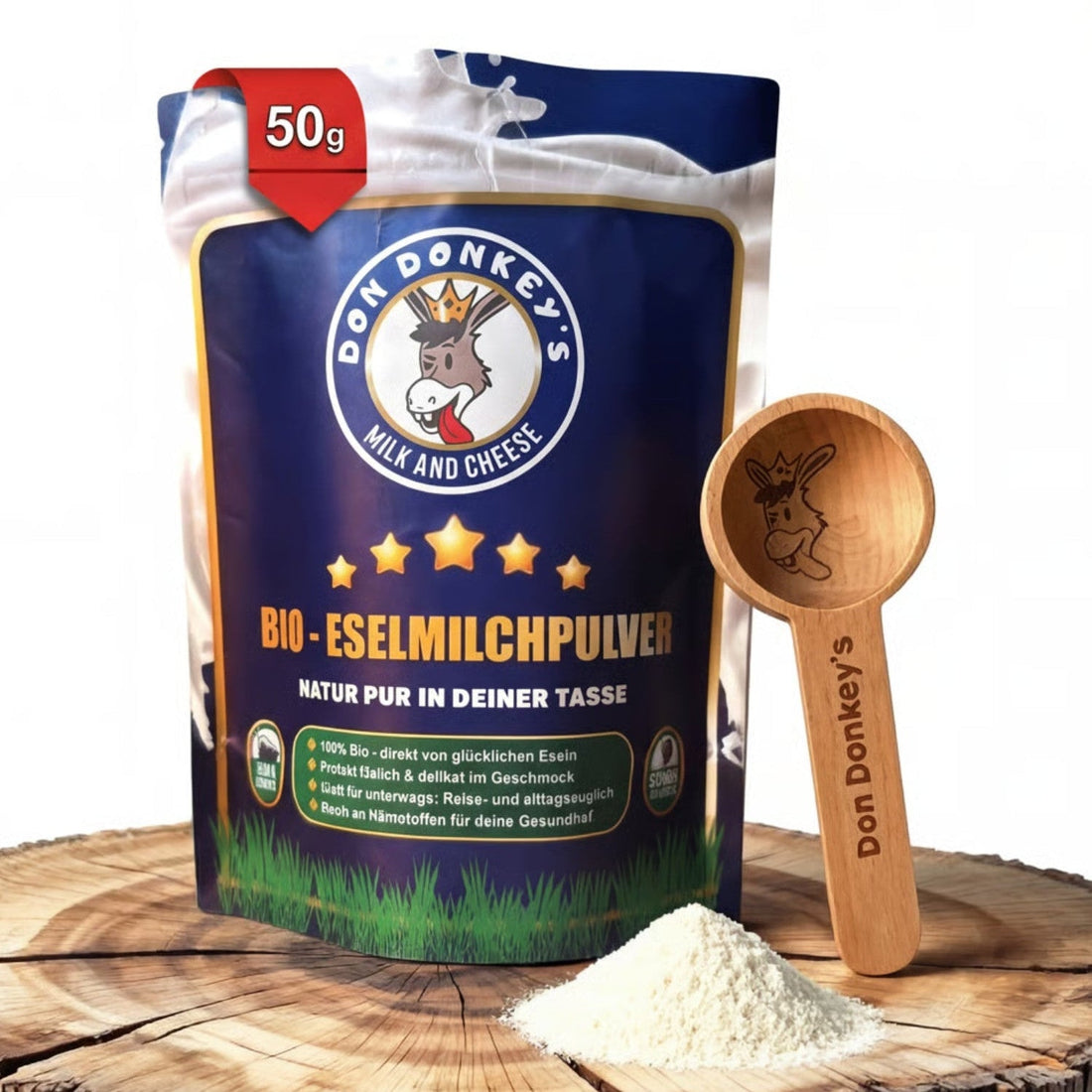
Also in our shop
Donkey Milk Powder
Donkey milk in powder form
For anyone who prefers a longer shelf life: our donkey milk in powder form – easy to store and portion.
20g · Unit price: €1.245,00 / 1 kg · incl. VAT, plus shipping