
 Buyer protection

Donkey milk research · Study 140
Raw donkey milk and raw cow’s milk in rats: energy balance and liver mitochondria
Rats that drank raw donkey milk for 4 weeks showed, according to the authors, lower energy efficiency, more proton leak in liver mitochondria and higher levels of the markers CPT and UCP2 compared with rats given an iso-energetic amount of raw cow’s milk. At the same time, the inflammation markers TNF-α and LPS were lower, and total thiols and two detoxifying enzymes were higher.
At a glance · swipe or use the arrows
The key figures
Study design
How it was studied
Animal study by a research group at the University of Naples Federico II (Italy). Rats drank raw donkey milk for 4 weeks; the comparison group received an iso-energetic amount of raw cow’s milk. The starting point was the hypothesis that donkey milk, with its low fat content and higher ratio of omega-3 to omega-6 fatty acids, affects energy balance, lipid metabolism and oxidative status. Energy balance, lipid metabolism, activity and proton leak of liver mitochondria, the markers carnitine palmitoyltransferase (CPT) and uncoupling protein 2 (UCP2), signs of inflammation (TNF-α, LPS) and antioxidant and detoxifying parameters were measured. Evaluated based on the abstract: number of animals, rat strain, drinking volumes, figures and a group without milk are not reported.
Results
What the study measured
According to the authors, raw donkey milk had a lipid-lowering (“hypolipidemic”) effect in the rats compared with raw cow’s milk; the abstract does not say which blood lipids changed or by how much.
In parallel, activity and proton leak of liver mitochondria were increased, as were the activity or expression of the markers carnitine palmitoyltransferase and uncoupling protein 2 (UCP2).
Energy efficiency of the animals was lower in the donkey milk group according to the authors.
The inflammation markers TNF-α and LPS were lower, while total thiols and the activity of the enzymes glutathione S-transferase and NADH quinone oxidoreductase were higher.
The authors interpret these findings, at least in part, as activation of the Nrf2 pathway, a cellular protective system against oxidative stress.
Authors’ conclusion: The “beneficial effects” of donkey milk are said to be attributable at least in part to activation of the Nrf2 pathway. The experiment compares two raw milks in rats over 4 weeks; it does not examine whether anything follows for weight, blood lipids or inflammation in humans.
Critical appraisal
Strengths and limitations
Rats, not humansClear limitation
Metabolism and mitochondria in rats respond differently from those in humans. The results cannot be transferred.
Title judges beyond the measurementsClear limitation
“Improves antioxidant and antiinflammatory defences” is an interpretation. Individual markers were measured in comparison with cow’s milk, not disease outcomes.
Only the abstract assessedNote
Number of animals, rat strain, drinking volumes and all figures are unknown. Funding and conflicts of interest could not be checked either.
Compared only with cow’s milkNote
A group without milk is not mentioned in the abstract. Differences may therefore also reflect properties of the cow’s milk.
Iso-energetic comparison of two raw milksStrength
Both groups received raw milk in iso-energetic amounts. This makes differences in composition, such as the fatty acid pattern, testable as an explanation.
Editorial note: The paper compares raw donkey milk and raw cow’s milk in a feeding study in rats and describes differences in liver mitochondria and metabolic markers. This is not enough for statements on weight, blood lipids or inflammation in humans. To the research archive.
Research question for DON DONKEY’S®
What is the ratio of omega-3 to omega-6 fatty acids in our donkey milk, and does it vary between batches and seasons?
Original publication
Diet supplementation with donkey milk upregulates liver mitochondrial uncoupling, reduces energy efficiency and improves antioxidant and antiinflammatory defences in rats
Original title: Diet supplementation with donkey milk upregulates liver mitochondrial uncoupling, reduces energy efficiency and improves antioxidant and antiinflammatory defences in rats
Lionetti L., Cavaliere G., Bergamo P., Trinchese G., De Filippo C., Gifuni G., Gaita M., Pignalosa A., Donizzetti I., Putti R., Di Palo R., Barletta A., Mollica M. P.
Molecular Nutrition & Food Research · 2012 · 56(10), 1596–1600
Department of Biological Sciences, University of Naples Federico II, Italy (according to author details)
Transparency: funding and conflicts of interest could not be checked from the abstract. No product-related statement for DON DONKEY’S®.
Summarised and checked by the DON DONKEY’S editorial team against the original publication · As of: November 2026
The study summarised above was carried out independently of DON DONKEY’S® and does not relate to our products. It serves solely to inform about the state of research.
DON DONKEY’S® donkey milk and donkey milk powder are foods. They are not intended to prevent, treat or cure any disease and do not replace medical advice.

From our shop
DON DONKEY’S® donkey milk
100 % donkey milk · raw milk, frozen
On this page we report the findings of a published study. Independently of that, you will find our donkey milk here: 100 % donkey milk, frozen as raw milk.
100 ml bottle / 100ml · Unit price: €249,00 / 1 l · incl. VAT, plus shipping
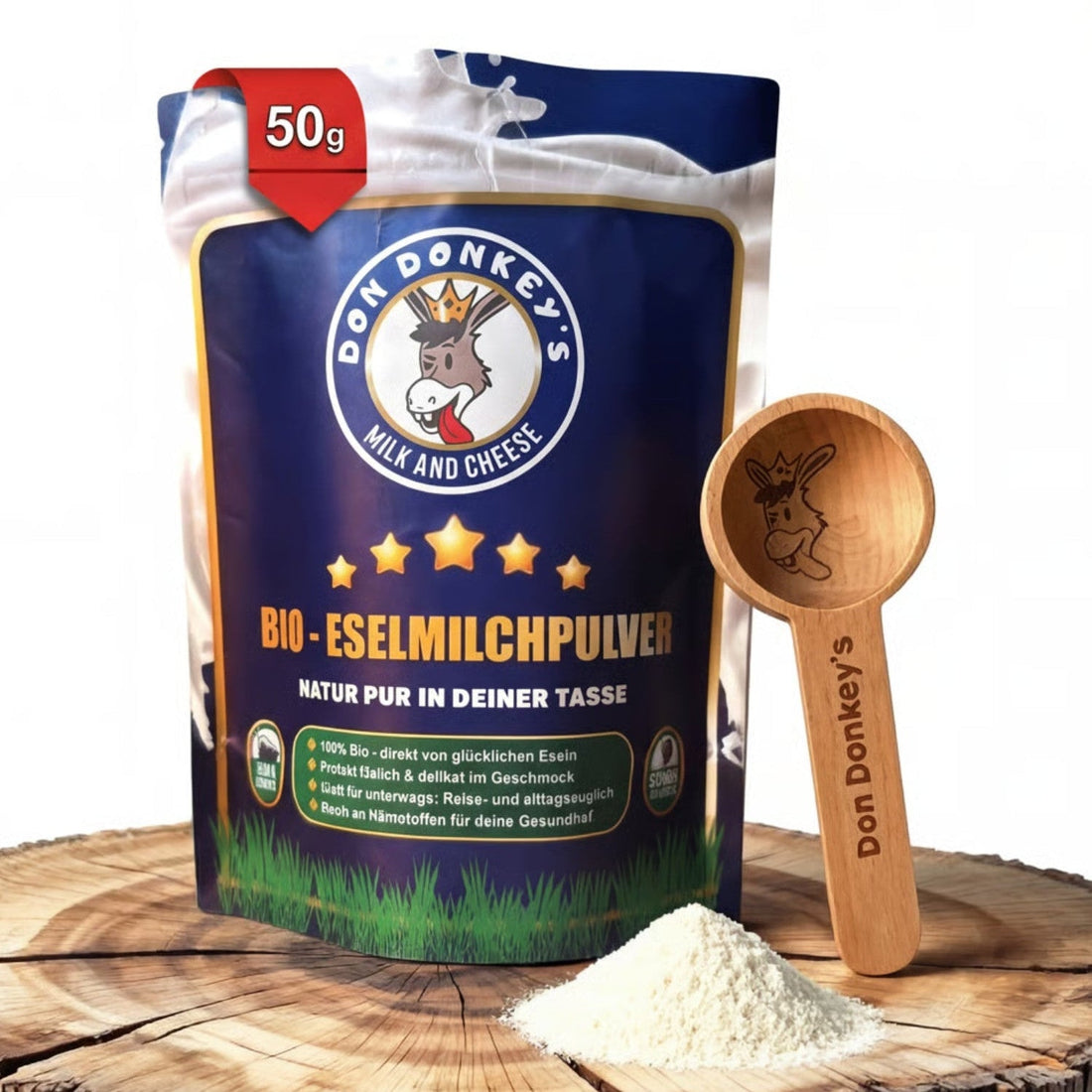
Also in our shop
Donkey Milk Powder
Donkey milk in powder form
For anyone who prefers a longer shelf life: our donkey milk in powder form – easy to store and portion.
20g · Unit price: €1.245,00 / 1 kg · incl. VAT, plus shipping