
 Buyer protection

Donkey milk research · Study 137
miRNAs in milk exosomes: human, cow’s and donkey milk compared
In exosomes from donkey milk, the authors identified 16 known mature and 196 novel miRNAs by sequencing, compared with 36 and 256 in human milk and 61 and 346 in cow’s milk. Target genes were predicted by computer; in all three milk types the analysis assigned the miRNAs, among others, to the AGE-RAGE signalling pathway.
At a glance · tap the cards
The key figures
Study design
How it was studied
Milk analysis by a research group at Shenyang Agricultural University (China). Exosomes were obtained from human milk, cow’s milk and donkey milk, and their miRNAs were determined by high-throughput sequencing. For the miRNAs found, the authors predicted target genes by computer and assigned them to functions and pathways via Gene Ontology and KEGG analyses. Evaluated based on the abstract: sample numbers, origin of the milk, stage of lactation and isolation method are not reported.
Interactive chart · values from the study
miRNAs identified in milk exosomes
Source: study abstract. The values for cow’s milk are listed there under “milk”; the assignment to cow’s milk follows from the order.
Results
What the study measured
In exosomes from donkey milk, 16 known mature and 196 novel miRNAs were identified.
Human milk contained 36 known and 256 novel miRNAs, cow’s milk 61 known and 346 novel.
According to the Gene Ontology analysis, the miRNAs of all three milk types were assigned to metabolic functions.
The KEGG analysis assigned the miRNAs of all three milk types to the AGE-RAGE signalling pathway, which the database lists under complications of diabetes.
On this basis, the authors selected miRNAs such as hsa-miR-8485, bta-miR-342 and miR-29c as diabetes-related candidates.
Authors’ conclusion: The paper is said to provide a new understanding of the function of miRNAs in mammalian milk and a new way to explore diabetes-related miRNAs. It shows which miRNAs occur; their functions and the link to diabetes rest on predictions, not on measurements in cells, animals or humans.
Critical appraisal
Strengths and limitations
Prediction, not effectClear limitation
Target genes and pathways were derived by computer. Whether miRNAs from milk reach the body and change anything there was not examined.
Diabetes link via databases onlyClear limitation
The AGE-RAGE pathway is a database assignment. No link with diabetes in humans can be derived from it.
Only the abstract assessedNote
Sample numbers, origin and lactation stage of the milk, and the isolation of the exosomes are unknown.
Uneven database coverageNote
miRNAs are better catalogued for humans and cattle than for donkeys. The low number of known miRNAs in donkey milk is therefore hard to interpret.
Direct three-species comparisonStrength
Human, cow’s and donkey milk were analysed with the same method in one paper, which makes the miRNA profiles easier to compare.
Editorial note: The study is an inventory of miRNAs in milk exosomes with computer-based assignment of functions. It says nothing about diabetes or metabolism in humans. Donkey milk is not a substitute for breast milk or infant formula; infant feeding belongs in medical hands. To the research archive.
Research question for DON DONKEY’S®
Can miRNAs still be detected in our donkey milk after freezing and thawing and in donkey milk powder, and how much do the amounts differ?
Original publication
Identification and analysis of miRNAs expression profiles in human, bovine, and donkey milk exosomes
Original title: Identification and analysis of miRNAs expression profiles in human, bovine, and donkey milk exosomes
Shang J., Ning J., Bai X., Cao X., Yue X., Yang M.
International Journal of Biological Macromolecules · 2023 · 252, 126321
College of Food Science, Shenyang Agricultural University, China (according to author details)
DOI: 10.1016/j.ijbiomac.2023.126321
Transparency: according to the database entry, funded by the National Natural Science Foundation of China and Shenyang Agricultural University; conflicts of interest could not be checked from the abstract. No product-related statement for DON DONKEY’S®.
Summarised and checked by the DON DONKEY’S editorial team against the original publication · As of: November 2026
The study summarised above was carried out independently of DON DONKEY’S® and does not relate to our products. It serves solely to inform about the state of research.
DON DONKEY’S® donkey milk and donkey milk powder are foods. They are not intended to prevent, treat or cure any disease and do not replace medical advice.

From our shop
DON DONKEY’S® donkey milk
100 % donkey milk · raw milk, frozen
On this page we report the findings of a published study. Independently of that, you will find our donkey milk here: 100 % donkey milk, frozen as raw milk.
100 ml bottle / 100ml · Unit price: €249,00 / 1 l · incl. VAT, plus shipping
Also in our shop
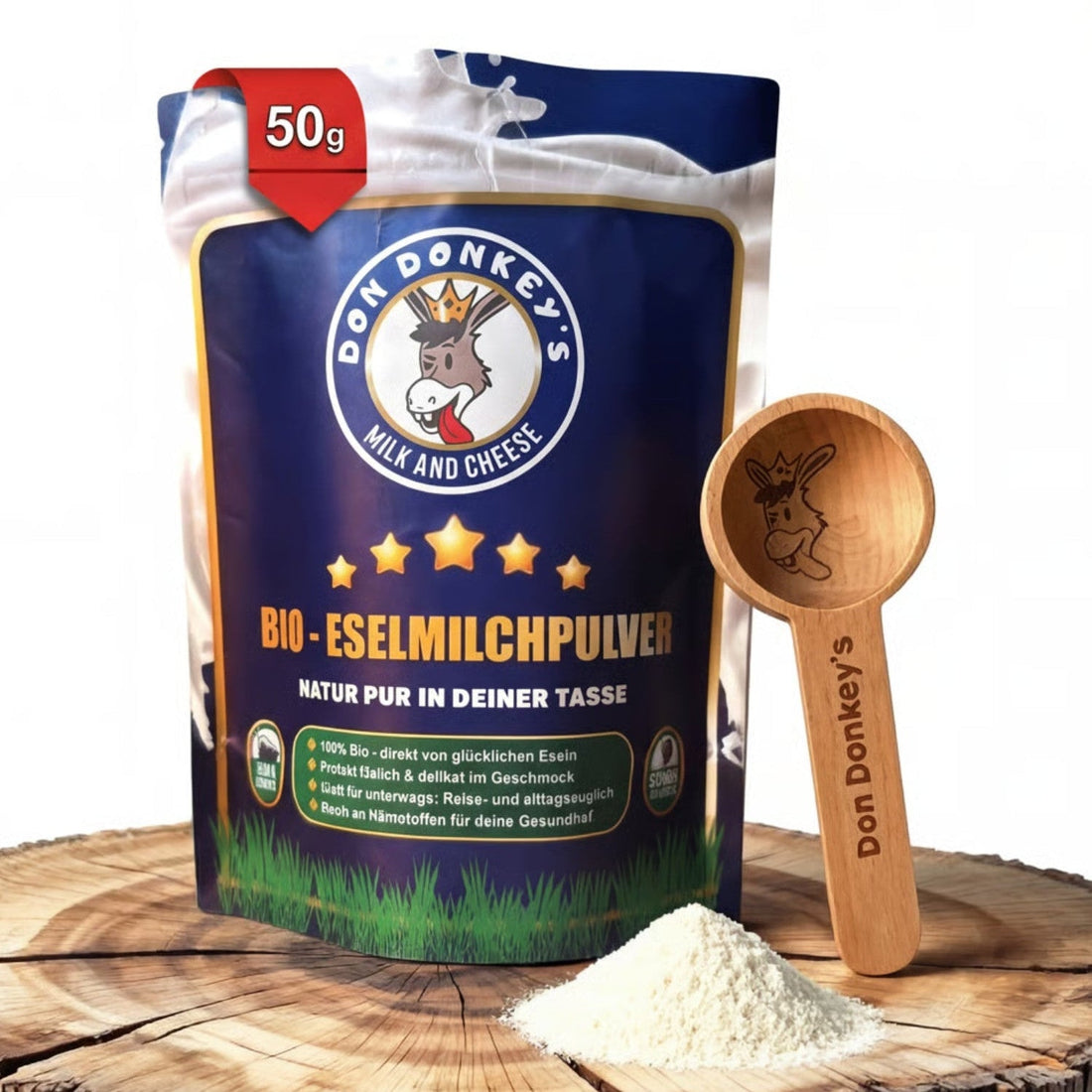
Donkey Milk Powder
Donkey milk in powder form
For anyone who prefers a longer shelf life: our donkey milk in powder form – easy to store and portion.
20g · Unit price: €1.245,00 / 1 kg · incl. VAT, plus shipping