
 Buyer protection

Donkey milk research · Study 136
Exosomes from donkey milk: protein profile of colostrum and mature milk
In exosomes from the milk of 30 Dezhou jennies, the proteomic analysis found 2,555 protein groups, 2,293 of them quantifiable. 276 proteins differed between colostrum (days 1 to 3) and mature milk (day 30): 211 were more abundant in colostrum, 65 less abundant. The authors derive possible functions of these proteins from databases; only their amounts were measured.
At a glance · swipe or use the arrows
The key figures
Study design
How it was studied
Milk analysis by a research group at Liaocheng University (China). 30 Dezhou jennies (second lactation, 4 to 5 years) at a national breeding centre supplied colostrum (1 to 3 days after foaling) and mature milk (30 days); foals were separated for 3 hours beforehand, and milking was done by hand. For each lactation stage, 5 individual samples each were combined into 6 pooled samples. Exosomes were isolated by ultracentrifugation and characterised by electron microscopy, nanoparticle measurement and Western blot (CD81, TSG101). Proteins were quantified with 4D label-free proteomics (mass spectrometry); a difference was defined as p < 0.05 with at least twice or half the amount. Functions were assigned through GO, KEGG and network analyses, not tested experimentally.
Interactive chart · values from the study
Exosomal proteins: shared or found in one milk type only
Source: section 2.2 and Figure 2A of the study (94.2%, 4.1% and 1.6%).
Second analysis
Differentially expressed exosomal proteins (276)
Source: section 2.2 of the study; threshold p < 0.05 and at least a 2-fold difference.
Results
What the study measured
The exosomes were around 80 nm in size; those from colostrum were slightly smaller (79.8 ± 0.59 nm) than those from mature milk (82.6 ± 0.93 nm). The protein content of colostrum exosomes was significantly higher.
16,197 peptides and 2,555 protein groups were found, 2,293 of them quantifiable. 94.2% of the proteins occurred in both milk types, 106 only in colostrum and 42 only in mature milk.
276 proteins differed in amount: 211 were more abundant in colostrum, 65 less abundant. The difference was particularly large for ANGPTL4 (163-fold) and for C1QTNF3 (over 50-fold), NEU1 (over 19-fold) and GPx3 (over 15-fold).
In mature milk, proteins of fat metabolism were more abundant, such as ACSL4 (over 9-fold), ACSL1 (over 8-fold) and perilipin 2 (over 2-fold).
According to the database analysis, the proteins more abundant in colostrum mainly belonged to pathways of immune defence, autophagy and glycan metabolism, while those more abundant in mature milk belonged to metabolic pathways.
The protein network comprised 240 nodes and 1,446 connections. Of the 10 most highly connected proteins, including complement factor C3, 9 were more abundant in colostrum.
Authors’ conclusion: Exosomes from colostrum are said to be rich in immune-related proteins, those from mature milk in proteins of metabolism; individual colostrum proteins could be of interest as food components. The study shows differences in protein amounts. Whether these proteins survive digestion or act in the body was not examined – as the authors themselves acknowledge.
Critical appraisal
Strengths and limitations
Amount measured, function only assignedClear limitation
The functions come from databases and network analyses. There was no experiment on effects.
Pooled samplesNote
5 individual samples each were combined. Differences between individual jennies remain invisible; the authors name this themselves as a limitation.
One breed, one farmNote
All animals were Dezhou jennies from one breeding centre on the same feed. The profile for other breeds and husbandry systems remains open.
Minor counting inconsistencyNote
2,406 shared proteins are reported, but 2,293 were quantifiable. The counts apparently refer to different bases; this is not explained.
Large dataset, raw data publicStrength
Thousands of proteins, six pooled samples per stage and exosome markers by Western blot. The raw data are in the public iProX database (IPX0011399000).
Editorial note: The paper describes how the protein profile of exosomes differs between colostrum and mature donkey milk. It does not support statements on immune defence or health, because no effect was measured. Donkey milk is not a substitute for breast milk or infant formula; infant feeding belongs in medical hands. To the research archive.
Research question for DON DONKEY’S®
How do exosome and protein content of our donkey milk differ between early and late months of lactation, and can the month of lactation be documented for each batch?
Original publication
Proteomic Profiling of Donkey Milk Exosomes Highlights Bioactive Proteins with Immune-Related Functions
Original title: Proteomic Profiling of Donkey Milk Exosomes Highlights Bioactive Proteins with Immune-Related Functions
Liu Y., Ma Q., Khan M. Z., Wang M., Xiang F., Zhang X., Kou X., Li S., Wang C., Li Y.
International Journal of Molecular Sciences · 2025 · 26(7), 2892
College of Agriculture and Biology, Liaocheng University, Shandong, China (according to the paper)
DOI: 10.3390/ijms26072892
Transparency: funded by the Shandong Provincial Natural Science Foundation, the National Key R&D Program of China, a student programme and a Liaocheng University project. Information on conflicts of interest was not included in the full-text extract. No product-related statement for DON DONKEY’S®.
Summarised and checked by the DON DONKEY’S editorial team against the original publication · As of: November 2026
The study summarised above was carried out independently of DON DONKEY’S® and does not relate to our products. It serves solely to inform about the state of research.
DON DONKEY’S® donkey milk and donkey milk powder are foods. They are not intended to prevent, treat or cure any disease and do not replace medical advice.

From our shop
DON DONKEY’S® donkey milk
100 % donkey milk · raw milk, frozen
On this page we report the findings of a published study. Independently of that, you will find our donkey milk here: 100 % donkey milk, frozen as raw milk.
100 ml bottle / 100ml · Unit price: €249,00 / 1 l · incl. VAT, plus shipping
Also in our shop
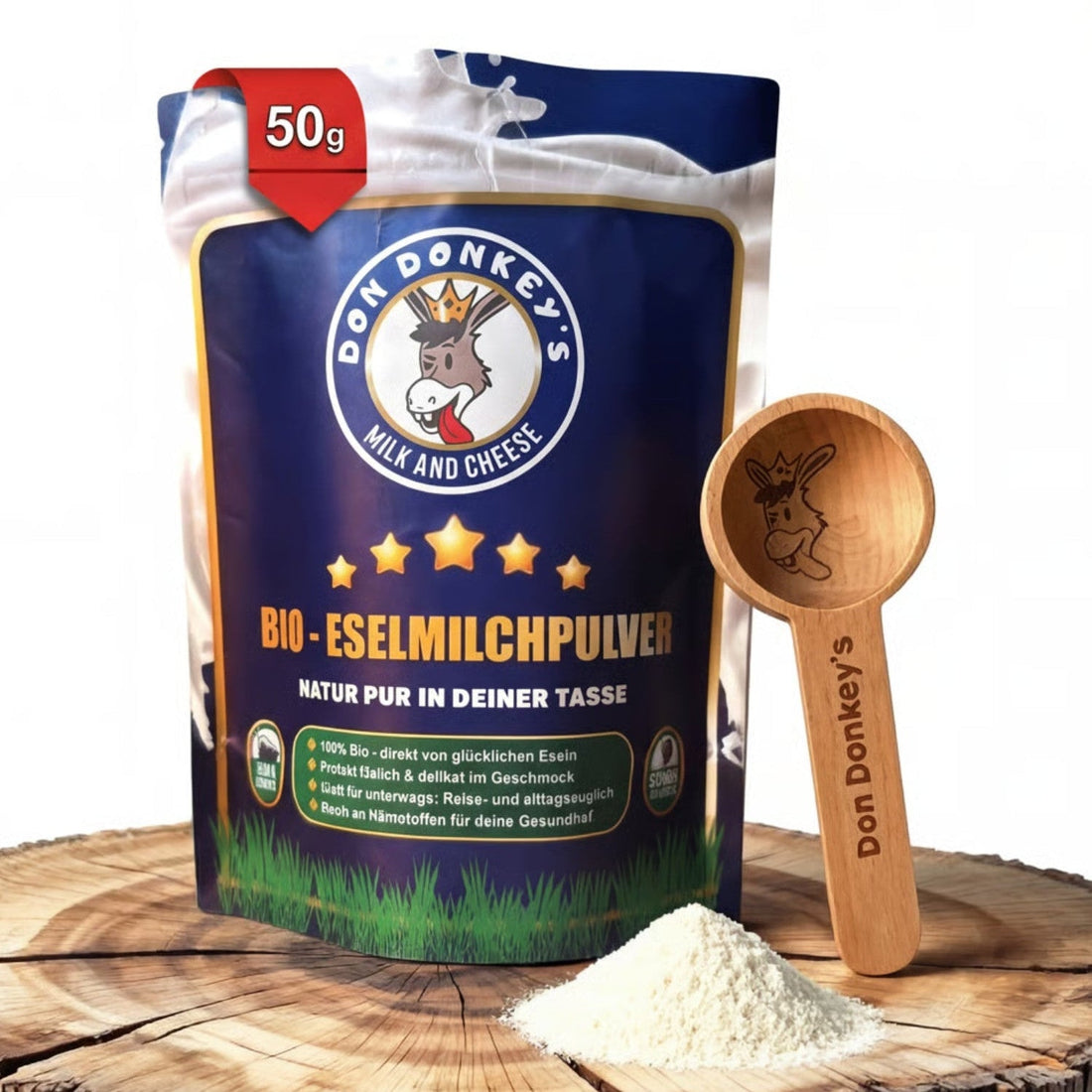
Donkey Milk Powder
Donkey milk in powder form
For anyone who prefers a longer shelf life: our donkey milk in powder form – easy to store and portion.
20g · Unit price: €1.245,00 / 1 kg · incl. VAT, plus shipping