
 Buyer protection

Donkey milk research · Study 135
Creams with donkey milk in nanoliposomes: skin moisture, water loss and pH measured
In 15 healthy volunteers, creams with skimmed donkey milk encapsulated in nanoliposomes showed “satisfactory” moisturising properties shortly after application according to the authors, measured as the electrical capacitance of the skin; with the night cream the value was reached earlier. Transepidermal water loss fell slightly only after 4 weeks, and skin pH stayed similar.
At a glance · tap the cards
The key figures
Study design
How it was studied
Application study by a research group from Niš (Serbia) with participation from Australia. 15 healthy volunteers (11 women, 4 men) received creams in which skimmed donkey milk was encapsulated in nanoliposomes; the formulation comes from the authors’ registered patent. Comparisons were made with a placebo cream and with untreated skin. Electrical capacitance of the skin (hydration), transepidermal water loss and skin surface pH were measured; use lasted at least 4 weeks. Evaluated based on the abstract: figures, measurement time points, allocation of skin sites and blinding are not reported.
Results
What the study measured
According to the authors, the patented creams showed “satisfactory” moisturising properties shortly after application, measured via the electrical capacitance of the skin.
At the sites treated with the night cream, measured hydration was reached earlier.
Transepidermal water loss fell only slightly and only after 4 weeks of treatment, at every skin site assessed.
Skin pH was similar after all treatments.
The abstract does not give specific values, differences from the placebo cream or statistical measures.
Authors’ conclusion: The tested creams may increase skin moisture shortly after application, possibly allowing deeper permeation of phospholipids and proteins without changing pH, and may contribute to “anti-ageing effects”. However, only three skin parameters were measured in 15 healthy people; skin ageing and the penetration of ingredients were not examined.
Critical appraisal
Strengths and limitations
Very small groupClear limitation
15 healthy volunteers, mostly women. This is not enough for general statements.
Conclusion goes beyond the measurementsClear limitation
Title and conclusion speak of a favourable effect and possible anti-ageing effects. Capacitance, water loss and pH were measured, not wrinkles or penetration depth.
Authors’ own patentNote
A formulation from the authors’ registered patent was tested. Funding and conflicts of interest could not be checked from the abstract.
Only the abstract assessedNote
Values, time points, blinding and the arrangement of skin sites are unknown. Whether an effect comes from the donkey milk or from the cream base cannot be judged.
Placebo cream and untreated skin as comparisonStrength
The study compares against two control conditions and uses established instrumental skin measurements rather than self-assessment alone.
Editorial note: The paper tests the authors’ own cosmetic formulation in a small group of healthy people. It is not informative for donkey milk as a food, and for cosmetics it shows only short-term measurements at the skin surface. To the research archive.
Research question for DON DONKEY’S®
What fat and protein values does a batch analysis of our donkey milk show, and how much do they vary between deliveries from our partner farms?
Original publication
Favorable effect of creams with skimmed donkey milk encapsulated in nanoliposomes on skin physiology
Original title: Favorable effect of creams with skimmed donkey milk encapsulated in nanoliposomes on skin physiology
Kocic H., Stankovic M., Tirant M., Lotti T., Arsic I.
Dermatologic Therapy · 2020 · 33(4), e13511
Clinic of Dermatology and Medical Faculty (Pharmacy), University of Niš, Serbia, with participation from Australia (according to author details)
DOI: 10.1111/dth.13511
Transparency: funding and conflicts of interest could not be checked from the abstract; the authors test a formulation from their own patent. No product-related statement for DON DONKEY’S®.
Summarised and checked by the DON DONKEY’S editorial team against the original publication · As of: November 2026
The study summarised above was carried out independently of DON DONKEY’S® and does not relate to our products. It serves solely to inform about the state of research.
DON DONKEY’S® donkey milk and donkey milk powder are foods. They are not intended to prevent, treat or cure any disease and do not replace medical advice.

From our shop
DON DONKEY’S® donkey milk
100 % donkey milk · raw milk, frozen
On this page we report the findings of a published study. Independently of that, you will find our donkey milk here: 100 % donkey milk, frozen as raw milk.
100 ml bottle / 100ml · Unit price: €249,00 / 1 l · incl. VAT, plus shipping
Also in our shop
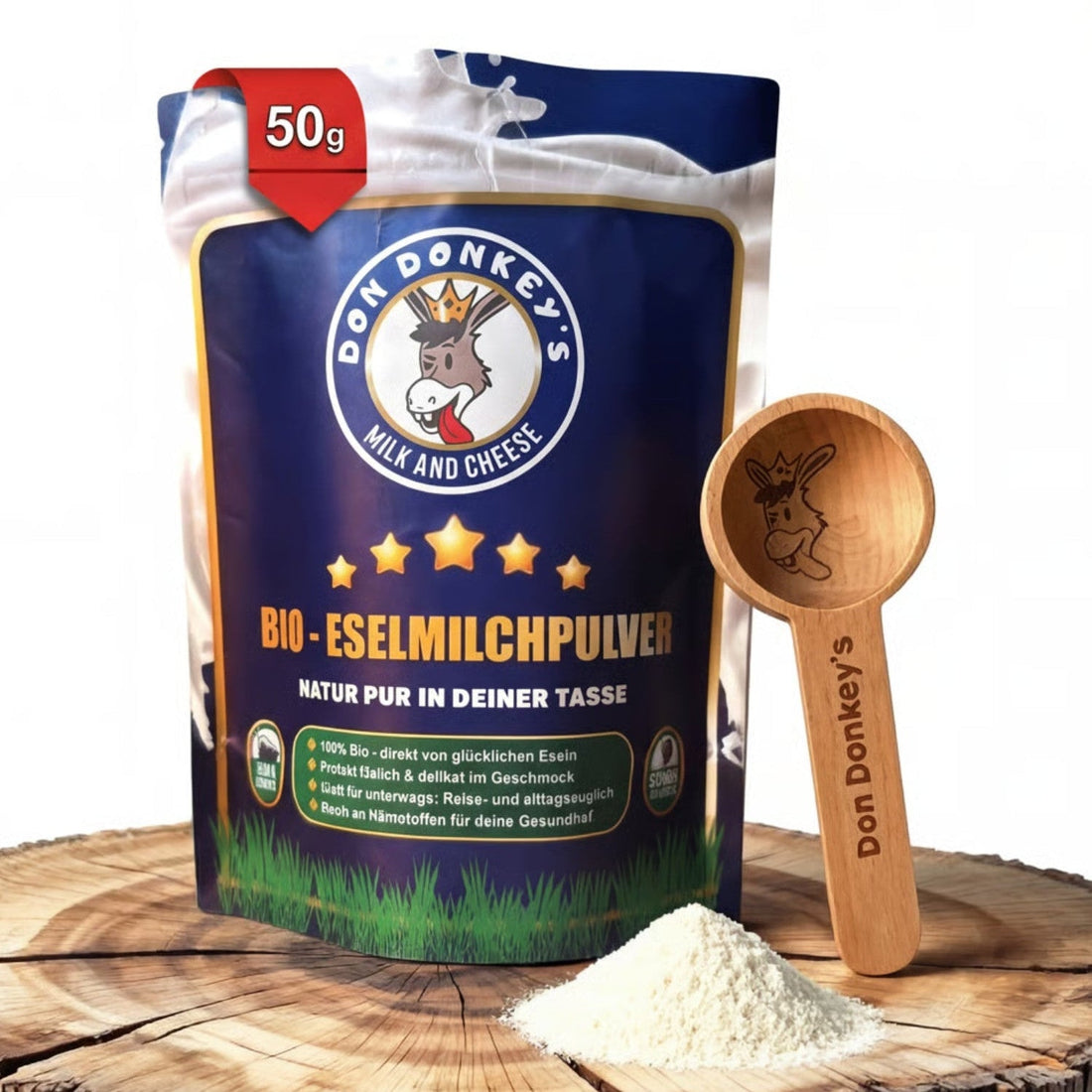
Donkey Milk Powder
Donkey milk in powder form
For anyone who prefers a longer shelf life: our donkey milk in powder form – easy to store and portion.
20g · Unit price: €1.245,00 / 1 kg · incl. VAT, plus shipping