
 Buyer protection

Donkey milk research · Study 134
Donkey milk exosomes and UVB light: measurements from cell culture and mice
UVB irradiation increased the share of β-galactosidase-positive, i.e. senescent, human skin cells (HaCaT) almost 80-fold according to the authors; with exosomes from donkey milk (20 µg/mL) this share was clearly lower. 1,186 genes changed both with UVB and with the subsequent exosome treatment. In mice the exosomes were injected under the skin of the back; there UVB reduced skin moisture by about 45%, and according to the authors the exosome group partly moved back towards the control.
At a glance · swipe or use the arrows
The key figures
Study design
How it was studied
Laboratory and animal study by a research group from Liaocheng (China). Exosomes were isolated by ultracentrifugation from mature donkey milk (30 days after foaling); the number of jennies supplying the milk is not stated. In the cell experiment, human keratinocytes (HaCaT) were irradiated with 20 mJ/cm² UVB daily for seven days and treated with 20 µg/mL donkey milk exosomes; exosomes from mesenchymal stem cells served as a positive control. Senescence staining (SA-β-gal), hydroxyproline, inflammatory factors, reactive oxygen species, DNA damage markers (γ-H2AX, 8-OHdG) and the gene expression profile (RNA sequencing, qPCR) were measured. In the animal experiment, female Kunming mice (8 weeks old) received increasing UVB doses (200, 400, 600 mJ/cm²) over six weeks, followed by 20 µg of exosomes injected under the skin of the back three times a week; controls received saline. The full text does not report the group sizes of the mice.
Results
What the study measured
After UVB, the share of β-galactosidase-positive skin cells was almost 80 times higher than in the control according to the authors. With donkey milk exosomes this share fell more than with the stem cell exosomes of the positive control.
UVB lowered hydroxyproline, a building block of collagen, by about 20%. With donkey milk exosomes the value was slightly above that with stem cell exosomes.
Eleven inflammation and senescence factors (including IL-6, IL-8, MMP1, MMP9) rose at mRNA level after UVB; both types of exosome lowered them again. Reactive oxygen species and the DNA damage markers γ-H2AX and 8-OHdG were also lower.
In RNA sequencing, 1,186 genes changed both with UVB and with exosome treatment. 17 of them belong to 197 ageing genes from a database; 10 were checked by qPCR, including p53, CDKN1A (p21) and ATM.
In the mice, UVB led to rough, partly scabbed skin, about 45% lower skin moisture and less type I and VII collagen. In the exosome group these values partly moved back towards the control according to the authors; exact figures are shown only in the figures.
In mouse skin, too, the exosomes shifted the expression of the ageing genes previously tested in cells towards the control, as well as the staining for γ-H2AX and 8-OHdG.
Authors’ conclusion: The authors see exosomes from donkey milk as a possible natural agent against UVB-induced skin ageing that reduces oxidative stress, cellular senescence and collagen breakdown. The experiment does not show this for humans: isolated exosomes were added to cells or injected under the skin of mice – not milk that was drunk and not a skincare product.
Critical appraisal
Strengths and limitations
Injected exosomes, not a foodClear limitation
The exosomes were isolated from the milk and injected under the skin of mice. This says nothing about drinking donkey milk or applying it to the skin.
Cells and mice, not humansClear limitation
HaCaT is a cell line, and Kunming mice have different skin from humans. The results cannot be transferred to human skin.
Unclear details in the methodsNote
Group sizes of the mice are missing. The dose is given once as 20 µg and in a figure as 100 µg/kg, and the discussion speaks of “topical application”, although the methods describe injection.
Conflict of interestNote
Four of the ten authors are employed by a company; according to the paper there was no external funding. By the authors’ own account, the exosome markers CD9, CD63 and TSG101 were not checked.
Several levels of measurement and a positive controlStrength
The paper combines a cell experiment, a mouse model, RNA sequencing and qPCR and compares with stem cell exosomes as a reference. The animal experiment was approved by an ethics committee.
Editorial note: The study describes how isolated exosomes from donkey milk behaved in the lab and after injection in mice exposed to UVB. It is basic research with methodological gaps and allows no statement on skin ageing in humans, neither for drinking donkey milk nor for cosmetics. To the research archive.
Research question for DON DONKEY’S®
How many exosomes can still be detected in our frozen donkey milk after thawing, and does the amount differ between batches?
Original publication
Protective Effects of Donkey Milk-Derived Exosomes Against UVB-Induced Skin Photoaging via Regulation of DNA Damage and Aging-Related Pathways
Original title: Protective Effects of Donkey Milk-Derived Exosomes Against UVB-Induced Skin Photoaging via Regulation of DNA Damage and Aging-Related Pathways
Yu J., Sun J., Cheng J., Liu G., Niu P., Liu Q., Wang Z., Huo Y., Tie H., Wang C.
BioMed Research International · 2026 · 2026, 4214259
Research group of C. Wang and H. Tie; first authors at a company in Liaocheng, Shandong, China (according to the paper)
DOI: 10.1155/bmri/4214259
Transparency: no funding according to the paper. Four authors are employed by a company in Liaocheng; the others declare no conflicts of interest. Animal experiment approved (No. 2023031303). No product-related statement for DON DONKEY’S®.
Summarised and checked by the DON DONKEY’S editorial team against the original publication · As of: November 2026
The study summarised above was carried out independently of DON DONKEY’S® and does not relate to our products. It serves solely to inform about the state of research.
DON DONKEY’S® donkey milk and donkey milk powder are foods. They are not intended to prevent, treat or cure any disease and do not replace medical advice.

From our shop
DON DONKEY’S® donkey milk
100 % donkey milk · raw milk, frozen
On this page we report the findings of a published study. Independently of that, you will find our donkey milk here: 100 % donkey milk, frozen as raw milk.
100 ml bottle / 100ml · Unit price: €249,00 / 1 l · incl. VAT, plus shipping
Also in our shop
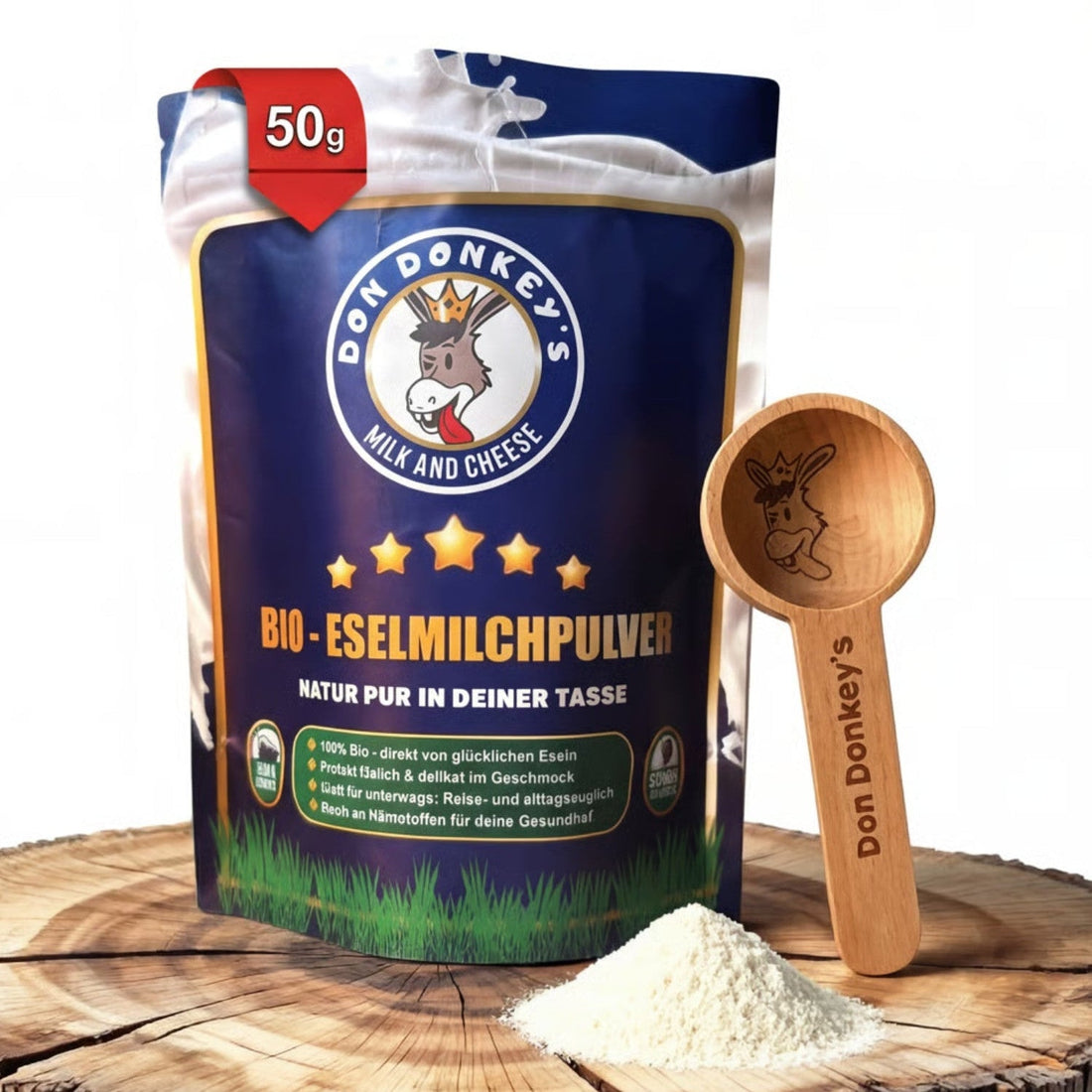
Donkey Milk Powder
Donkey milk in powder form
For anyone who prefers a longer shelf life: our donkey milk in powder form – easy to store and portion.
20g · Unit price: €1.245,00 / 1 kg · incl. VAT, plus shipping