
 Buyer protection

Donkey milk research · Study 130
Donkey, cow and human milk in rats: energy, inflammation markers and gut microbiota
With the same energy intake from milk, rats given donkey milk had triglycerides of 90 instead of 116 mg/dl (control) and TNF-α of 0.055 instead of 0.092 ng/ml; cow milk barely differed from the control on these values.
At a glance · swipe or use the arrows
The key figures
Study design
How it was studied
Animal experiment at the University of Naples Federico II: 60-day-old male Wistar rats (mean 345 g) were housed individually and divided into four groups of seven animals. One group received standard feed only (control); the other three additionally received cow, donkey or human milk for four weeks. The amount of milk was chosen so that each milk group took in 82 kJ per day from milk, corresponding to 21 ml of cow milk, 48 ml of donkey milk or 22 ml of human milk. Weight gain, energy efficiency, blood values, inflammation markers, liver mitochondria, oxidative status, gut microbiota and short-chain fatty acids in faeces were measured. Analysis: ANOVA with Newman-Keuls test, mean ± standard error.
Interactive chart · values from the study
Serum inflammation markers after four weeks
Values from Table 2 of the study (means, n = 7 per group). TNF-α and IL-10 converted here to pg/ml (study: ng/ml). LPS = endotoxin in the blood. Switch using the buttons.
Second analysis
Blood glucose, HOMA index and blood lipids
Values from Table 1 of the study (means, n = 7 per group). HOMA = index calculated from fasting glucose and insulin; human milk 1.314 rounded here.
Results
What the study measured
According to the text, only the animals given cow milk gained more body weight; this was not the case with donkey or human milk. Gross energy efficiency was highest with cow milk and lowest with donkey milk. The study shows these values only as a figure.
Blood glucose was 138.6 mg/dl (control), 130.1 (cow milk), 112.1 (donkey milk) and 112.7 mg/dl (human milk). The HOMA index was 2.19, 2.09, 1.75 and 1.31. Triglycerides were 116, 132, 90 and 120 mg/dl; total cholesterol ranged from 58 to 63 mg/dl.
TNF-α was 0.055 ng/ml with donkey milk and 0.058 with human milk, compared with 0.092 and 0.090 ng/ml in control and cow milk. IL-1 was 42.9 and 42.2 pg/ml versus 56.4 (control) and 64.0 pg/ml (cow milk). Serum LPS was 0.584 and 0.580 EU/ml versus 0.704 and 0.668 EU/ml.
IL-10 rose in all three milk groups: from 0.061 ng/ml (control) to 0.134 (cow milk), 0.177 (donkey milk) and 0.200 ng/ml (human milk). Total serum glutathione was 0.101, 0.128, 0.154 and 0.199 (unit given in the text as nmol/mg protein/min). The study shows liver mitochondria, hepatic glutathione and UCP2 only graphically.
In the gut microbiota, Verrucomicrobia were 58 % lower with donkey milk than in the control and TM7 575 % higher than with cow milk; with cow milk, Bacteroidetes rose by 22 %. Butyrate and propionate in faeces increased with donkey and human milk but not with cow milk; according to the text, the effect with donkey milk was twice as large as with human milk. The study gives no absolute values for this.
Authors’ conclusion: In the view of Trinchese and colleagues (2015), donkey and human milk affected energy efficiency and inflammatory status in rats differently from cow milk; as a possible explanation, the authors point to changes in mitochondrial function and gut microbiota. The finding describes animals under experimental conditions and allows no conclusion about humans.
Critical appraisal
Strengths and limitations
Animal experiment with small groupsClear limitation
Only young male rats were studied, seven animals per group, over four weeks. Metabolism, gut microbiota and milk digestion in rats differ from humans; female animals are missing entirely.
Control without milkClear limitation
The control group received no milk and therefore neither the additional 82 kJ nor the fluid. Differences from the control can therefore not be attributed to a particular milk alone; the comparison between the milk groups is more informative.
Unequal drinking volumesNote
For the same energy, the animals received 48 ml of donkey milk but only 21 ml of cow milk or 22 ml of human milk. The more than doubled fluid volume is an additional difference between the groups.
Many values only as figuresNote
Weight gain, energy efficiency, liver values, UCP2 and faecal fatty acids are reported only graphically or in relative terms. With many outcomes and small groups, individual differences should not be overinterpreted.
Four groups, equal energyStrength
The design compares three types of milk at equal energy intake with a control and records blood values, inflammation markers, mitochondria and gut microbiota in one experiment. The work was funded by public research grants.
Editorial note: The study is a well-described feeding experiment in rats. It shows that cow, donkey and human milk behaved differently on several measured values under these conditions. Whether anything can be derived from this for human nutrition is open and was not part of the investigation. To the research archive.
Research question for DON DONKEY’S®
Do the differences in blood lipids, inflammation markers and gut microbiota seen in rats given donkey milk also appear in controlled human studies when drinking volume and energy are kept equal?
Original publication
Human, donkey and cow milk differently affect energy efficiency and inflammatory state
Original title: Human, donkey and cow milk differently affects energy efficiency and inflammatory state by modulating mitochondrial function and gut microbiota
Trinchese G., Cavaliere G., Berni Canani R., Matamoros S., Bergamo P., De Filippo C., Aceto S., Gaita M., Cerino P., Negri R., Greco L., Cani P. D., Mollica M. P.
Journal of Nutritional Biochemistry · 2015 · 26(11), 1136–1146
University of Naples Federico II; European Laboratory for Food Induced Diseases, Naples; Université catholique de Louvain, Brussels; Institute of Food Sciences, CNR, Avellino
DOI: 10.1016/j.jnutbio.2015.05.003
Transparency: funded by FNRS and PDR (Belgium) and an ERC Starting Grant (336452-ENIGMO). The authors declare no conflicts of interest. No product-related statement for DON DONKEY’S®.
Summarised and checked by the DON DONKEY’S editorial team against the original publication · As of: November 2026
The study summarised above was carried out independently of DON DONKEY’S® and does not relate to our products. It serves solely to inform about the state of research.
DON DONKEY’S® donkey milk and donkey milk powder are foods. They are not intended to prevent, treat or cure any disease and do not replace medical advice.

From our shop
DON DONKEY’S® donkey milk
100 % donkey milk · raw milk, frozen
On this page we report the findings of a published study. Independently of that, you will find our donkey milk here: 100 % donkey milk, frozen as raw milk.
100 ml bottle / 100ml · Unit price: €249,00 / 1 l · incl. VAT, plus shipping
Also in our shop
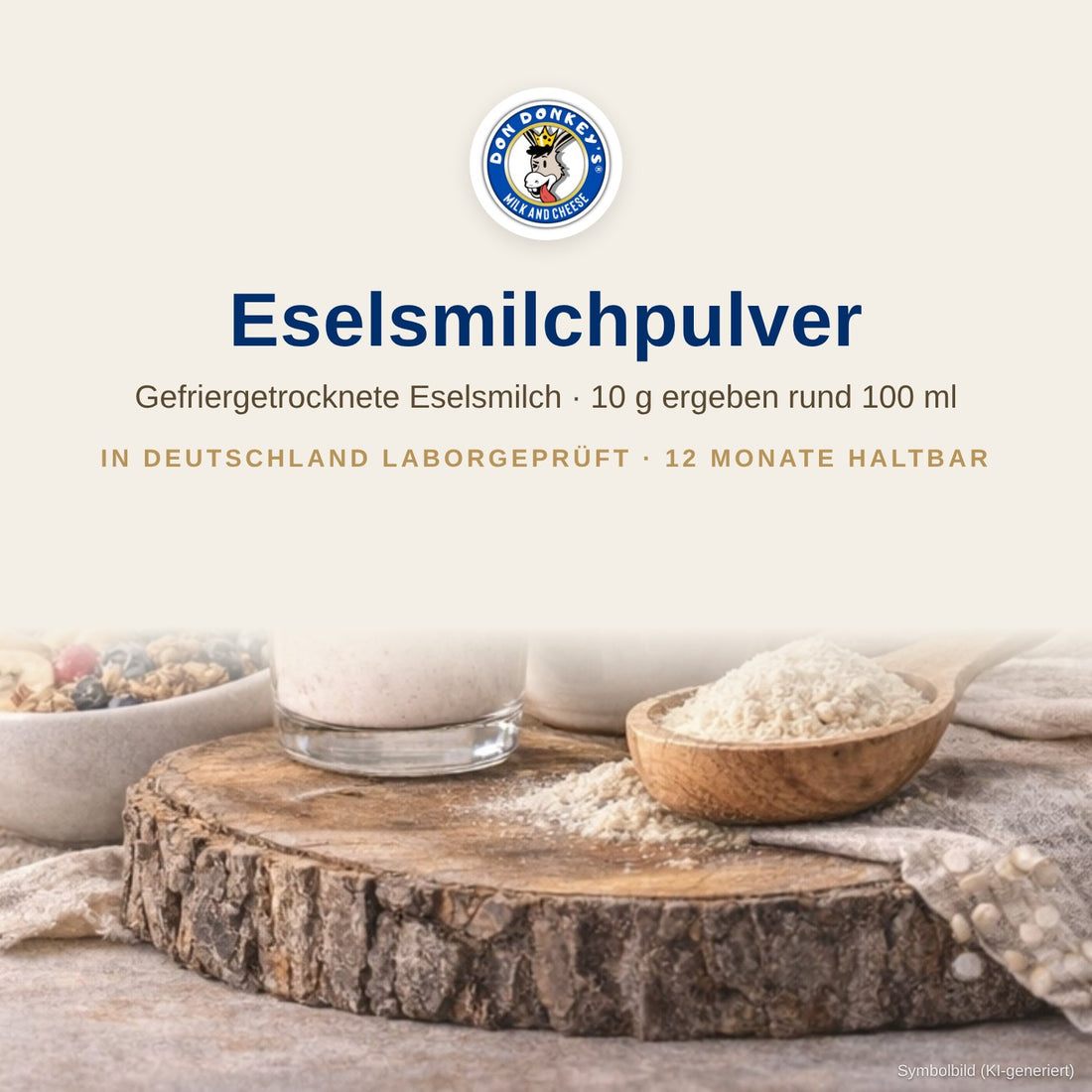
Donkey Milk Powder
Donkey milk in powder form
For anyone who prefers a longer shelf life: our donkey milk in powder form – easy to store and portion.
20g · Unit price: €1.245,00 / 1 kg · incl. VAT, plus shipping