
 Buyer protection

Research on donkey milk · Study 129
Protein profile of donkey milk: caseins and whey proteins
In milk from Martina Franca jennies, lysozyme fell from 1.34 mg/mL (day 60) to 0.76 mg/mL (day 190); β-lactoglobulin averaged 3.75 mg/mL and lactoferrin 0.080 g/L.
At a glance · swipe or use the arrows
The key figures
Study design
How it was studied
Laboratory work of a strongly summarising nature: milk from 20 Martina Franca jennies in mid-lactation from one farm in central Italy was examined for its protein profile. Caseins and whey proteins were separated by ion exchange and reversed-phase chromatography, resolved by SDS gel electrophoresis and identified by N-terminal sequencing; a two-dimensional electrophoresis of the total caseins was also shown. Lysozyme, β-lactoglobulin and α-lactalbumin were quantified at five lactation time points (days 60–190), lactoferrin was determined chromatographically and lactoperoxidase via its enzyme activity. According to the sources cited, a large part of the tables reproduces data from earlier publications by the same research group (2008, 2012) and from the literature. Children with cow’s milk allergy were not examined.
Interactive chart · values from the study
Lysozyme and α-lactalbumin over the course of lactation
Values from Table 3 of the study (taken there from Vincenzetti et al. 2008); without measures of spread and without the number of samples per time point.
Second analysis
β-lactoglobulin over the course of lactation
Values from Table 3 of the study; not determined for day 60. Mean of the four time points according to the text 3.75 mg/mL.
Results
What the study measured
Ion exchange chromatography and gel electrophoresis separated nine peaks, identified as β- and αS1-caseins. αS2-, γ- and κ-casein were not detected in this work.
Reversed-phase chromatography of the skimmed milk gave three main peaks: lysozyme (14.60 kDa), α-lactalbumin (14.12 kDa) and β-lactoglobulin (22.40 kDa). In 2D electrophoresis of the total caseins, around 14 spots appeared, mostly β- and αS1-caseins, with marked heterogeneity.
Lysozyme was 1.34 mg/mL on day 60 and fell to 0.76 mg/mL by day 190 (mean according to the text 1.0 mg/mL). β-lactoglobulin was between 3.60 and 4.13 mg/mL (mean 3.75 mg/mL), and α-lactalbumin rose from 0.81 mg/mL (day 60) to 1.97 mg/mL (day 90) and then fell slightly to 1.63 mg/mL.
Lactoferrin was determined at 0.080 ± 0.0035 g/L. Lactoperoxidase activity was low (4.83 ± 0.35 mU/mL), equivalent to 0.11 ± 0.027 mg/L.
In the literature comparison (Table 1), donkey milk is given a total protein of 1.5–1.8 g/100 g, a casein content of 0.64–1.03 g/100 g and a whey protein content of 0.49–0.80 g/100 g; for human milk, 0.9–1.7, 0.32–0.42 and 0.68–0.83 g/100 g respectively.
Authors’ conclusion: In the view of Polidori and Vincenzetti (2013), the protein composition of donkey milk resembles human milk in several respects, in particular through the low total protein content and the contents of lysozyme and α-lactalbumin. The authors’ further conclusions on the nutrition of particular groups of people are based on the literature, not on their own studies in humans, and cannot be derived from the measurements.
Critical assessment
Strengths and limitations
Title and content do not matchClear limitation
The title refers to children with cow’s milk protein allergy, but only the protein profile of the milk was examined. The paper contains no data of its own on tolerance in children; the classification is based on the literature.
Mostly reproduced dataClear limitation
Table 1 comes from the literature, Tables 2 and 3 according to the source from an earlier paper by the same group (2008), and the 2D analysis from a paper from 2012. Table 4 refers to a study on human milk. What was newly measured in this paper remains unclear.
Mid-lactation or course of lactation?Note
According to the methods section, the samples come from mid-lactation, but Table 3 shows five time points from day 60 to day 190. Sample numbers per time point, measures of spread and statistics are missing.
Contradictory comparison figuresNote
The abstract states a casein content “very close to human milk”, but Table 1 gives 0.64–1.03 for donkey milk compared with 0.32–0.42 g/100 g. For lactoferrin in human milk, the text gives 1.0–6.0 g/L, whereas Table 4 gives 0.3–4.2 g/L. The αS1-casein sequence reads RPKLPHRQPE in the text and RPKLPHQPE in Table 2.
Mean of α-lactalbuminNote
The abstract gives a mean α-lactalbumin content of 1.8 mg/mL. By our own recalculation, this corresponds only to the mean of days 90–190; across all five time points of Table 3, it comes to around 1.60 mg/mL.
Compact protein overviewStrength
The paper clearly summarises the identification and contents of key milk proteins of an Italian breed and gives N-terminal sequences and molecular masses that can be compared with later proteomic work.
Editorial assessment: At its core, the paper is a compilation of protein measurements on donkey milk, mostly from earlier work by the same group. It describes which caseins and whey proteins can be detected and in what amounts. Whether and how donkey milk might be considered in cow’s milk allergy is a medical question and not the subject of the measurements. To the research archive.
Research question for DON DONKEY’S®
How much do lysozyme, α-lactalbumin and β-lactoglobulin vary between individual jennies, breeds and farms when they are recorded over the whole lactation with individual animal samples and measures of spread?
Original publication
Protein profile of donkey milk: caseins and whey proteins
Editorial title; original title of the publication: Use of Donkey Milk in Children with Cow's Milk Protein Allergy.
Polidori P., Vincenzetti S.
Foods · 2013 · 2(2), 151–159
School of Pharmacy and School of Veterinary Medical Sciences, University of Camerino, Matelica, Italy
10.3390/foods2020151: 10.3390/foods2020151
Transparency: the paper gives no information on funding. The authors declare no conflicts of interest. No product-related statement for DON DONKEY’S®.
Summarised and reviewed by the DON DONKEY’S editorial team on the basis of the original publication · as of October 2026
The study summarised above was carried out independently of DON DONKEY’S® and does not relate to our products. It serves solely to inform about the state of research.
DON DONKEY’S® donkey milk and donkey milk powder are foods. They are not intended to prevent, treat or cure any disease and do not replace medical advice.

From our shop
DON DONKEY’S® donkey milk
100 % donkey milk · raw milk, frozen
On this page we report the findings of a published study. Independently of that, you will find our donkey milk here: 100 % donkey milk, frozen as raw milk.
100 ml bottle / 100ml · Unit price: €249,00 / 1 l · incl. VAT, plus shipping
Also in our shop
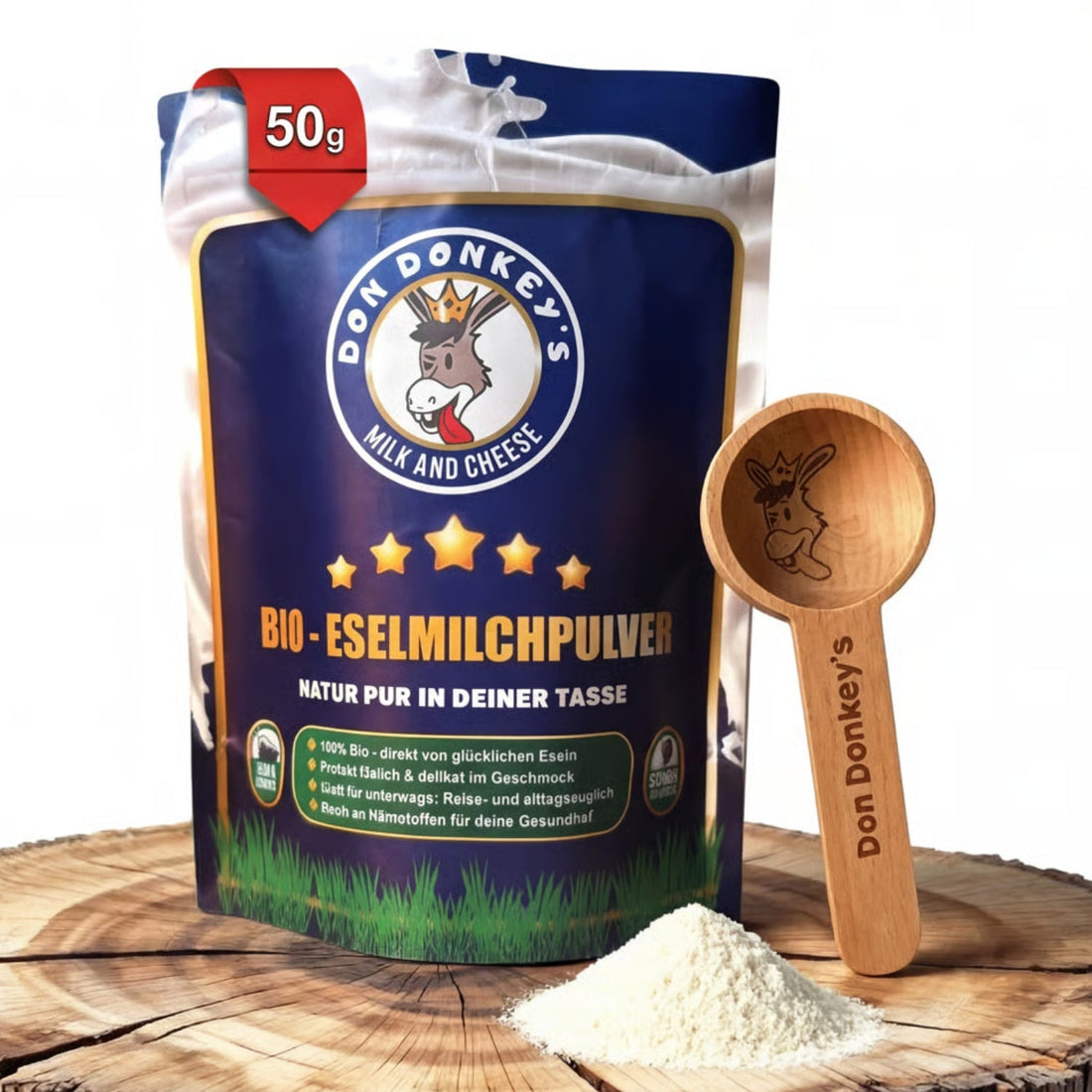
Donkey Milk Powder
Donkey milk in powder form
For anyone who prefers a longer shelf life: our donkey milk in powder form – easy to store and portion.
20g · Unit price: €1.245,00 / 1 kg · incl. VAT, plus shipping