
 Buyer protection

Research on donkey milk · Study 128
Proteomic data on donkey milk
633 proteins were recorded in six pasteurised donkey milk samples from three Greek regions. Only 19 of them were assigned to donkey or horse sequences; 505 are based on a single unique peptide.
At a glance · tap the cards
The key figures
Study design
How it was studied
A data article without the authors’ own animals: six commercially available, pasteurised donkey milk samples stored frozen, from three regions of Greece (Attica, Epirus, Macedonia; two samples each), were purchased. After thawing, the samples were centrifuged and separated into fat, whey and casein layers; the whey fraction was examined (200 µg protein per batch, digestion with trypsin). The peptides were measured by nano-liquid chromatography with tandem mass spectrometry (bottom-up proteomics) in triplicate per sample and matched against curated protein databases for mammals and for the donkey (false discovery rate 1 %, peptides at least 6 amino acids). The proteins were classified by Gene Ontology categories (molecular function, biological process, cellular component). Amounts were not determined; the raw data are available as supplementary tables.
Interactive chart · values from the study
Most frequent milk proteins by number of spectrum matches
Values from Supplementary Table 1 of the study (editorially selected: donkey or horse sequences). PSMs are a rough measure of detection frequency, not a concentration. The digestive enzyme trypsin used as part of the method (63 PSMs) is not shown.
Second analysis
Assignment of the 633 proteins by database species
Editorial count of the species information (OS=) in Supplementary Table 1. The species describes the database sequence through which a protein was recognised, not the origin of the protein; all samples were donkey milk.
Results
What the study measured
In total, 633 proteins or protein groups were identified in the six samples. According to the paper, 628 assignments come from the mammal database and 5 from the donkey database.
The five proteins recognised via the donkey database are β-lactoglobulin 1 and 2 and β-, αS1- and αS2-casein. Via horse sequences, α-lactalbumin A and B/C, lactotransferrin, serum albumin, lysozyme C (milk isoform), clusterin and κ-casein, among others, were recorded.
By number of spectrum matches, β-lactoglobulin 1 (346), β-casein (219) and β-lactoglobulin 2 (133) dominated. By summed peak area, 22.16 % was accounted for by β-lactoglobulin 1 and 23.36 % by the two α-lactalbumin entries together.
The remaining proteins were mostly recognised via sequences of other species (mouse 233, human 141, rat 75, cattle 73). Many of them are cellular and membrane proteins; in the cellular component assignment, cytoplasm (228), membrane (218) and nucleus (197) were the most frequent, and 74 proteins were listed as “secreted”.
The depth of detection is low for most entries: 505 of the 633 proteins are based on only one unique peptide, 406 on only one spectrum match, and the median sequence coverage is 5.31 %.
The authors give a repeatability of over 85 % between the three measurements of the same sample and of 72 % between the six samples.
Authors’ conclusion: In the view of Proikakis et al. (2021), the analysis with 633 identified proteins provides a detailed description of the protein inventory of commercial donkey milk; in their view, the data could help in the further development of donkey milk products. The authors’ statement that the proteins confirm a high nutritional value was not measured in the study – nutrient contents or effects were not the subject of the investigation.
Critical assessment
Strengths and limitations
Only 19 of the 633 entries were assigned to donkey or horse sequences, the rest via mouse, human, rat, cattle and other species. Whether each is the corresponding donkey protein was not checked separately.
505 proteins are based on a single unique peptide, 406 on only one spectrum match, and 225 entries have a score of 0 in Supplementary Table 1. The total of 633 should therefore be read as an upper limit.
Supplementary Table 1 contains the porcine trypsin used for digestion (63 PSMs, sixth most frequent entry) and several human skin keratins that usually come from sample preparation. They are included in the count of 633.
According to the methods section, only the whey fraction was analysed, but the list contains β-, αS1-, αS2- and κ-casein, with β-casein even the second most frequent entry. The separation of whey and casein by centrifugation was therefore incomplete; the abstract and data table speak generally of “proteins of donkey milk”.
Six pasteurised commercial samples were examined without information on animals, lactation stage or heating conditions. No concentrations were determined; PSMs and peak areas allow only rough relative comparisons.
All 633 entries are disclosed with score, coverage, peptide counts, molecular mass and Gene Ontology assignment, along with individual data per sample and replicate. This makes the list verifiable and usable for comparisons.
Editorial assessment: The data article lists which proteins could be detected in six Greek commercial samples of donkey milk. The classic milk proteins are well documented; for most of the other entries, the basis for detection is narrow. No statements about amounts, nutritional value or effects can be derived from it. To the research archive.
Research question for DON DONKEY’S®
Which of the many proteins assigned via only a single peptide and via sequences of other species can actually be confirmed in donkey milk with a complete donkey protein database and quantification?
Original publication
Proteomic data of donkey's milk
Original title of the publication.
Proikakis S.C., Bouroutzika E.V., Anagnostopoulos A.K., Tsangaris G.Th.
Data in Brief · 2021 · 39, 107507
Proteomics Research Unit, Biomedical Research Foundation of the Academy of Athens, Athens; Veterinary Faculty, University of Thessaly, Karditsa, Greece
10.1016/j.dib.2021.107507: 10.1016/j.dib.2021.107507
Transparency: project “FoodOmicsGR-RI – Comprehensive Characterization of Foods” (MIS 5029057) under the Operational Programme “Competitiveness, Entrepreneurship and Innovation” (NSRF 2014–2020), co-financed by Greece and the European Union (European Regional Development Fund). The authors declare no competing financial interests or personal relationships that could have influenced the work. No product-related statement for DON DONKEY’S®.
Summarised and reviewed by the DON DONKEY’S editorial team on the basis of the original publication · as of October 2026
The study summarised above was carried out independently of DON DONKEY’S® and does not relate to our products. It serves solely to inform about the state of research.
DON DONKEY’S® donkey milk and donkey milk powder are foods. They are not intended to prevent, treat or cure any disease and do not replace medical advice.

From our shop
DON DONKEY’S® donkey milk
100 % donkey milk · raw milk, frozen
On this page we report the findings of a published study. Independently of that, you will find our donkey milk here: 100 % donkey milk, frozen as raw milk.
100 ml bottle / 100ml · Unit price: €249,00 / 1 l · incl. VAT, plus shipping
Also in our shop
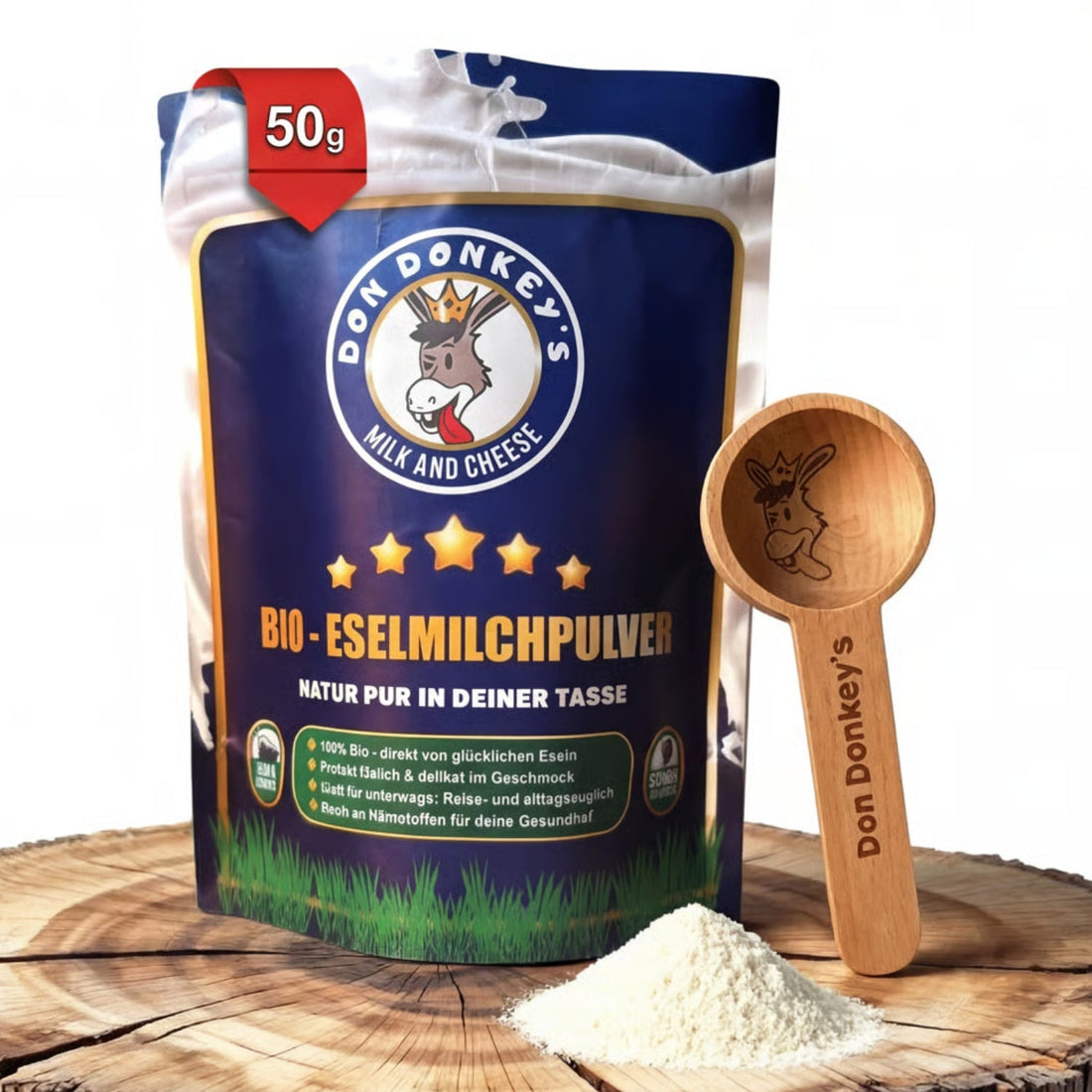
Donkey Milk Powder
Donkey milk in powder form
For anyone who prefers a longer shelf life: our donkey milk in powder form – easy to store and portion.
20g · Unit price: €1.245,00 / 1 kg · incl. VAT, plus shipping