
 Buyer protection

Research on donkey milk · Study 127
Fat and fatty acids of donkey milk over 210 days
In nine Martina Franca jennies, milk fat content fell from 0.72 % (day 15) to 0.42 % (day 210) and energy value from 1857.3 to 1645.6 kJ/kg. The share of saturated fatty acids fell from 62.88 % to 41.54 % on day 180.
At a glance · swipe or use the arrows
The key figures
Study design
How it was studied
Nine multiparous Martina Franca jennies (6–12 years, 320 ± 30 kg), described in the study as healthy, with a similar foaling date (± 7 days) were kept semi-extensively in the south-eastern Murgia area (Apulia, Italy): 7–10 hours of grazing on natural scrub vegetation daily, plus 2.0–2.5 kg of oats per animal per day. The foals stayed with the jennies and were separated 3 hours before milking; the jennies were machine-milked twice a day. Individual milk samples (morning and evening milk pooled) were taken on days 15, 30, 45, 60, 90, 120, 150, 180 and 210 after birth. Fat, protein and lactose were determined by infrared milk analysis, the gross energy value was calculated with the Perrin formula, and the fatty acid profile was analysed by capillary gas chromatography (share of identified fatty acids). The analysis used a repeated-measures model and t-tests.
Interactive chart · values from the study
Fat content of the milk over the course of lactation
Means (n = 9) from Table 1 of the study; no fat value is given for day 45. Days 15 and 30 differed significantly from day 210.
Second analysis
Selected fatty acids over the course of lactation
Means (n = 9) from Table 4 of the study; standard deviations are not given there.
Results
What the study measured
Milk fat content averaged 0.54 % and was highest on day 15 (0.72 %) and day 30 (0.71 %); it gradually fell to 0.42 % on day 210, significantly only compared with this last time point. The calculated gross energy value followed the fat and fell from 1857.3 to 1645.6 kJ/kg; the authors put the decrease at 10 %.
Averaged over the lactation, the milk fat consisted of 51.98 % saturated, 28.00 % monounsaturated and 20.02 % polyunsaturated fatty acids. The most frequent individual fatty acids were oleic, palmitic and linoleic acid; capric, lauric, myristic and caprylic acid were each in the range of several per cent, stearic acid below 2 %.
According to the text, the share of saturated fatty acids fell from 62.88 % on day 15 to 41.54 % on day 180. Lauric acid (−59 %) and myristic acid (−54.5 %) decreased most; capric acid fell from 13.46 % (day 30) to 5.82 % (day 180). Monounsaturated fatty acids rose from 23.58 % to 34.40 % on day 180, driven mainly by oleic acid (17.55 to 27.57 %).
Among the polyunsaturated fatty acids, linoleic acid (8.83 % on day 15, peak of 17.20 % on day 180) and alpha-linolenic acid (3.85 % on day 15, 11.17 % on day 210) increased. The n-6 to n-3 ratio was about 2:1 overall and below 1 on day 210; the authors attributed the late rise in alpha-linolenic acid to richer pasture in late lactation.
Long-chain fatty acids such as EPA (0.50 %), arachidonic acid (0.09 %) and DHA (0.02 %) occurred only in very small proportions and did not change significantly. The Δ9-desaturase indices for C16:1 and C18:1 rose over the course of lactation.
The purely computational fatty acid indices according to Ulbricht and Southgate (atherogenic index on average 1.16, thrombogenic index 0.70) decreased over the course of lactation. These figures only describe the fatty acid pattern; effects in humans were not examined.
Authors’ conclusion: In the view of Martemucci and D’Alessandro (2012), donkey milk is characterised by low fat and energy values, a high share of polyunsaturated fatty acids with alpha-linolenic and linoleic acid, and a low n-6/n-3 ratio; fat and energy decrease over the course of lactation, while unsaturated fatty acids increase. The authors therefore considered donkey milk interesting for the nutrition of children and adults. This classification is based on the literature and computational indices, not on studies in humans.
Critical assessment
Strengths and limitations
Small group, one husbandry system
Nine jennies of one breed were examined under pasture husbandry in one region. Feed and pasture changed over the year, so lactation stage and feeding cannot be separated.
Means in the text differ from Table 4
By our editorial recalculation, Table 4 gives a mean of 12.39 % for linoleic acid, while the text gives 18.38 % – more than the highest individual value in the table (17.20 %) and incompatible with 20.02 % total PUFA. The text means for caprylic, capric, lauric and myristic acid are also around 10–15 % above the table means.
Inconsistent energy and fat figures
The abstract gives 1719.2 kJ/kg and the results section 1748.5 kJ/kg as the mean energy value; the decrease according to Table 1 is around 11 % rather than 10 %. The mean fat content is given as 0.54 %, while the mean of the table values is 0.57 %. A fat value is missing for day 45, and the protein and lactose contents used in the energy calculation are not reported.
Minor inconsistencies
For day 180, the text gives 41.54 % saturated fatty acids, while the sum from Table 4 is 40.56 %. The ratio of unsaturated to saturated fatty acids is sometimes given as a percentage, and the stated longitude of the site (60° east) does not fit Apulia.
Far-reaching interpretations by the authors
The discussion derives statements about the nutrition and health of children and adults from the fatty acid pattern and the literature. These were not examined in the study; only milk analyses were carried out.
Long-term observation of the same animals
The same jennies were sampled at nine time points over seven months, and Table 4 documents 42 individual fatty acids and desaturase indices per time point. The pairwise significance comparisons between all time points are disclosed in tables.
Editorial assessment: The study provides measurements of fat, energy and fatty acid pattern of raw milk from a southern Italian donkey breed kept on pasture. Health effects in humans were not examined and cannot be derived from these data. To the research archive.
Research question for DON DONKEY’S®
How far can the fat content and fatty acid pattern of donkey milk be steered via pasture and feed composition when lactation stage and season are recorded separately in one trial?
Original publication
Fat content, energy value and fatty acid profile of donkey milk during lactation and implications for human nutrition
Original title of the publication.
Martemucci G., D’Alessandro A.G.
Lipids in Health and Disease · 2012 · 11, 113
Department of Agricultural and Environmental Science, University of Bari, Bari, Italy
10.1186/1476-511X-11-113: 10.1186/1476-511X-11-113
Transparency: INTERREG IIIA Greece–Italy (project code I2101030) and a grant from the University of Bari Aldo Moro. The authors declare no competing interests. No product-related statement for DON DONKEY’S®.
Summarised and reviewed by the DON DONKEY’S editorial team on the basis of the original publication · as of October 2026
The study summarised above was carried out independently of DON DONKEY’S® and does not relate to our products. It serves solely to inform about the state of research.
DON DONKEY’S® donkey milk and donkey milk powder are foods. They are not intended to prevent, treat or cure any disease and do not replace medical advice.

From our shop
DON DONKEY’S® donkey milk
100 % donkey milk · raw milk, frozen
On this page we report the findings of a published study. Independently of that, you will find our donkey milk here: 100 % donkey milk, frozen as raw milk.
100 ml bottle / 100ml · Unit price: €249,00 / 1 l · incl. VAT, plus shipping
Also in our shop
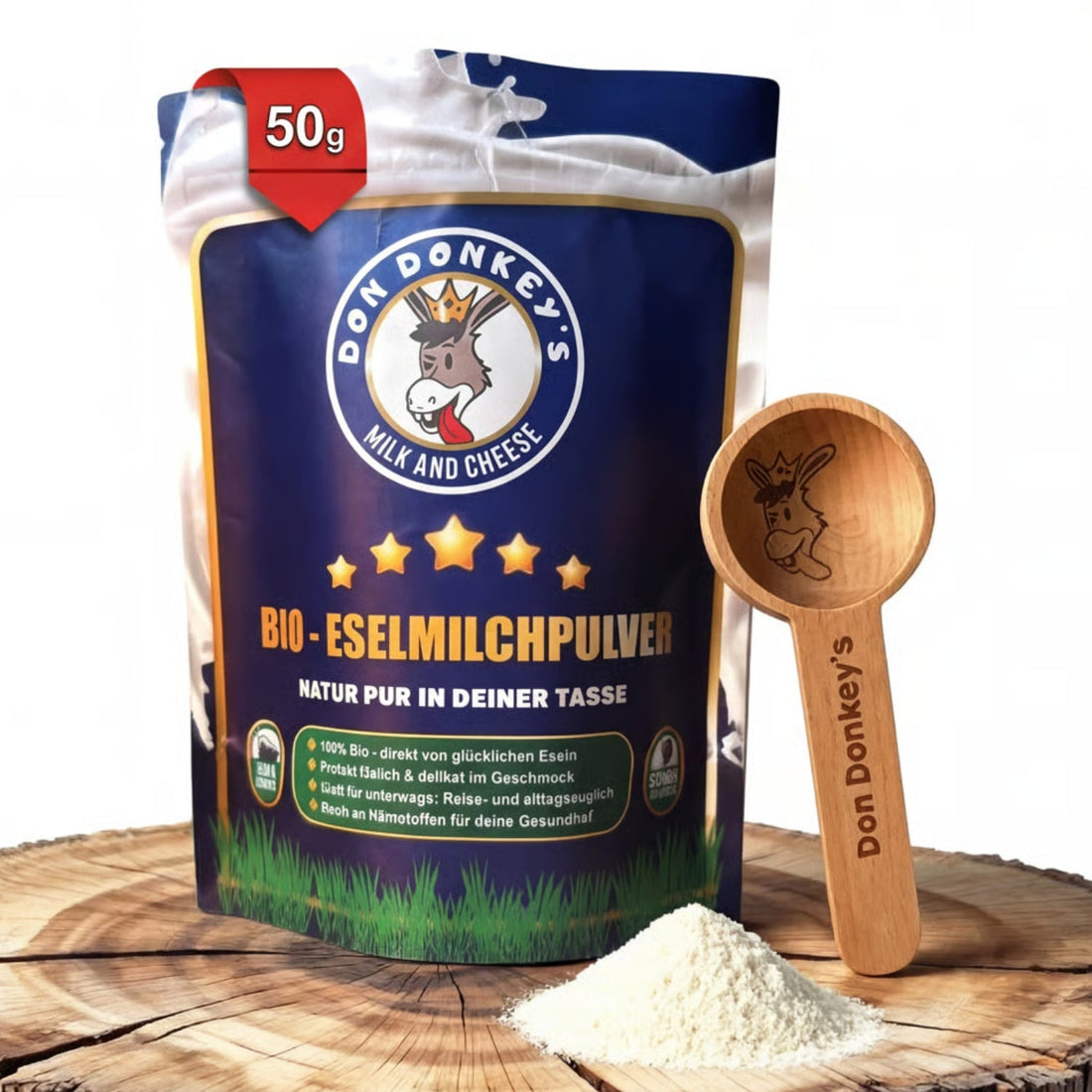
Donkey Milk Powder
Donkey milk in powder form
For anyone who prefers a longer shelf life: our donkey milk in powder form – easy to store and portion.
20g · Unit price: €1.245,00 / 1 kg · incl. VAT, plus shipping