
 Buyer protection

Research on donkey milk · Study 126
Chemical and sensory properties of fresh cheese from enzymatically coagulated donkey milk
With microbial rennet, donkey milk could be coagulated in around 9 minutes; the fresh cheese achieved a yield of 7.21 % with 25.87 % protein and 2.90 % fat. The comparison cheese from cow’s milk reached a yield of 23.52 %.
At a glance · tap the cards
The key figures
Study design
How it was studied
Pooled milk from ten Martina Franca jennies in mid-lactation (machine-milked, farm in Apulia) was made into fresh cheese on a laboratory scale in six replicates; pooled cow’s milk served as the control. For each batch, 5 L of milk was warmed in a water bath and calcium chloride (0.3 g/L) and microbial rennet were added; the curd was cut, heated to 46 °C, moulded, dry-salted after 2 h at 25 °C and stored overnight at 4 °C. After about 24 hours, yield, composition (dry matter, protein, fat, ash, pH), the fatty acid profile of milk, cheese and whey (gas chromatography), volatile compounds (headspace SPME-GC-MS, semi-quantitative), the protein fractions (electrophoresis) and the sensory profile (flavour profile method, trained panel of five) were determined.
Interactive chart · values from the study
Selected fatty acids: donkey milk vs. fresh cheese
Means from Table 2 of the study (six cheesemakings). Except for oleic acid, milk and cheese differed significantly in each case.
Second analysis
Composition of the cheeses after 24 hours
Means from Table 1 of the study; all differences significant (p < 0.05).
Results
What the study measured
The donkey milk (pH 7.01; 2.21 % protein, 0.33 % fat, 6.76 % lactose) coagulated quickly with microbial rennet: 9.15 ± 3.10 minutes passed before cutting. The curd, however, remained very soft and had to be handled gently; processing up to moulding took 42.10 minutes compared with 13.20 minutes for cow’s milk, which formed a firm curd almost immediately under the same conditions.
After 24 hours, the donkey fresh cheese contained 34.19 % dry matter, 25.87 % protein, 2.90 % fat and 3.31 % ash at pH 5.85; the yield was 7.21 %. The control cheese from cow’s milk was semi-firm with 49.88 % dry matter, 23.76 % fat and a yield of 23.52 %. The authors attributed the yield, higher than in the literature, mainly to the high protein content of the milk used.
In the donkey milk, oleic acid (24.46 %), palmitic acid (19.08 %) and linoleic acid (18.27 %) dominated. In the cheese, the share of saturated fatty acids, at 67.01 %, was markedly higher than in the milk (48.46 %), mainly due to more palmitic, myristic and stearic acid; polyunsaturated fatty acids fell from 23.92 % to 6.55 %. In cow’s milk, the shifts were weaker and significant only for stearic acid.
The authors suspected that large fat globules are retained more strongly in the curd than small ones and differ in their fatty acid pattern. Because of high variability, the whey analyses could not support this assumption.
11 volatile compounds were identified in donkey milk, most frequently acetic acid (5.65 µg/kg) and acetone (2.84 µg/kg), and 18 in the donkey fresh cheese, including acetoin (11.93 µg/kg), 2-methylbutanal (8.79 µg/kg) and 2-ethylhexanol (7.16 µg/kg). For 2-ethylhexanol, the authors also considered it possible that it came from plastic materials used in production.
The sensory panel chose nine descriptors for the donkey fresh cheese; the most intense were the aroma “egg yolk”, followed by an animal note and “caramel”, while “sweet” dominated the taste. The texture resembled fresh feta but became dry and chalky after a few days of storage (13 °C) and was not suitable for ripening. Electrophoresis showed new casein fragments after 24 hours, which the authors attributed to the activity of the microbial rennet.
Authors’ conclusion: In the view of Faccia et al. (2020), donkey milk can be made into fresh cheese with microbial rennet under suitable conditions; the real difficulty lies not in coagulation itself but in firming the curd. The authors described the cheese as a product with a very low fat content and a pleasant aroma. They saw a need for improvement in texture and yield and suggested increasing the casein content, for example by gentle concentration or membrane filtration.
Critical assessment
Strengths and limitations
Contradictory information on the origin of the milkNote
According to the abstract, the milk came from one Martina Franca jenny; according to the methods section, from ten animals. When the milk for the six cheesemakings was obtained and whether it was freshly collected each time remains open.
Control cheese arithmetically inconsistentNote
By our editorial recalculation, the yield and composition of the cow’s milk cheese imply that around 154 % of the milk fat and 122 % of the milk protein would be recovered in the cheese, which is not possible. For the donkey fresh cheese, the values are a plausible 63 % and 84 %.
Fatty acid shift unexplainedNote
The sharp fall in polyunsaturated fatty acids from milk to cheese is unusual and is explained only as a hypothesis. According to the table, the whey contained less than 0.1 % fat, and its fatty acid profile varied widely.
Laboratory scale and small panelClear limitation
Small batches of 5 L of milk were made. The sensory evaluation is based on a consensus profile of five trained assessors and is available only as a graphic; no consumer test was carried out.
Aroma compounds only semi-quantitativeNote
The volatile compounds were estimated against an internal standard assuming equal response factors. The interpretation of the “egg yolk” aroma via compounds shared with egg yolk is a supposition of the authors.
Direct comparison with cow’s milkStrength
Donkey and cow’s milk were processed with the same method in six replicates, and milk, cheese and whey were examined chemically, electrophoretically and sensorially. The raw values are given in tables with standard deviations.
Editorial assessment: The study is a technological laboratory experiment on cheesemaking and describes the composition, fatty acids, aroma compounds and sensory properties of a trial product. Nutritional effects in humans were not examined. To the research archive.
Research question for DON DONKEY’S®
Can the yield and curd firmness of donkey milk fresh cheese be improved by gentle enrichment of the casein without substantially changing the fatty acid profile and aroma?
Original publication
Chemical-Sensory Traits of Fresh Cheese Made by Enzymatic Coagulation of Donkey Milk
Original title of the publication.
Faccia M., Gambacorta G., Martemucci G., Difonzo G., D’Alessandro A.G.
Foods · 2020 · 9(1), 16
Department of Soil, Plant and Food Sciences and Department of Agro-Environmental and Territorial Sciences, University of Bari, Bari, Italy
10.3390/foods9010016: 10.3390/foods9010016
Transparency: according to the paper, no external funding. The authors declare no conflicts of interest. No product-related statement for DON DONKEY’S®.
Summarised and reviewed by the DON DONKEY’S editorial team on the basis of the original publication · as of October 2026
The study summarised above was carried out independently of DON DONKEY’S® and does not relate to our products. It serves solely to inform about the state of research.
DON DONKEY’S® donkey milk and donkey milk powder are foods. They are not intended to prevent, treat or cure any disease and do not replace medical advice.

From our shop
DON DONKEY’S® donkey milk
100 % donkey milk · raw milk, frozen
On this page we report the findings of a published study. Independently of that, you will find our donkey milk here: 100 % donkey milk, frozen as raw milk.
100 ml bottle / 100ml · Unit price: €249,00 / 1 l · incl. VAT, plus shipping
Also in our shop
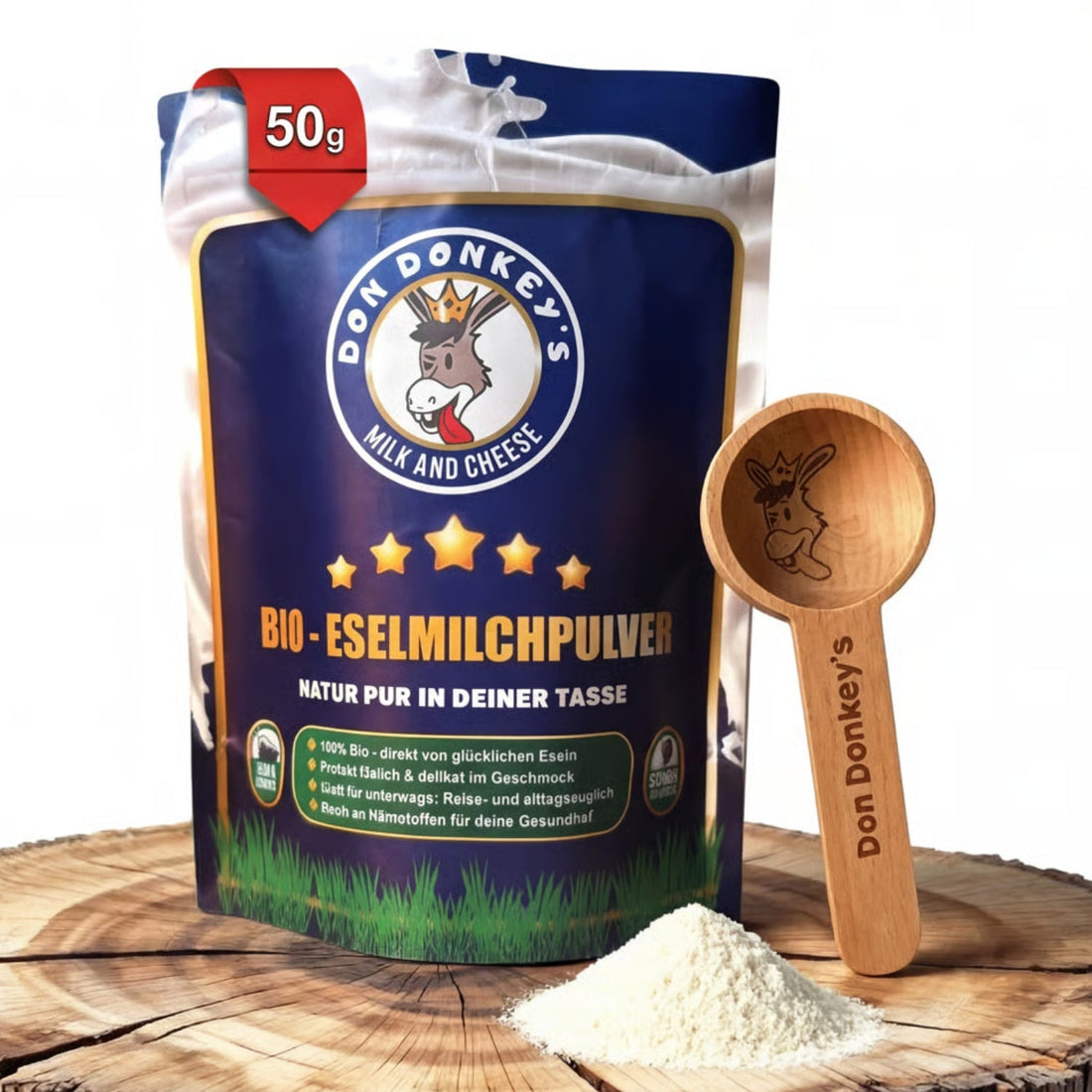
Donkey Milk Powder
Donkey milk in powder form
For anyone who prefers a longer shelf life: our donkey milk in powder form – easy to store and portion.
20g · Unit price: €1.245,00 / 1 kg · incl. VAT, plus shipping