
 Buyer protection

Research on donkey milk · Study 125
IgG in donkey colostrum: the first 24 hours
In nine Amiata jennies, the IgG content of colostrum fell from 1.95 log10 mg/mL directly after birth (around 89 mg/mL) to 1.40 log10 mg/mL after 24 hours (around 25 mg/mL). In the foals’ blood, IgG rose over the same period from 8.97 to 14.91 mg/mL.
At a glance · swipe or use the arrows
The key figures
Study design
How it was studied
Ten Amiata jennies from a regional stud (Le Bandite di Scarlino, Tuscany) were cared for with their foals at the veterinary teaching hospital of the University of Pisa in the 2019 foaling season; nine jenny–foal pairs were analysed. The jennies received grass hay ad libitum and a commercial concentrate according to NRC recommendations; the foals stayed with their mothers. Colostrum was collected by hand separately from the left and right udder halves directly after birth and 6, 12 and 24 hours later (72 samples), together with the foals’ blood serum (36 samples). IgG was determined by single radial immunodiffusion (SRID) with a test developed for horse IgG. The foals were weighed at birth and then weekly until day 28. The analysis used the Friedman test, a regression model on log10-transformed colostrum values, a mixed model for the serum values and Pearson correlations.
Interactive chart · values from the study
IgG in colostrum in the first 24 hours
Means (n = 9) from Table 2 of the study, log10-transformed; back-calculated about 89, 58, 36 and 25 mg/mL. 12 h and 24 h did not differ significantly.
Second analysis
IgG in the foals’ blood serum
Means (n = 9) from Table 3 of the study; measured by SRID with a test for horse IgG.
Results
What the study measured
Nine of the ten jenny–foal pairs enrolled were analysed; one pair was excluded from the analysis. The jennies were on average 12.11 ± 4.07 years old and had foaled 4.62 ± 2.34 times; four foals were male, five female.
The IgG content of colostrum did not differ significantly between the left and right udder halves. The further analysis is therefore based on the mean of both halves.
The IgG content of colostrum directly after birth was 1.95 log10 mg/mL and fell via 1.76 (6 h) and 1.56 (12 h) to 1.40 log10 mg/mL after 24 hours. The value at birth was significantly above all later ones, and the 6 h value above those at 12 h and 24 h; 12 h and 24 h did not differ. In the regression model, IgG decreased by 0.0244 log10 mg/mL per hour.
In the foals’ blood serum, IgG rose from 8.97 mg/mL at birth to 11.91 mg/mL (6 h), 14.87 mg/mL (12 h) and 14.91 mg/mL (24 h). After 24 hours, all foals were above 13 mg/mL. No correlation was found between the IgG content of colostrum at birth and the foals’ serum IgG after 24 hours.
The foals weighed on average 27.83 ± 5.40 kg at birth; the mean weight gain is given as 0.841 ± 0.2 kg. There was no correlation between the IgG content of colostrum and weight gain.
The authors classified the IgG course in colostrum as similar to that in horses and described higher values than in studies on mares and Martina Franca jennies; in their view, donkey foals already had more IgG in their blood at birth than horse foals. There was no direct comparison within the study.
Authors’ conclusion: In the view of Turini et al. (2020), the IgG course in the colostrum of Amiata jennies resembles that in horses: the content is highest directly after birth and decreases continuously in the first 24 hours. In their view, donkey foals already have more IgG in their blood at birth than horse foals. The authors considered larger numbers of animals necessary to establish breed-specific reference values.
Critical assessment
Strengths and limitations
Nine jenny–foal pairs of one breed from one stud were analysed; the authors themselves describe the work as a preliminary study. Breed-specific reference ranges cannot yet be derived from it.
IgG was measured with an SRID test developed for horses because no donkey-specific test was available. Validation for donkey IgG is not described, so the absolute values should be compared with caution.
By our editorial recalculation, the individual values in Table 1 give means of 1.94, 1.69, 1.53 and 1.37 log10 mg/mL, while Table 2 gives 1.95, 1.76, 1.56 and 1.40. The standard deviations given in Table 2 (0.97–1.49) are not compatible with the spread of the individual values (around 0.12–0.29 log10 units).
The weight gain of 0.841 kg is given without a time reference; the abbreviation stands for a weekly gain, which over 28 days would give only around 3.4 kg. No coefficients are reported for the correlations, and the amount of colostrum ingested was not recorded.
In Table 1, the value 1.41 log10 mg/mL occurs very frequently, and individual samples are at 0.76. The paper does not explain whether these are measurement limits of the test.
Colostrum from both udder halves and foal serum were collected at the same four time points in the first 24 hours, the individual values of all jennies are documented in tables, and all samples were analysed in one run.
Editorial assessment: The study describes the colostrum of the first 24 hours after birth, which is reserved for the foals, and the IgG course in the foals’ blood. No statements about the composition of donkey milk obtained later or about effects in humans can be derived from it. To the research archive.
Research question for DON DONKEY’S®
How are the amount of colostrum actually ingested and the IgG course in foal blood related in different donkey breeds when a method validated for donkey IgG is used?
Original publication
Evaluation of jennies' colostrum: IgG concentrations and absorption in the donkey foals. A preliminary study
Original title of the publication.
Turini L., Bonelli F., Nocera I., Battaglia F., Meucci V., Panzani D., Mele M., Sgorbini M.
Heliyon · 2020 · 6(8), e04598
Department of Veterinary Sciences, University of Pisa; Ospedale Didattico Veterinario “Mario Modenato”, San Piero a Grado; Centro di Ricerche Agro-ambientali “E. Avanzi”, University of Pisa, Pisa, Italy
10.1016/j.heliyon.2020.e04598: 10.1016/j.heliyon.2020.e04598
Transparency: according to the paper, no specific funding from public, commercial or not-for-profit funders. The authors declare no conflicts of interest. No product-related statement for DON DONKEY’S®.
Summarised and reviewed by the DON DONKEY’S editorial team on the basis of the original publication · as of October 2026
The study summarised above was carried out independently of DON DONKEY’S® and does not relate to our products. It serves solely to inform about the state of research.
DON DONKEY’S® donkey milk and donkey milk powder are foods. They are not intended to prevent, treat or cure any disease and do not replace medical advice.

From our shop
DON DONKEY’S® donkey milk
100 % donkey milk · raw milk, frozen
On this page we report the findings of a published study. Independently of that, you will find our donkey milk here: 100 % donkey milk, frozen as raw milk.
100 ml bottle / 100ml · Unit price: €249,00 / 1 l · incl. VAT, plus shipping
Also in our shop
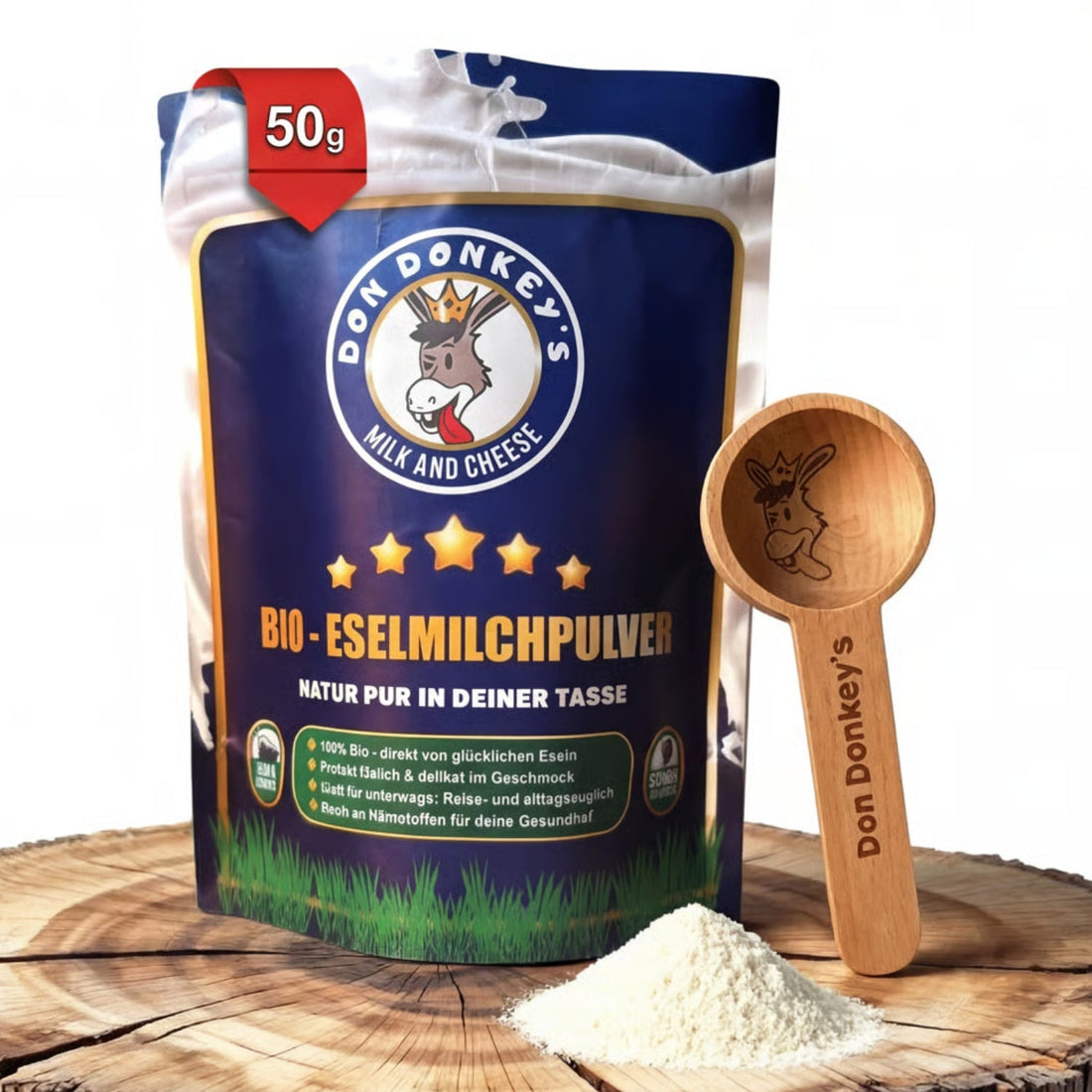
Donkey Milk Powder
Donkey milk in powder form
For anyone who prefers a longer shelf life: our donkey milk in powder form – easy to store and portion.
20g · Unit price: €1.245,00 / 1 kg · incl. VAT, plus shipping