
 Buyer protection

Research on donkey milk · Study 124
Zamorano-Leonés donkey milk: nutrient profile
Milk from eight Zamorano-Leonés jennies contained 1.68 % protein, 0.56 % fat and 6.6 % lactose at 155 kJ/100 g. Polyunsaturated fatty acids made up 27.06 % of the fatty acids, oleic acid 25.12 %.
At a glance · tap the cards
The key figures
Study design
How it was studied
Raw milk from eight primiparous or multiparous jennies of the endangered Spanish breed Zamorano-Leonés (4–8 years, 270 ± 30 kg), described in the study as healthy, from a farm in Sieteiglesias de Tormes (Salamanca, Spain) was examined. The animals were kept extensively with pasture, alfalfa ad libitum and an oat supplement. In the first six weeks the foals received all the milk; thereafter about 2 L per day was milked by hand twice a day, about 4 hours apart. Samples were taken every two weeks in September and October 2021 between days 60 and 120 of lactation (four dates). pH, acidity, basic composition, fatty acids (gas chromatography), amino acids (HPLC), protein fractions (gel electrophoresis), vitamins (liquid chromatography, partly with mass spectrometry) and minerals (ICP-MS) were determined. To compare vitamins and minerals, part of the milk was heated for 15 s at 75 °C in a water bath. The analysis was mainly descriptive; comparisons with other breeds and species are based on literature values.
Interactive chart · values from the study
Macro elements in Zamorano-Leonés donkey milk
Means from Table 4 (n = 12 according to the footnote). Trace elements in µg/kg: zinc 2184.73, copper 150.9, selenium 107.1, iron 100.
Second analysis
Fatty acid groups compared by breed
Values from Table 6; the comparison breeds come from other studies with their own methods, and no statistical comparison was made. Amiata is referred to as “Aminata” in the paper.
Results
What the study measured
The milk had a pH of 7.16 and, according to Table 5, contained 90.95 % water, 0.36 % ash, 1.68 % protein, 0.56 % fat and 6.6 % lactose; the energy content was calculated at 155 kJ/100 g.
The most frequent fatty acids were oleic acid (25.12 %), palmitic acid (21.56 %), linoleic acid (14.31 %) and α-linolenic acid (12.32 %), followed by capric (5.68 %) and lauric acid (5.20 %). Saturated fatty acids made up 43.91 %, monounsaturated 29.03 % and polyunsaturated 27.06 %; the ratio of polyunsaturated to saturated was 0.62 and the ω6/ω3 ratio 1.16.
Among the amino acids, glutamic acid (0.35 %), aspartic acid and proline (0.16 % each) and leucine and valine (0.15 % each) dominated. In the gel, β-lactoglobulin, α-lactalbumin, caseins and lysozyme were the quantitatively most important protein bands; immunoglobulins and lactoferrin occurred in smaller proportions.
The milk contained 63 mg/L vitamin C as well as thiamine 200, riboflavin 345, pyridoxine 200, folic acid 525.8 and cobalamin 3.69 (unit in the paper “µL/L”). For vitamin D, 1.5 µg/100 mL is given, for vitamin E 6.75 µg/100 mL.
The most frequent minerals were potassium (863 mg/kg), calcium (676 mg/kg) and phosphorus (518 mg/kg), followed by sodium (173 mg/kg) and magnesium (84 mg/kg). Trace elements measured were zinc 2184.73, copper 150.9, selenium 107.1 and iron 100 µg/kg; the calcium–phosphorus ratio was 1.30.
After 15 s at 75 °C, water-soluble vitamins and minerals did not differ significantly from raw milk according to the authors (data not shown). Fat-soluble vitamins decreased: vitamin E by 66.22 %, vitamin A by 35 % and vitamin D, according to the results section, by 10 %.
Authors’ conclusion: In the view of Albertos et al. (2022), the milk of Zamorano-Leonés jennies is similar to that of other donkey breeds in its protein and amino acid profile but contains more unsaturated fatty acids as well as much vitamin C, folic acid, zinc and selenium. The authors saw it as a nutrient-rich food or ingredient and as a way of preserving the endangered breed; their statements about health benefits were not tested in the study.
Critical assessment
Strengths and limitations
Small sample, literature comparison
Eight animals from one farm were examined over two months; the tables give n = 12 without explanation. Comparisons with other breeds and species are based exclusively on literature values with different methods and without statistical testing.
Swapped values and units
The results text gives 0.56 % protein and 1.68 % fat, Table 5 the other way round. Linoleic acid and α-linolenic acid are each assigned to the wrong ω series. B vitamins are given in “µL/L”, acidity in g/L in the methods section and per 100 g in the results.
Contradictory vitamin D figures
According to the results section, vitamin D fell by 10 % on heating; according to the discussion, from 1.5 to 0.15 µg/100 mL (around −90 %), while it is also described as the most stable vitamin. The values for vitamin A are available only as a figure.
Recalculated totals
By our editorial recalculation, the essential amino acids in Table 2 add up to around 44 % of the total rather than the stated 54 %. Monounsaturated and polyunsaturated fatty acids add up to 56.09 %, whereas 55.09 % unsaturated fatty acids is stated.
Health statements not examined
The abstract and conclusion contain health-related statements that were not examined in this study; only the composition was measured. The statement that copper and selenium were determined in donkey milk for the first time does not hold according to the literature.
Broad profile of a breed not previously studied
For the first time, the milk of the endangered Zamorano-Leonés breed is described comprehensively – from basic composition through fatty and amino acids to vitamins and minerals. A reference material was included for the mineral analysis.
Editorial assessment: The study describes the composition of raw milk from a small group of Spanish jennies and contains several errors in figures and units. No conclusions about health effects or individual commercial products can be drawn from it. To the research archive.
Research question for DON DONKEY’S®
How does the milk of Zamorano-Leonés jennies change over a whole lactation and between pasture and housing periods, and how does it differ from other breeds when all samples are measured with the same analytical methods?
Original publication
Characterisation of Zamorano-Leonese Donkey Milk as an Alternative Sustainably Produced Protein Food
Original title of the publication.
Albertos I., López M., Jiménez J.-M., Cao M.J., Corell A., Castro-Alija M.J.
Frontiers in Nutrition · 2022 · 9, 872409
Universidad Católica de Ávila (UCAV), Ávila; Recognized Research Group, Faculty of Nursing and Department of Immunology, University of Valladolid, Valladolid, Spain
10.3389/fnut.2022.872409: 10.3389/fnut.2022.872409
Transparency: no funding is stated in the full text. The authors declare no commercial or financial relationships that could be construed as a potential conflict of interest. No product-related statement for DON DONKEY’S®.
Summarised and reviewed by the DON DONKEY’S editorial team on the basis of the original publication · as of October 2026
The study summarised above was carried out independently of DON DONKEY’S® and does not relate to our products. It serves solely to inform about the state of research.
DON DONKEY’S® donkey milk and donkey milk powder are foods. They are not intended to prevent, treat or cure any disease and do not replace medical advice.

From our shop
DON DONKEY’S® donkey milk
100 % donkey milk · raw milk, frozen
On this page we report the findings of a published study. Independently of that, you will find our donkey milk here: 100 % donkey milk, frozen as raw milk.
100 ml bottle / 100ml · Unit price: €249,00 / 1 l · incl. VAT, plus shipping
Also in our shop
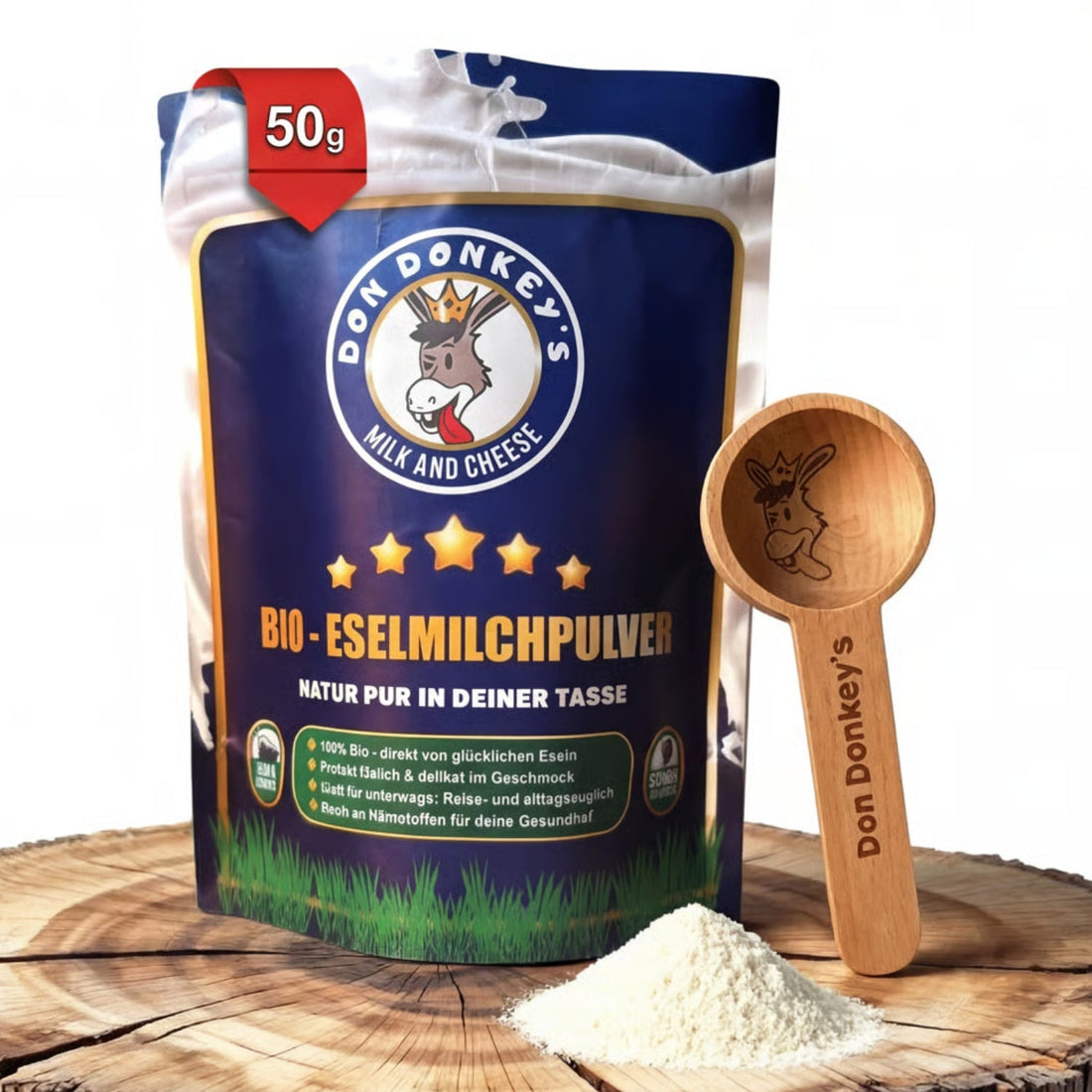
Donkey Milk Powder
Donkey milk in powder form
For anyone who prefers a longer shelf life: our donkey milk in powder form – easy to store and portion.
20g · Unit price: €1.245,00 / 1 kg · incl. VAT, plus shipping