
 Buyer protection

Research on donkey milk · Study 123
Crude protein in feed: milk yield in jennies
In 24 Dezhou jennies, the extrapolated milk yield with 14.2 % or 15.3 % crude protein in the feed was 3.27 and 3.41 kg/d, and with 13.1 % 2.80 kg/d. Milk protein content rose slightly from 1.82 to 1.87–1.89 %.
At a glance · swipe or use the arrows
The key figures
Study design
How it was studied
Feeding trial on the experimental farm of Inner Mongolia Agricultural University (Hohhot, China) with 24 lactating Dezhou jennies (34 ± 4.9 days in lactation, 2.52 ± 0.72 kg/d milk, 2.8 ± 0.6 foalings, 239 ± 24 kg) housed individually with their foals. The animals were randomly allocated to three rations with 15.3 % (high), 14.2 % (medium) and 13.1 % crude protein (low) in dry matter (n = 8 each); all rations had the same energy (12.4 MJ/kg digestible energy) with a concentrate to forage ratio of 30:70 based on millet straw and alfalfa. After 2 weeks of acclimatisation, 8 weeks of data collection followed. The foals were separated 3 hours before milking with visual contact, and the jennies were machine-milked twice a day; daily milk yield (EMY) was extrapolated as amount obtained × 4. Milk composition was determined weekly by mid-infrared analysis, digestibility in week 8 using acid-insoluble ash as a marker, and blood values at the end of the trial. The analysis used mixed models with repeated measures and Duncan’s test.
Interactive chart · values from the study
Milk yield by crude protein content of the feed
LS means from Table 2 (n = 8 each). EMY = amount obtained × 4; energy- and solids-corrected milk using formulas for dairy cows.
Second analysis
Apparent digestibility of nutrients
Means from Table 3 (week 8, n = 8 each); NDF/ADF = neutral and acid detergent fibre.
Results
What the study measured
The milk yield obtained with 15.3 % and 14.2 % crude protein, at 0.85 and 0.82 kg/d, was higher than with 13.1 % (0.70 kg/d); extrapolated, this corresponded to 3.41, 3.27 and 2.80 kg/d. There was no significant difference between the high and medium levels.
Milk protein content (1.89 and 1.87 vs. 1.82 %), dry matter (9.20 and 9.18 vs. 9.13 %) and milk urea nitrogen (41.06 and 39.89 vs. 33.98 mg/dL) were higher at the two higher levels than at the low one. Fat (0.25–0.28 %) and lactose (7.07–7.11 %) remained unchanged.
Because of the higher milk yield, the daily amounts of protein (64.44 and 60.84 vs. 50.93 g), lactose (243.34 and 232.27 vs. 197.29 g) and dry matter (313.54 and 299.68 vs. 254.91 g) obtained also rose.
Feed intake in all groups was 7.38–7.49 kg dry matter per day. Feed efficiency and the efficiency of milk protein formation (0.059 and 0.061 vs. 0.054) were better at the two higher levels.
The apparent digestibility of dry matter, crude protein, crude fat, fibre fractions, calcium and phosphorus was lower at 13.1 % crude protein than in the other two groups, for example for crude protein 74.40 % compared with 80.28 and 82.21 %.
In blood serum, total protein, albumin and urea nitrogen were lower at the low level, and non-esterified fatty acids and β-hydroxybutyrate higher, than in the other two groups. The authors interpreted this as an indication of greater mobilisation of body fat at 13.1 % crude protein.
Authors’ conclusion: In the view of Yue et al. (2022), raising the crude protein content from 13.1 % to 14.2 % of dry matter improves milk performance, feed efficiency and protein synthesis efficiency in lactating jennies; more than 14.2 % crude protein brought no further increase. The authors regarded 14.2 % as an adequate protein supply for milk production under their trial conditions.
Critical assessment
Strengths and limitations
Small, short trialClear limitation
Eight animals of one breed on one experimental farm were examined per group over eight weeks, with three closely spaced protein levels. Besides crude protein, the shares of maize, soybean meal and maize gluten in the ration also changed.
Extrapolated milk yieldNote
The daily milk yield is the amount obtained multiplied by the literature factor of 4. Energy- and solids-corrected milk and protein synthesis efficiency were calculated with formulas for dairy cows; the authors themselves acknowledge the limited transferability.
Table and text inconsistentNote
According to the text, the daily fat yield was significantly higher at the high and medium levels than at the low level; in Table 2, however, the medium level (8.83 g, “ab”) does not differ from the low one. The column headers in Tables 3 and 4 read “WP” and “HF/WF” instead of HP/MP, and SCM/DMI shows “025”.
Implausible units in serumNote
Calcium (2.73–2.78) and phosphorus (1.29–1.33) are given in “mg/L”, non-esterified fatty acids (0.17–0.28) in “µmol/L”. At this order of magnitude, the values fit mmol/L better; the units are therefore not editorially confirmed.
Interpretations not tested directlyNote
The assessment that 15.3 % crude protein represents an oversupply is based on blood and milk urea values; no nitrogen balance was drawn up. The health properties of donkey milk mentioned in the introduction were not the subject of the study.
Controlled trial designStrength
The animals were randomly allocated, the rations had the same energy, and the pre-period served as a covariate in the mixed model. Milk samples were taken weekly over eight weeks, and all table values are given with SEM and p-values.
Editorial assessment: The study provides data on feeding lactating jennies and the resulting milk yield and basic composition. No direct conclusions about other breeds, husbandry systems or individual commercial products can be drawn from it. To the research archive.
Research question for DON DONKEY’S®
How do the crude protein content and amino acid pattern of the feed affect the individual protein fractions of donkey milk, such as caseins, whey proteins and lysozyme, over a whole lactation?
Original publication
Effect of Varying Dietary Crude Protein Level on Milk Production, Nutrient Digestibility, and Serum Metabolites by Lactating Donkeys
Original title of the publication.
Yue Y., Li L., Tong M., Li S., Zhao Y., Guo X., Guo Y., Shi B., Yan S.
Animals · 2022 · 12(16), 2066
Inner Mongolia Key Laboratory of Animal Nutrition and Feed Science, College of Animal Science, Inner Mongolia Agricultural University, Hohhot, China
10.3390/ani12162066: 10.3390/ani12162066
Transparency: Science and Technology Major Project of Inner Mongolia Autonomous Region (zdzx2018001). The authors declare no conflicts of interest. No product-related statement for DON DONKEY’S®.
Summarised and reviewed by the DON DONKEY’S editorial team on the basis of the original publication · as of October 2026
The study summarised above was carried out independently of DON DONKEY’S® and does not relate to our products. It serves solely to inform about the state of research.
DON DONKEY’S® donkey milk and donkey milk powder are foods. They are not intended to prevent, treat or cure any disease and do not replace medical advice.

From our shop
DON DONKEY’S® donkey milk
100 % donkey milk · raw milk, frozen
On this page we report the findings of a published study. Independently of that, you will find our donkey milk here: 100 % donkey milk, frozen as raw milk.
100 ml bottle / 100ml · Unit price: €249,00 / 1 l · incl. VAT, plus shipping
Also in our shop
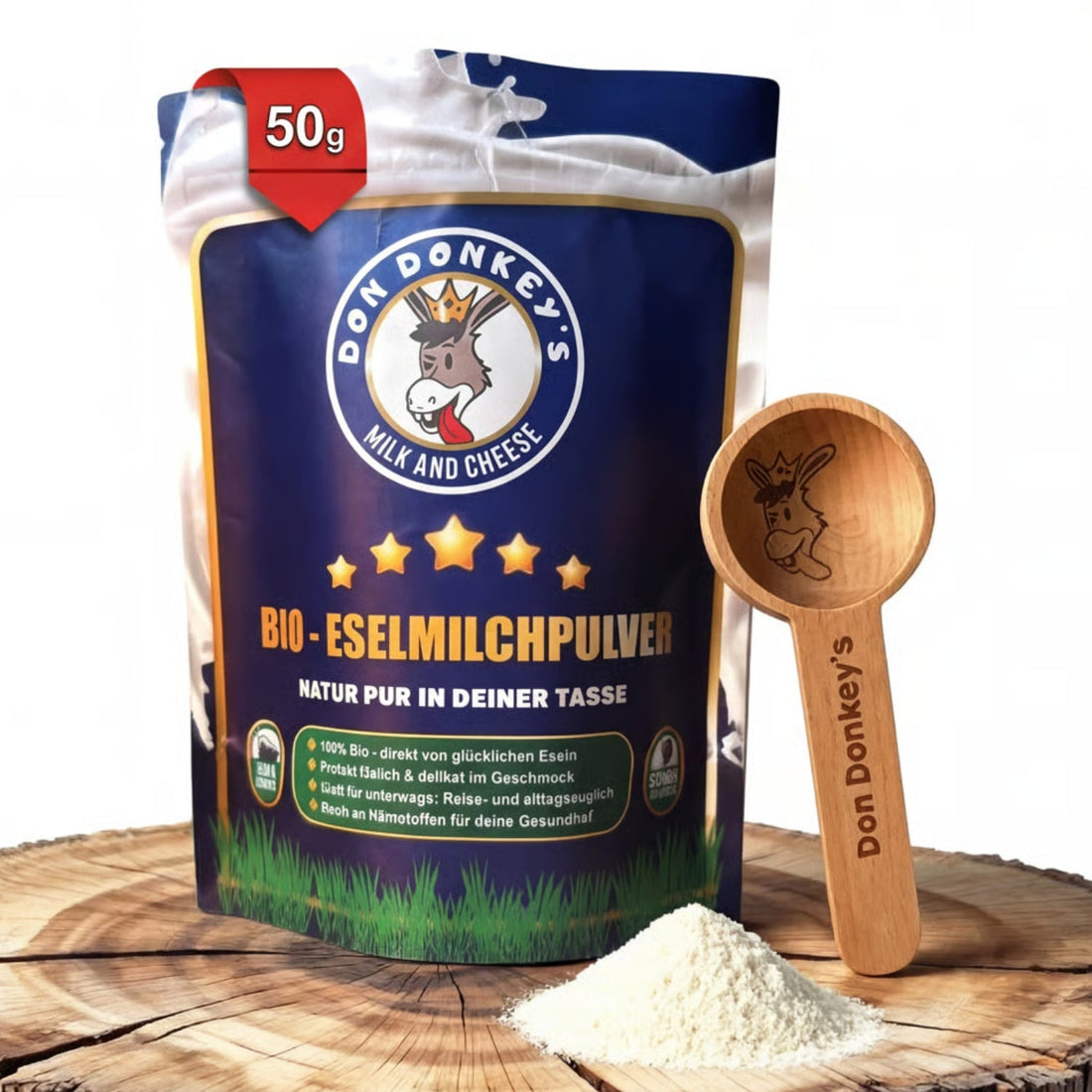
Donkey Milk Powder
Donkey milk in powder form
For anyone who prefers a longer shelf life: our donkey milk in powder form – easy to store and portion.
20g · Unit price: €1.245,00 / 1 kg · incl. VAT, plus shipping