
 Buyer protection

Research on donkey milk · Study 121
The jenny’s mammary gland: miRNA and mRNA compared
In mammary gland tissue of Liaoxi jennies, 3144 mRNAs and 293 miRNAs differed between lactation (day 60) and the dry period. Genes for caseins were around 17 to 18 times more active during lactation.
At a glance · swipe or use the arrows
The key figures
Study design
How it was studied
Six Liaoxi jennies on a breeding farm in Fuxin (Liaoning Province, China; 6.3 ± 1.2 years, 280.3 ± 20.1 kg, 2.1 ± 0.4 foalings) were kept under the same conditions. From three animals each in lactation (60 days after birth) and in the dry period (not lactating, not pregnant), a tissue sample of about 100 mg was taken from the right mammary gland under general anaesthesia. The tissue was examined histologically; mRNA and small RNA libraries were sequenced from the RNA. Differentially expressed mRNAs were counted from a twofold change and FDR < 0.05, miRNAs from a twofold change and p < 0.05. Target genes of the miRNAs were determined with two prediction methods, negatively correlated miRNA–mRNA pairs (r < −0.7) were linked into networks, and nine mRNAs and nine miRNAs were checked by qRT-PCR.
Interactive chart · values from the study
Differentially expressed transcripts in the mammary gland
Lactation (day 60) vs. dry period, n = 3 each (sections 3.2 and 3.3). mRNA: at least twofold change and FDR < 0.05; miRNA: at least twofold change and p < 0.05.
Second analysis
Genes for milk constituents: activity in lactation
Fold-change values from the discussion section (sequencing data, n = 3 each). β-lactoglobulin II (LGB2, 152.15-fold) not shown because of its different order of magnitude.
Results
What the study measured
Histologically, the lactating tissue showed large, dilated alveoli with milk secretion and little connective tissue. In the dry period, the alveoli were small with a narrow lumen, connective and adipose tissue increased, and the alveolar walls were thicker.
In the mRNA data (98.49–98.89 % usable reads, around 90 % mapped to the donkey genome), 3144 mRNAs differed between the groups: 987 were higher in lactation, 2157 lower. In addition, 536 novel mRNAs were described. The genes were distributed across 340 KEGG pathways, including ECM–receptor interaction, the PI3K-Akt signalling pathway, protein digestion and absorption, and arachidonic acid metabolism.
Among the miRNAs, 293 were differentially expressed (231 higher, 62 lower; 227 known, 66 novel). 35 of them were found only in the lactation group and 4 only in the dry group. Their predicted target genes (2979) were assigned, among others, to RNA polymerase, glycosphingolipid biosynthesis and glycerophospholipid metabolism.
Combining the two data sets gave 850 mRNAs with a pattern opposite to the miRNAs. A network relating to milk fat, milk protein, vitamins and immune function comprised 35 mRNAs and 20 miRNAs; the authors named novel-m0032-3p, miR-195, miR-26-5p, miR-23-3p, miR-674-3p and miR-874-3p as central miRNAs.
Genes more active in lactation included casein genes (CSN1S1 18.13-fold, CSN1S2 16.85-fold), cathepsins (CTSB 4.28-fold, CTSD 3.98-fold), genes of milk fat formation (CIDEA 26.16-fold, SREBF1 2.36-fold, TWF1 2.05-fold, XDH 2.02-fold) and genes of vitamin transport (TCN2 2.30-fold, CD320 3.51-fold). β-lactoglobulin II (152.15-fold) and immunoglobulin-related genes (IGHM 8.24-fold, PIGR 7.32-fold) were also elevated.
qRT-PCR testing of nine randomly selected mRNAs and nine miRNAs showed significant differences between the groups in the same direction as the sequencing.
Authors’ conclusion: In the view of Fei et al. (2022), differentially expressed miRNAs in the mammary gland of jennies regulate target genes associated with milk fat, milk protein and vitamin metabolism and with immune functions; they named novel-m0032-3p, miR-195 and miR-874-3p, among others, as central miRNAs. The authors saw this as a basis for improving the milk yield of jennies in future; the composition of the milk was not measured.
Critical assessment
Strengths and limitations
Very small groups
Only three animals of one breed from one farm were examined per state, and the lactation and dry groups consisted of different animals. Differences between individual animals therefore cannot be separated from the lactation state.
Thresholds of differing strictness
A correction for multiple testing (FDR) was applied for mRNAs, but only an uncorrected p-value for miRNAs. False-positive hits are therefore more likely among the 293 miRNAs.
Inconsistent labels
The non-lactating group is called “D” in the methods section and “N” in the results and figures. CSN1S2 is referred to in the text as “αs1-casein isoform X3”, although the gene is assigned to αs2-casein in the same paragraph.
No independent confirmation
qRT-PCR testing was carried out on the same six tissue samples. The miRNA target genes are computationally predicted and were not tested functionally; the fold-change values of individual genes are given only in the discussion section.
Milk itself not examined
Mammary gland tissue was analysed, not the milk. The authors’ further statements about properties of the milk are based on the literature; effects in humans were not the subject of the study.
First combined analysis
According to the authors, this is the first combined miRNA–mRNA analysis of the donkey mammary gland. Sequencing quality and mapping rates are documented in tables per sample, and the complete gene lists are available as supplementary material.
Editorial assessment: The study describes the basics of gene regulation in udder tissue and provides no measurements of the milk itself. No conclusions about constituents, effects in humans or individual commercial products can be drawn from it. To the research archive.
Research question for DON DONKEY’S®
Are the differences in gene activity found in the mammary gland reflected in measurable contents of caseins, fat and vitamins in the milk, and how does the miRNA pattern change over the whole lactation?
Original publication
An Integrated Analysis of Lactation-Related miRNA and mRNA Expression Profiles in Donkey Mammary Glands
Original title of the publication.
Fei Y., Gai Y., Liao Q., Zhang L., Li Z., Li B., Bai M., Li N., Deng L.
Genes · 2022 · 13(9), 1637
Department of Animal Genetics, Breeding and Reproduction and Department of Basic Veterinary Medicine, College of Animal Science and Veterinary Medicine, Shenyang Agricultural University, Shenyang, China
10.3390/genes13091637: 10.3390/genes13091637
Transparency: Foundation from the Department of Education of Liaoning Province, China (LSNFW201904). The authors declare no conflicts of interest. No product-related statement for DON DONKEY’S®.
Summarised and reviewed by the DON DONKEY’S editorial team on the basis of the original publication · as of October 2026
The study summarised above was carried out independently of DON DONKEY’S® and does not relate to our products. It serves solely to inform about the state of research.
DON DONKEY’S® donkey milk and donkey milk powder are foods. They are not intended to prevent, treat or cure any disease and do not replace medical advice.

From our shop
DON DONKEY’S® donkey milk
100 % donkey milk · raw milk, frozen
On this page we report the findings of a published study. Independently of that, you will find our donkey milk here: 100 % donkey milk, frozen as raw milk.
100 ml bottle / 100ml · Unit price: €249,00 / 1 l · incl. VAT, plus shipping
Also in our shop
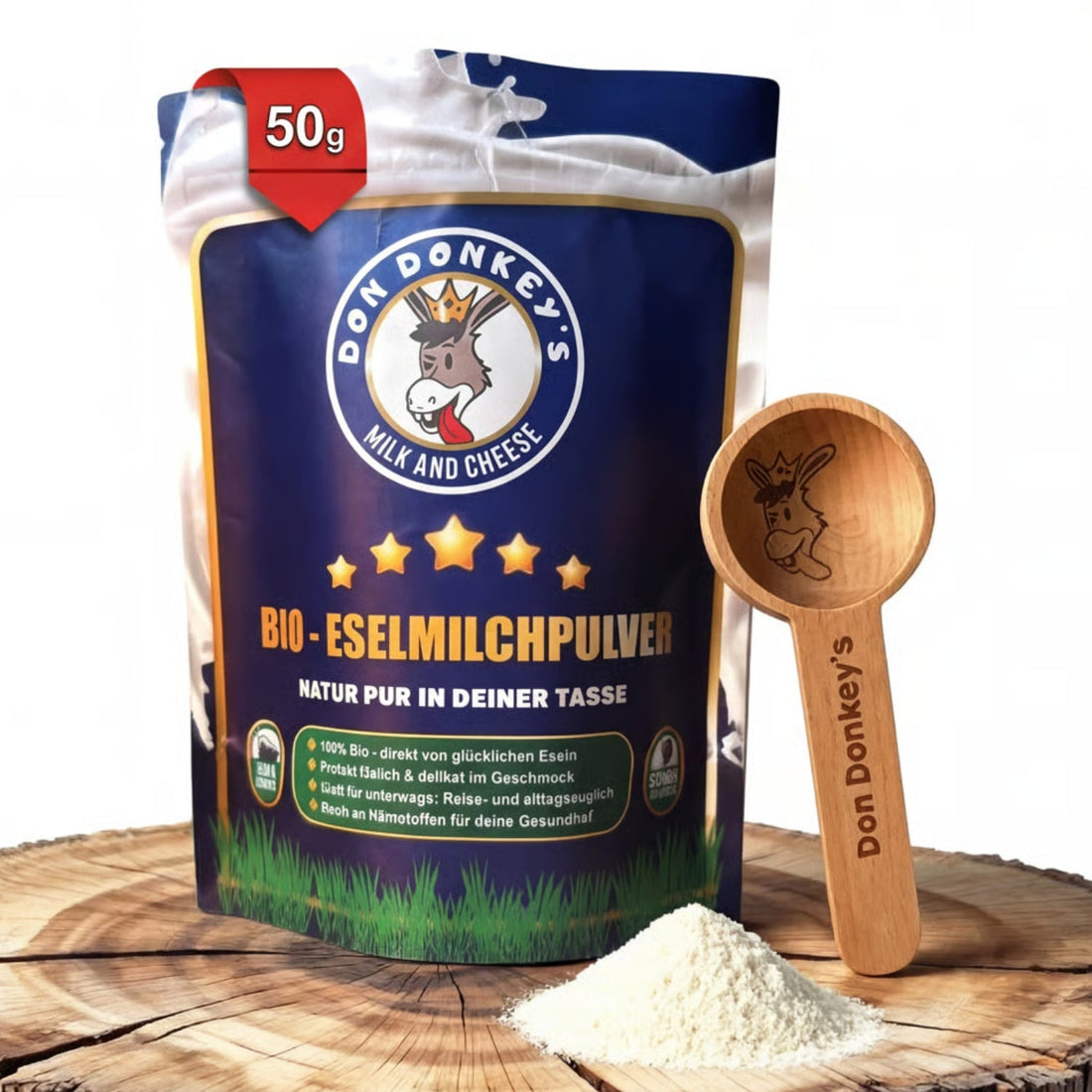
Donkey Milk Powder
Donkey milk in powder form
For anyone who prefers a longer shelf life: our donkey milk in powder form – easy to store and portion.
20g · Unit price: €1.245,00 / 1 kg · incl. VAT, plus shipping