
 Buyer protection

Research on donkey milk · Study 120
κ-casein gene from milk cells of Halari donkeys
DNA was obtained from 10 mL of milk each from ten Halari jennies; a 235 bp section of the κ-casein gene (CSN3) was detected in all samples. The sequence matched the reference by 99 %.
At a glance · tap the cards
The key figures
Study design
How it was studied
From ten lactating Halari jennies at the donkey milk unit of the ICAR-National Research Centre on Equines in Hisar (India), kept under the same husbandry and feeding conditions, about 10 mL of milk each was milked by hand, filtered and stored at 4 °C for 24 h until processing. The somatic milk cells were obtained by centrifugation (400 × g) and washed, and the DNA was isolated with a lysis and isopropanol precipitation method. A 235 bp fragment of the κ-casein gene (CSN3) was amplified by PCR (35 cycles, annealing at 57 °C), with GAPDH as the control gene. The products were checked by gel electrophoresis and Sanger-sequenced. Each sample was amplified in triplicate; the detection rate was compared with DNA from blood samples (chi-square test). In addition, CSN3 amino acid sequences from twelve species from a public database were compared in a phylogenetic tree (maximum likelihood, 1000 bootstrap replicates).
Interactive chart · values from the study
PCR programme for the κ-casein fragment
Details from the methods section (section on polymerase chain reaction); the middle three steps were repeated 35 times.
Second analysis
Sample size and replicates
Details from the data analysis and statistical analysis of samples sections; the number of blood samples for the comparison is not given.
Results
What the study measured
Genomic DNA could be obtained from all ten milk samples and appeared as a single clear band in gel electrophoresis. The authors therefore regarded milk as a non-invasive DNA source for molecular studies.
PCR gave a single band of 235 bp for the κ-casein gene (CSN3) in all samples, as well as the 100 bp fragment of the control gene GAPDH; according to the authors, no non-specific products occurred.
Sanger sequencing of the fragment showed 99 % agreement with the genomic reference sequence. This demonstrates the presence of the CSN3 gene in DNA obtained from milk cells of Halari donkeys.
The detection rate was 100 % for DNA from both milk and blood; there was no difference (chi-square test, P > 0.99).
In the phylogenetic tree of CSN3 amino acid sequences from twelve species, donkey, horse, zebra, camel and human grouped more closely together than with cattle, buffalo, yak, mithun, goat and sheep.
Authors’ conclusion: In the view of Singh et al. (2024), DNA can be obtained reliably and non-invasively from somatic milk cells of Halari jennies, and the κ-casein gene can be detected in it. The authors saw the method as a basis for further studies on milk protein genes and for the conservation of this endangered breed. Their further interpretation of the phylogenetic data was not tested experimentally in the study.
Critical assessment
Strengths and limitations
Contradiction in the abstractNote
The abstract contains the sentence that the κ-casein gene was not amplified from the DNA of the milk cells, and a few sentences later claims the opposite. Results and figures show successful amplification; the sentence is probably an editing error.
Gene detection, not a protein measurementClear limitation
Only the presence of a 235 bp gene fragment was examined (qualitative PCR). This says nothing about the amount or properties of κ-casein in the milk. The authors’ conclusion that the phylogenetic tree points to properties more similar to those in humans is not supported by the data.
Origin of the phylogenetic sequencesNote
According to the methods section, all amino acid sequences, including the donkey’s, come from a public database; the figure legend, by contrast, speaks of the sequence of the Halari donkey. No complete protein can be derived from the authors’ own fragment of only 235 bp.
Blood comparison barely describedNote
For the comparison with blood DNA, neither the number nor the origin of the blood samples is given. With 100 % detection in both groups, the chi-square test with P > 0.99 has little informative value.
Incomplete detailsNote
The conflict of interest statement announces details but gives none. Primers and conditions for the control gene GAPDH are missing, and “99 % complementarity” is an imprecise way of describing sequence agreement.
Non-invasive, open methodStrength
The DNA was obtained without blood sampling from milk obtained during regular milking. Ten animals with three replicates each, sequence confirmation and a publicly deposited data set make the procedure easy to follow.
Editorial assessment: The study is methodological laboratory work: it shows that DNA for genetic analyses can be obtained from a few millilitres of donkey milk. No statements about the κ-casein content of the milk, tolerance or effects in humans can be derived from it. To the research archive.
Research question for DON DONKEY’S®
How much κ-casein does the milk of Halari jennies actually contain at protein level, and are there variants in the CSN3 gene of this breed that are related to the composition or yield of the milk?
Original publication
Milk somatic cell DNA isolation and characterization of κ-casein gene in Halari donkey milk
Original title of the publication.
Singh P., Bhardwaj A., Nayan V., Legha R.A., Pal Y., Soni S., Giri S.K., Bhattacharya T.K.
Heliyon · 2024 · 10(2), e24991
ICAR-National Research Centre on Equines, Hisar, Haryana, India; ICAR-Central Institute for Research on Buffaloes, Hisar, India; Department of Biotechnology, Maharaja Agrasen University, Baddi, Himachal Pradesh, India
10.1016/j.heliyon.2024.e24991: 10.1016/j.heliyon.2024.e24991
Transparency: Indian Council of Agricultural Research (ICAR), Ministry of Agriculture and Farmers Welfare of the Government of India, via an institute grant of ICAR-NRCE (IXX15413) and the National Livestock Mission, DAHD (R300121112022-DADF-Dept-Part(l) (E-22977)). The statement in the paper announces the “following” possible competing interests but names none; a substantive statement is therefore missing. No product-related statement for DON DONKEY’S®.
Summarised and reviewed by the DON DONKEY’S editorial team on the basis of the original publication · as of October 2026
The study summarised above was carried out independently of DON DONKEY’S® and does not relate to our products. It serves solely to inform about the state of research.
DON DONKEY’S® donkey milk and donkey milk powder are foods. They are not intended to prevent, treat or cure any disease and do not replace medical advice.

From our shop
DON DONKEY’S® donkey milk
100 % donkey milk · raw milk, frozen
On this page we report the findings of a published study. Independently of that, you will find our donkey milk here: 100 % donkey milk, frozen as raw milk.
100 ml bottle / 100ml · Unit price: €249,00 / 1 l · incl. VAT, plus shipping
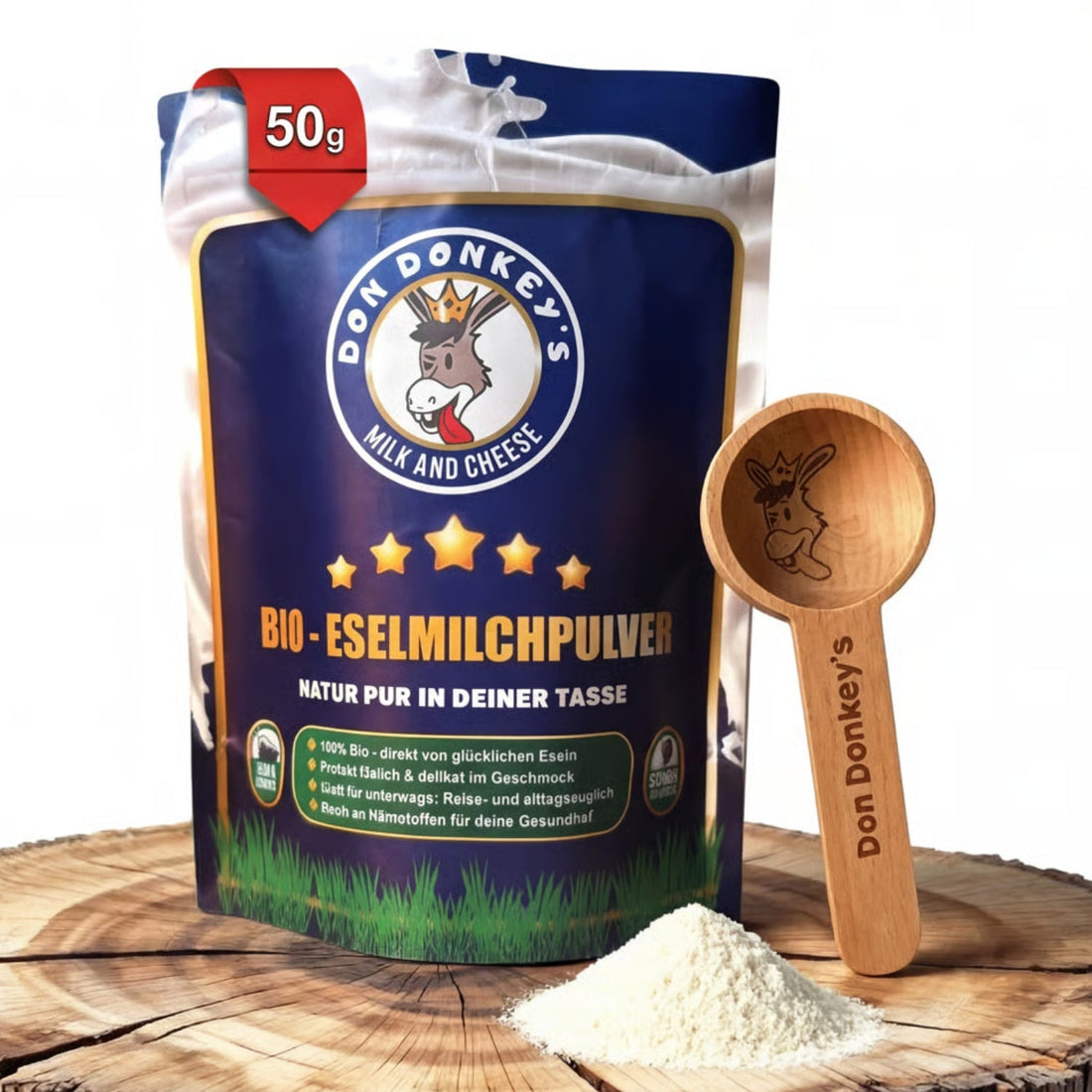
Also in our shop
Donkey Milk Powder
Donkey milk in powder form
For anyone who prefers a longer shelf life: our donkey milk in powder form – easy to store and portion.
20g · Unit price: €1.245,00 / 1 kg · incl. VAT, plus shipping