
 Buyer protection

Research on donkey milk · Study 12
A human milk fortifier made from donkey milk
In Turin, Bertino et al. conducted a randomised study with 156 preterm infants. Their mother's milk was fortified either with a newly developed fortifier made from donkey milk or with a standard fortifier based on cow's milk. It is the original study of the FortiLat series.
What it's about
How well is the new fortifier tolerated?
Very small preterm infants need more protein and energy than breast milk alone provides. In hospital, their mother's milk is therefore enriched with a fortifier. Standard fortifiers are based on cow's milk.
Researchers at the University of Turin and the Italian National Research Council CNR developed a fortifier made from donkey milk: FortiLat. This study tested whether preterm infants tolerated it better than the standard fortifier. Both groups received a comparable energy and protein intake.
FortiLat was produced from donkey milk by membrane filtration, heat treatment and freeze-drying and was not commercially available at the time of the study.
What exactly was studied?
Briefly explained
The terms used in this study
An additive used to enrich breast milk for preterm infants with protein, energy and minerals.
Here: a pause in feeding of at least 8 hours, for example because of vomiting or gastric residuals.
Necrotising enterocolitis – a serious bowel disease that mainly affects very small preterm infants.
The range in which the true effect plausibly lies. If it includes "no difference", the result is not significant.
156 preterm infants were randomly assigned to one of the two fortifiers: 77 donkey milk, 79 cow's milk.
For 21 days, the breast milk was fortified with the respective fortifier and continuously adjusted.
Intolerance, NEC, deaths, progression of feeding and growth were recorded.
Follow-up studies later examined growth and development at 18 months and allergies at school age.
Interactive · The data at a glance
Four views of 156 preterm infants
How was allocation done, what did the primary endpoint show, what did the secondary analyses show – and where was there no difference? Switch between the views.
Illustration of the values reported in the original publication with 95 % confidence intervals. The arrangement of the dots is schematic.
Key findings
What the researchers report
Fewer events – not significant
With the donkey milk fortifier these events occurred less often. However, the wide confidence interval includes "no difference".
Less vomiting and fewer bilious gastric residuals
In the donkey milk fortifier group there were fewer such episodes per infant. As several endpoints were tested, these findings should be read with caution.
No difference
Growth until discharge also did not differ between the groups.
The study was open-label (the allocation was known), was run in a single centre, and in the control group considerably fewer events occurred (24 %) than assumed in the planning (45 %). According to the publication, several authors are inventors of a patent on the donkey milk fortifier.
Critical assessment
An indication, not proof
What the study shows
What it does not show
Research question for DON DONKEY’S®
What separates a clinical raw material from a food?
FortiLat shows that a standardised specialty product can be made from donkey milk. The underlying technology has been filed for a patent by the University of Turin and CNR (WO2015056166, EP3057450B1). For us, this is a reason to document the quality of our milk precisely – and to draw a clear line between food and clinical nutrition.
Original publication
A Novel Donkey Milk–derived Human Milk Fortifier in Feeding Preterm Infants: A Randomized Controlled Trial
Bertino E., Cavallarin L., Cresi F., Tonetto P., Peila C., Ansaldi G., Raia M., Varalda A., Giribaldi M., Conti A., Antoniazzi S., Moro G. E., Spada E., Milani S., Coscia A.
Journal of Pediatric Gastroenterology and Nutrition · 2019 · 68(1):116–123
Neonatology, University of Turin, CNR-ISPA, CREA, Italian Association of Human Milk Banks, University of Milan
DOI: 10.1097/MPG.0000000000002168
Full text: PMC6314716
The publication describes a study with a specialty product for preterm infants. It does not allow any statement about donkey milk or donkey milk powder as a food or any product-related statement for DON DONKEY’S®.

From our shop
DON DONKEY’S® donkey milk
100 % donkey milk · raw milk, frozen
On this page we report the findings of a published study. Independently of that, you will find our donkey milk here: 100 % donkey milk, frozen as raw milk.
100 ml bottle / 100ml · Unit price: €249,00 / 1 l · incl. VAT, plus shipping
Also in our shop
Donkey Milk Powder
Donkey milk in powder form
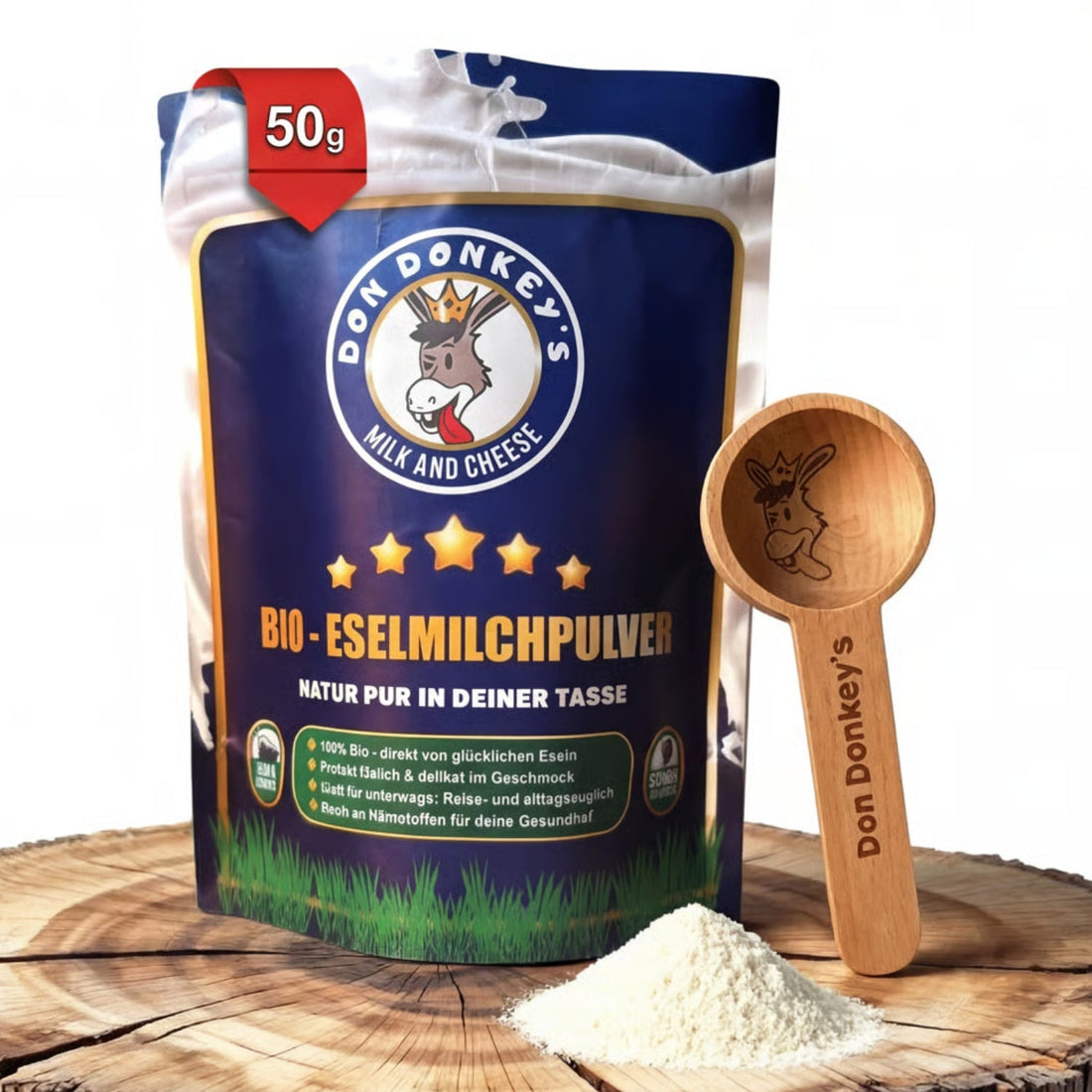
For anyone who prefers a longer shelf life: our donkey milk in powder form – easy to store and portion.
20g · Unit price: €1.245,00 / 1 kg · incl. VAT, plus shipping