
 Buyer protection

Research on donkey milk · Study 118
Analysis of miRNAs in the milk of four livestock species
In milk from 49 jennies from Lazio, miRNAs made up 7.74 % of the mapped small RNAs, compared with only 0.87–1.57 % in buffalo, goat and sheep. Only four miRNAs occurred in all four types of milk.
At a glance · tap the cards
The key figures
Study design
How it was studied
Individual milk samples from commercial farms in the Lazio region (Italy) were collected during routine machine milking: 49 jennies of the Amiata (n = 37) and Ragusana (n = 12) breeds from two farms (1st to 7th lactation, 2nd to 7th month of lactation) as well as goats (n = 498), sheep (n = 443) and water buffalo (n = 648) from five farms each. Donkeys, goats and sheep grazed with supplementary hay and grain. The samples were combined into pooled samples (donkey: 20) and from these into one overall pool per species (50 ml). RNA was isolated from 2 ml, small RNAs were sequenced and mapped to reference genomes (the horse genome for the donkey). Target genes were determined with two prediction programs and classified by GO and KEGG analysis; selected miRNAs were checked by qPCR.
Interactive chart · values from the study
miRNA share of annotated RNA by type of milk
Values from the results section (Figure 1B); one pooled sequencing run per species without biological replication.
Second analysis
The four shared miRNAs compared by species
Rounded shares from the results text on Figure 3; one pooled sample per species.
Results
What the study measured
After quality filtering, 9,385,067 reads remained for donkey milk; at 94.6 %, the highest share could be mapped to the reference genome here (buffalo 92 %, goat 89.3 %, sheep 84.8 %).
The miRNA share of annotated RNA in donkey milk was 7.74 %, well above buffalo (0.87 %), goat (1.57 %) and sheep (1.12 %). 130 miRNAs were identified in donkey milk, 132 in goat’s, 83 in buffalo and 43 in sheep’s milk.
Only four miRNAs – miR-200a, miR-200b, miR-200c and miR-23a – occurred in all four types of milk. miR-200a made up 15 % of all miRNA reads in donkey milk (sheep 11 %, buffalo 6 %, goat 5 %); miR-200b and miR-200c were also proportionally most frequent in donkey milk, whereas miR-23a was most frequent in goat’s milk.
Other miRNAs such as miR-148a, let-7c, miR-29a, miR-30d, miR-143 and miR-221 were found in donkey, goat and buffalo milk but not in sheep’s milk; miR-194 occurred in donkey, goat and sheep’s milk. In donkey milk, the authors also named miR-21, let-7c and miR-22.
135 possible target genes were predicted for the donkey miRNAs (buffalo 121, sheep 132, goat 55). Across all species, the GO and KEGG analyses assigned the target genes mainly to metabolic, developmental and immune signalling pathways; these are computational predictions, not measured effects.
According to the authors, qPCR testing of selected miRNAs showed the same direction as the sequencing data; numerical values are available only as a figure.
Authors’ conclusion: In the view of Cendron et al. (2024), milk from all four species contains both miRNAs occurring across species and species-specific miRNAs, with donkey milk showing the highest miRNA share. The authors suspected that the predicted target genes are related to the development, adaptation, growth and immune response of the young animals and to performance traits of the livestock, and considered studies on individual animals taking lactation stage, age and parity into account to be necessary.
Critical assessment
Strengths and limitations
One pool per species
All donkey samples were combined into a single pool and sequenced once. There are therefore no biological replicates and no statistics on differences between species; influences of breed, lactation stage or farm cannot be separated. The authors themselves recommend studies on individual animals.
Horse genome as reference
The donkey reads were mapped to the horse genome, the buffalo reads to the cattle genome. Donkey-specific miRNAs may therefore be missed or misassigned; the high mapping rate should be read with this limitation in mind.
Contradictory group counts
The goat–donkey–buffalo combination is mentioned twice in the results section (with 10 and 11 miRNAs), while the discussion speaks of 12. It also mentions “10 miRNAs in all four species”, although according to the Venn diagram only four are shared.
Further inconsistencies
According to the results section, donkey milk had the most miRNAs, but the figures given show 132 for goat and 130 for donkey. miR-22-3p is described as missing in donkey milk, while elsewhere the presence of miR-22 in donkey milk is confirmed. The normalisation is called RPKM but described as reads per million.
Functions only predicted
Target genes and signalling pathways are based on computer predictions. The authors’ statements about importance for immune defence, growth or development of the young animals and about uptake of miRNAs via food were not tested experimentally; effects in humans were not the subject of the study.
Broad sample base, open data
The pools are based on individual samples from over 1600 animals from 17 farms, for donkey on 49 animals of two breeds. All four species were analysed with the same method, selected results were checked by qPCR, and the raw data are publicly deposited.
Editorial assessment: The study describes which small RNA molecules can be detected in pooled raw milk from Italian jennies, compared with three ruminant species. The functional information is predicted; no conclusions about effects in humans or individual commercial products can be drawn from it. To the research archive.
Research question for DON DONKEY’S®
How much do the miRNA share and the miR-200 family vary in the milk of individual jennies depending on breed, month of lactation and feeding, and does the high miRNA share persist when a donkey genome is used as the reference?
Original publication
Analysis of miRNAs in milk of four livestock species
Original title of the publication.
Cendron F., Rosani U., Franzoi M., Boselli C., Maggi F., De Marchi M., Penasa M.
BMC Genomics · 2024 · 25, 859
Department of Agronomy, Food, Natural Resources, Animals and Environment (DAFNAE) and Department of Biology, University of Padova; Istituto Zooprofilattico Sperimentale del Lazio e della Toscana “M. Aleandri”, Rome; Azienda Sanitaria Locale Roma 4, Italy
10.1186/s12864-024-10783-4: 10.1186/s12864-024-10783-4
Transparency: open-access funding by the Università degli Studi di Padova; no other funding is mentioned. The authors declare no conflicts of interest. No product-related statement for DON DONKEY’S®.
Summarised and reviewed by the DON DONKEY’S editorial team on the basis of the original publication · as of October 2026
The study summarised above was carried out independently of DON DONKEY’S® and does not relate to our products. It serves solely to inform about the state of research.
DON DONKEY’S® donkey milk and donkey milk powder are foods. They are not intended to prevent, treat or cure any disease and do not replace medical advice.

From our shop
DON DONKEY’S® donkey milk
100 % donkey milk · raw milk, frozen
On this page we report the findings of a published study. Independently of that, you will find our donkey milk here: 100 % donkey milk, frozen as raw milk.
100 ml bottle / 100ml · Unit price: €249,00 / 1 l · incl. VAT, plus shipping
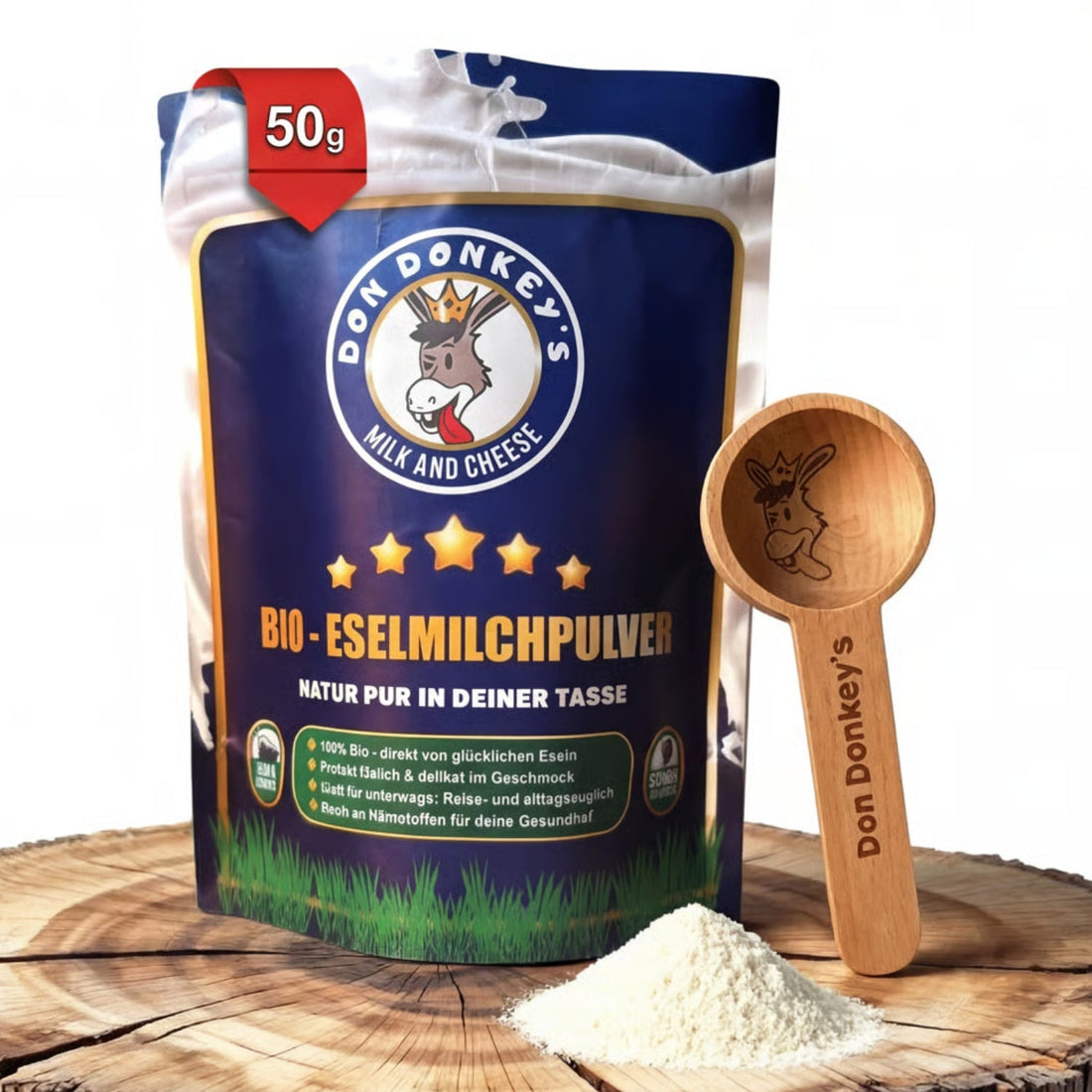
Also in our shop
Donkey Milk Powder
Donkey milk in powder form
For anyone who prefers a longer shelf life: our donkey milk in powder form – easy to store and portion.
20g · Unit price: €1.245,00 / 1 kg · incl. VAT, plus shipping