
 Buyer protection

Research on donkey milk · Study 116
Aroma compounds in donkey, yak, camel, goat and cow milk powders
Five milk powders made in the laboratory were compared with two methods: 55 and 86 volatile compounds were recorded. 58 of the 86 compounds were found in the donkey milk powder, 25 of them only there, including several ethyl esters.
At a glance · tap the cards
The key figures
Study design
How it was studied
One batch of raw milk each from yak, donkey, camel, goat and cow was obtained directly from producers in different regions of China in May 2024; the donkey milk came from a breeding cooperative near Jinan (Shandong Province). All samples were pasteurised uniformly (72–80 °C, 15 s), freeze-dried in the laboratory and stored at −80 °C. The volatile compounds were determined by headspace gas chromatography–ion mobility spectrometry (HS-GC-IMS) and by headspace solid-phase microextraction plus gas chromatography–mass spectrometry (HS-SPME-GC–MS, internal standard ethyl decanoate), each in triplicate. The analysis included PCA, cluster analyses and OPLS-DA and PLS-DA with permutation tests; substances with VIP > 1 and p < 0.05 were regarded as key compounds.
Interactive chart · values from the study
Number of volatile compounds detected per milk powder
Editorial count of the HS-SPME-GC–MS values from Table 2 (entries other than “ND”). The text gives different figures of 24 (donkey), 4 (camel) and 1 (cow) compounds that occur in only one powder.
Second analysis
Short- and medium-chain fatty acids in the powder comparison
Means of triplicate measurements (HS-SPME-GC–MS), Table 2. Butanoic acid was not detected in the donkey milk powder (cow: 2520).
Results
What the study measured
HS-GC-IMS recorded 55 signals, 53 of them identified; several substances appeared as monomer and dimer signals. According to the fingerprint plot, 1-butanol, 2,6-dimethylpyrazine, 4-methyl-3-penten-2-one, butyl isobutyrate, 1-propanol and hexanal, among others, were higher in the donkey milk powder than in the other powders.
By peak volume, donkey and yak milk powders contained the highest shares of ketones and esters. In the PCA of the GC-IMS data (PC1 47 %, PC2 25 %), donkey and yak separated clearly from camel, goat and cow, which lay close together.
HS-SPME-GC–MS found 86 compounds, 15 of them in all powders. According to Table 2, 58 compounds were detectable in the donkey milk powder, more than in the other powders (34–39).
Compounds occurring only in the donkey milk powder included ethyl octanoate (872), hexanal (622), ethyl decanoate (268), 1-octen-3-ol (83.9), (E)-2-heptenal (78.0), nonanal (54.8), (E,E)-2,4-nonadienal (53.7) and ethyl laurate (47.9). Butanoic acid, with 2520 the highest single value in the cow’s milk powder, was not detected in the donkey milk powder.
Long-chain alkanes such as pentadecane (535 vs. 1502–3963) and hexadecane (650 vs. 1612–4065) were well below the values of camel, goat and cow milk powders in the donkey milk powder. Hexanoic, octanoic and decanoic acid were markedly lower in the donkey milk powder than in camel and cow milk powders (hexanoic acid 302 vs. 1891 each) but of a similar order of magnitude to yak and goat.
OPLS-DA models of both methods separated all five powders (R² 0.979 and 0.986; Q² 0.942 and 0.933; 200 permutation tests each). The authors identified 27 (GC-IMS) and 24 (GC–MS) substances as key compounds; only three compounds were recorded by both methods.
Authors’ conclusion: In the view of Zhou et al. (2025), the five milk powders differed clearly in the type and amount of their volatile compounds; donkey and yak milk powders stood out from camel, goat and cow milk powders mainly through esters and ketones. The authors saw the combination of both methods as a basis for classifying milk powders and detecting adulteration; sensory evaluation or statements about effects were not the subject of the study.
Critical assessment
Strengths and limitations
Only one batch of milk from one producer was examined per species; the triplicate measurements are technical replicates. Differences may therefore also be due to origin, feeding, lactation stage or sampling, and the model quality of the OPLS-DA is based on very few independent samples.
According to the text, 17 substances occurred as monomer and dimer (18 are listed); Table 1 contains 19 such pairs. The PCA is said to be based on “85” compounds identified by GC-IMS, although only 55 signals were recorded.
Text and Venn diagram give 24, 7, 4, 1 and 1 compounds occurring only in donkey, yak, camel, goat and cow milk powder respectively. According to Table 2, the figures are 25, 7, 5, 1 and 2. For individual compounds, too, the details of their distribution across the powders differ between text and table.
No unit is given for the GC–MS values in Table 2, although an internal standard was used. Several database assignments are not plausible for milk aroma and are not discussed in the paper.
All samples were pasteurised and freeze-dried uniformly. The results therefore describe this laboratory process and cannot be transferred directly to commercial powders with other processing or to fresh milk. No sensory test was carried out.
The combination of GC-IMS and GC–MS with uniform sample preparation allows a direct comparison of the five types of milk. Table 2 documents all 86 GC–MS compounds with mean and standard deviation, and the models were checked with permutation tests.
Editorial assessment: The study provides an analytical aroma profile of laboratory freeze-dried donkey milk powder compared with four other types of milk. As only one batch was examined per species, the values are suitable as initial orientation, not as general characteristics of donkey milk powder or individual commercial products. To the research archive.
Research question for DON DONKEY’S®
Do the ethyl esters and aldehydes found in donkey milk powder remain stable as distinguishing features when milk from many farms, seasons and lactation stages and different drying and storage conditions are included?
Original publication
Differentiation and characterization of volatile compounds in five common milk powders using HS-GC-IMS, HS-SPME-GC–MS, and multivariate statistical approaches
Original title of the publication.
Zhou Y., Wang D., Zhao J., Guo Y., Yan W.
Food Chemistry: X · 2025 · 25, 102179
College of Biochemical Engineering and Beijing Key Laboratory of Bioactive Substances and Functional Food, Beijing Union University, Beijing; Institute of Apicultural Research, Chinese Academy of Agricultural Sciences, Beijing, China
10.1016/j.fochx.2025.102179: 10.1016/j.fochx.2025.102179
Transparency: National Key Research and Development Program of China (2023YFF1103802). The authors declare no competing financial interests or personal relationships that could have influenced the work. No product-related statement for DON DONKEY’S®.
Summarised and reviewed by the DON DONKEY’S editorial team on the basis of the original publication · as of October 2026
The study summarised above was carried out independently of DON DONKEY’S® and does not relate to our products. It serves solely to inform about the state of research.
DON DONKEY’S® donkey milk and donkey milk powder are foods. They are not intended to prevent, treat or cure any disease and do not replace medical advice.

From our shop
DON DONKEY’S® donkey milk
100 % donkey milk · raw milk, frozen
On this page we report the findings of a published study. Independently of that, you will find our donkey milk here: 100 % donkey milk, frozen as raw milk.
100 ml bottle / 100ml · Unit price: €249,00 / 1 l · incl. VAT, plus shipping
Also in our shop
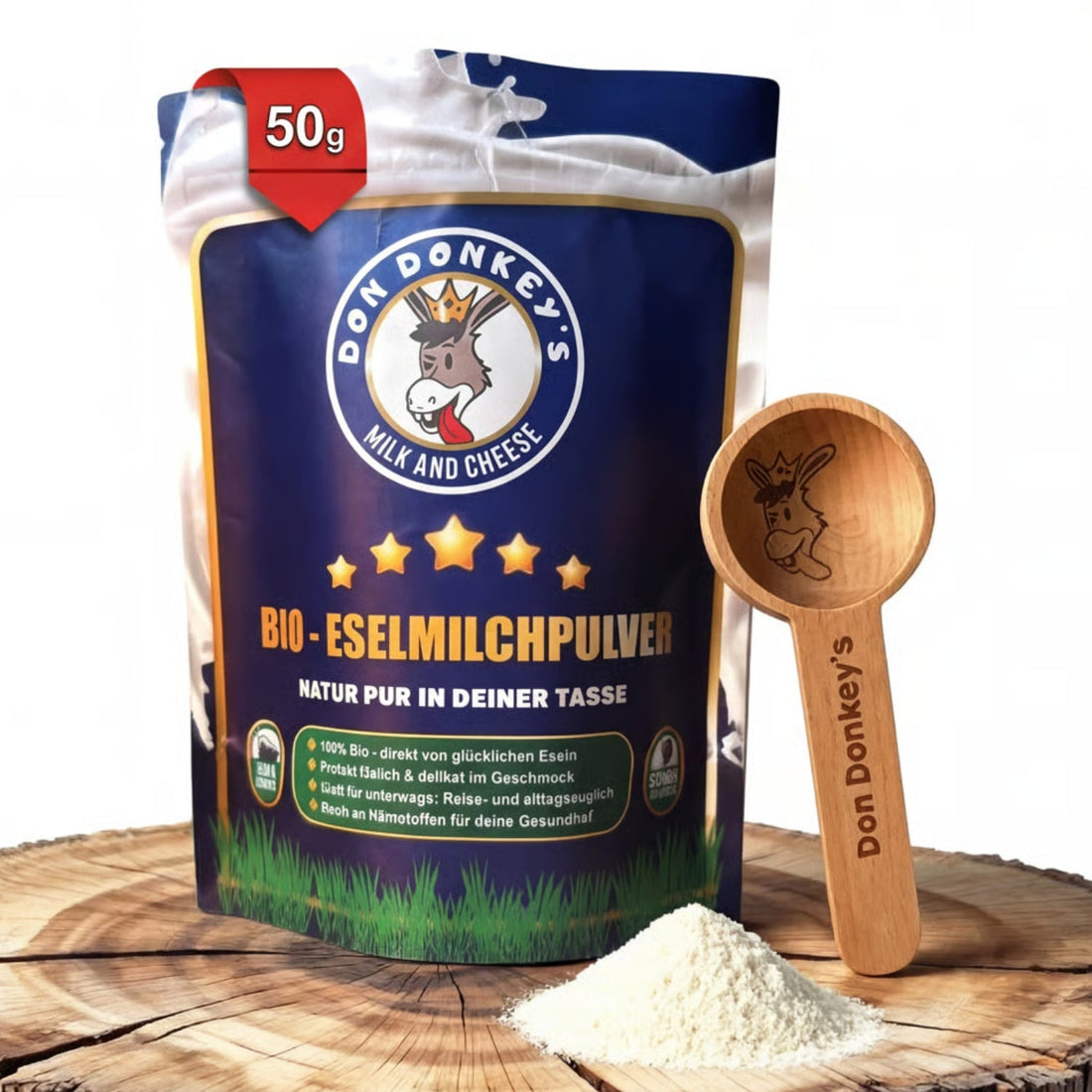
Donkey Milk Powder
Donkey milk in powder form
For anyone who prefers a longer shelf life: our donkey milk in powder form – easy to store and portion.
20g · Unit price: €1.245,00 / 1 kg · incl. VAT, plus shipping