
 Buyer protection

Research on donkey milk · Study 115
Lipid profiles of ten types of milk compared
640 lipids were recorded in raw milk from eight species. Donkey milk had the lowest fat content at 0.52 %; with the same sample volume, 548 of the 640 lipids were lower than in Holstein milk.
At a glance · swipe or use the arrows
The key figures
Study design
How it was studied
Raw milk from ten types of milk from eight species was examined: camel (two dairies in Xinjiang), mare and goat (Xinjiang), donkey and Jersey cow (different dairies in Hebei), buffalo (Guangxi), yak (Qinghai and Hongyuan yak milk from Sichuan) and Holstein cow (Inner Mongolia), with six replicates each. Total fat content was determined gravimetrically after solvent extraction. For lipidomics, 80 µL of milk each was extracted with an internal standard and measured by ultra-high-performance liquid chromatography with high-resolution mass spectrometry in positive and negative ion mode; annotation used a lipid database. The analysis included principal component and PLS-DA analysis, cluster analysis, correlations and volcano plots (VIP > 1, p < 0.01, fold change > 2), mostly with Holstein milk as the reference.
Interactive chart · values from the study
Total fat content of the raw milk
Values from sections 3.2 and 4.1 (Figure 1); yak (3.59–3.91 %) without clear assignment and mare without a figure in the text are not shown; the assignment of the two camel values to their origins is not clear in the text.
Second analysis
Significantly differing lipids in pairwise comparisons with donkey milk
Section 3.4, Figures 6d, 7c and 7d. For Holstein vs. donkey, the text gives only the 548 lipids lower in donkey milk. Same sample volume, therefore strongly influenced by fat content.
Results
What the study measured
Total fat content ranged from 8.01 % in buffalo milk through 4.91 and 5.03 % in camel milk, 4.30 % (Jersey) and 3.86 % (Holstein) to 3.75 % (goat) and 3.59–3.91 % (yak). Mare’s and donkey milk were markedly lower; for donkey milk, the discussion gives 0.52 %.
Across all samples, 640 lipid species were identified, including triglycerides, phospholipids, sphingolipids, ceramides and wax esters; triglycerides were the most frequent class in all types of milk. For donkey milk, the authors described relatively high signals of cholesteryl esters, LBPA and primary fatty acid amides, while ceramides and monoglycerides were barely detectable in some samples.
In the principal component analysis (PC1 59.8 %, PC2 20.3 %), donkey and mare’s milk were close together, camel milk formed its own group, and buffalo milk was furthest away. In the cluster analysis of the 50 strongest differences, however, donkey and mare’s milk did not group together, which the authors attributed to the low fat content of donkey milk.
Compared with Holstein milk, 548 of 640 lipids were significantly lower in donkey milk; only a few triglycerides with polyunsaturated fatty acid residues were higher. Compared with mare’s milk, 463 lipids differed (460 higher in mare’s milk), and compared with goat’s milk, 551 (530 higher in goat’s milk).
Between the two camel milks (164 lipids) and the two yak milks (262 lipids), the differences were smaller than between species; for Hongyuan yak milk, the authors named LPC (O-16:0) as a possible marker of origin.
Authors’ conclusion: In the view of Wei et al. (2025), the lipid profiles of the types of milk examined differed clearly between species and only moderately within a species. They described donkey milk as very low in fat with little lipid diversity. The authors saw lipid markers such as LPC (O-16:0) as an approach to verifying origin, for example for Hongyuan yak milk; health effects were not examined.
Critical assessment
Strengths and limitations
Comparison at equal volume
All samples were extracted with the same milk volume (80 µL), and missing values were replaced with half the detection limit. The many “lower” lipids in donkey milk therefore mainly reflect the low fat content and hardly the composition of the milk fat.
Origin of the donkey milk barely described
For the donkey milk, only “dairies in Hebei” are mentioned. Breed, number of animals, lactation stage and feeding are missing; whether the six replicates are individual animals, tank milk or repeat measurements remains open.
Abstract and results contradict each other
The abstract describes donkey milk as rich in cholesteryl esters and polyunsaturated fatty acids. The results show 548 of 640 lipids lower than in Holstein milk, and fatty acids were not measured separately; statements on fatty acid ratios come from the literature.
Inconsistent figures and details
The methods section speaks of ten species, the abstract and conclusion of eight. In the mare–donkey comparison, the text mentions three lower lipids but then lists four. The fat content of donkey milk (0.52 %) appears only in the discussion, and that of mare’s milk not at all as a figure.
Application statements not examined
The authors’ recommendations on the suitability of individual types of milk for particular diets or products are based on the literature and were not tested in the study.
Broad comparison with variants of origin
Ten types of milk were measured with the same method, including two origins each of camel and yak milk. The peak areas of all 640 lipids are published as supplementary material.
Editorial assessment: The study provides a broad lipid comparison, but donkey milk is described only roughly. Because the samples were compared by volume rather than by amount of fat, the results mainly show the low fat content of donkey milk. No statements about effects or individual commercial products can be derived from it. To the research archive.
Research question for DON DONKEY’S®
How does the lipid profile of donkey milk differ from that of other types of milk when the samples are normalised to the same amount of fat rather than the same milk volume?
Original publication
Non-Targeted Lipidomics Analysis of Characteristic Milk Using High-Resolution Mass Spectrometry (UHPLC-HRMS)
Original title of the publication.
Wei T., Zhou T., Zhang S., Quan Z., Liu Y.
Foods · 2025 · 14(12), 2068
Key Laboratory of Milk and Dairy Products Detection and Monitoring Technology, State Administration for Market Regulation, Shanghai Institute of Quality Inspection and Technical Research, Shanghai, China; Fudan Microbiome Center, School of Life Sciences, Fudan University, Shanghai, China
10.3390/foods14122068: 10.3390/foods14122068
Transparency: Science and Technology Project of the Shanghai Institute of Quality Inspection and Technical Research (KY-2024-2-SP). The authors declare no conflicts of interest. No product-related statement for DON DONKEY’S®.
Summarised and reviewed by the DON DONKEY’S editorial team on the basis of the original publication · as of October 2026
The study summarised above was carried out independently of DON DONKEY’S® and does not relate to our products. It serves solely to inform about the state of research.
DON DONKEY’S® donkey milk and donkey milk powder are foods. They are not intended to prevent, treat or cure any disease and do not replace medical advice.

From our shop
DON DONKEY’S® donkey milk
100 % donkey milk · raw milk, frozen
On this page we report the findings of a published study. Independently of that, you will find our donkey milk here: 100 % donkey milk, frozen as raw milk.
100 ml bottle / 100ml · Unit price: €249,00 / 1 l · incl. VAT, plus shipping
Also in our shop
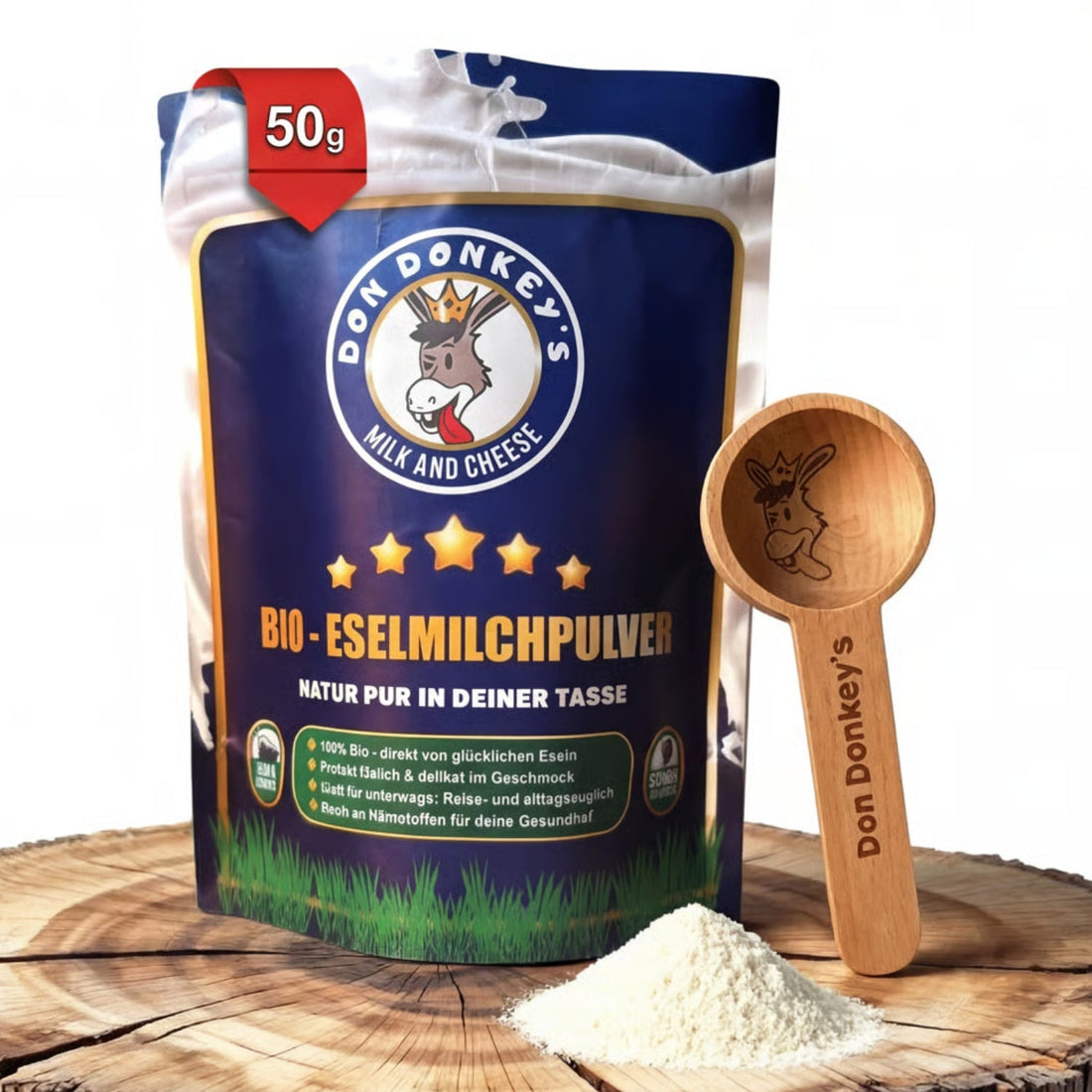
Donkey Milk Powder
Donkey milk in powder form
For anyone who prefers a longer shelf life: our donkey milk in powder form – easy to store and portion.
20g · Unit price: €1.245,00 / 1 kg · incl. VAT, plus shipping