
 Buyer protection

Research on donkey milk · Study 114
Lipidomics and positional distribution of fatty acids in the milk of nine mammalian species
683 lipids were recorded in milk from nine species. In the triglycerides of donkey milk, polyunsaturated fatty acids were 26.90 mol% (human milk 29.96, cow’s milk 3.17 mol%).
At a glance · tap the cards
The key figures
Study design
How it was studied
Mature pooled milk from Holstein cow, buffalo, yak, goat, sheep, camel, mare and donkey, as well as pooled human milk (18 donors, 3–6 months after birth) from China, was examined, with three biological replicates each. The donkey milk came from the collecting tank of a cooperative; each replicate comprised milk from about 10–20 lactating animals. The lipid molecules were recorded relatively by liquid chromatography–tandem mass spectrometry. From the isolated triglyceride fraction, the fatty acids were determined in mol% by gas chromatography–mass spectrometry; the distribution between the middle (sn-2) and outer positions (sn-1/3) was determined by enzymatic, position-specific cleavage. Differential lipids were determined against human milk (fold change > 2 or < 0.5, p < 0.05, VIP > 1); similarity to human milk was assessed with a Bray–Curtis-based index.
Interactive chart · values from the study
Fatty acid groups in the triglycerides
Means (n = 3) from Table 2 of the study; short-chain C1–C6, medium-chain C7–C14.
Second analysis
Similarity to human milk by lipid molecules
Values from the results text on Figure 5; a computational comparison of composition, not a statement about suitability for particular diets.
Results
What the study measured
In total, 683 lipid molecules from five main categories and 25 subclasses were recorded; by number, glycerolipids dominated (67.5 %), followed by glycerophospholipids (17.3 %), sphingolipids (6.7 %), free fatty acids (4.5 %) and sterol lipids (4.0 %). In all types of milk, triglycerides were the most frequent subclass.
In principal component analysis, the ruminant milks overlapped, while camel, mare, donkey and human milk formed separate groups; mare and donkey milk were close together. Compared with human milk, 157 differential lipids were found in donkey milk, mostly with a higher relative amount in the animal milk.
In the triglycerides of donkey milk, even-chain saturated fatty acids were 40.05 mol%, close to human milk (37.62 mol%) and well below Holstein and goat’s milk (69.87 and 69.63 mol%). Polyunsaturated fatty acids reached 26.90 mol%, almost entirely linoleic acid (25.67 mol%); α-linolenic acid was 0.83 mol% (mare’s milk 16.75 mol%).
Short-chain fatty acids made up 1.31 mol% in donkey milk and 10.34–23.08 mol% in ruminant milk; in all species they were preferentially at the outer positions. In donkey milk, 47.21 % of palmitic acid was at the middle sn-2 position (human milk 55.48 %); oleic and linoleic acid, by contrast, were preferentially at the outer positions.
Branched-chain and odd-chain fatty acids occurred in donkey milk only in small amounts (0.13 and 0.35 mol%) but were 73.56 % and 76.89 % at the sn-2 position.
In the similarity index to human milk, donkey milk came first in all three sub-scores: lipid molecules 0.25, triglyceride fatty acids 0.66, sn-2 fatty acids 0.73; in the overall score, 0.55, ahead of mare’s milk (0.48) and the ruminant milks (0.41–0.44).
Authors’ conclusion: In the view of Chen et al. (2026), the milk lipids of ruminants resemble one another, while camel, mare and donkey milk show their own profiles. In terms of lipid molecules and sn-2 fatty acids, donkey milk was computationally the most similar to the fat profile of human milk, followed by mare’s milk. The authors saw their data as a reference for evaluating animal milks and for developing fat blends; effects were not examined.
Critical assessment
Strengths and limitations
Three pooled samples per species
Only three pooled samples were available per type of milk, for donkey from a cooperative with 10–20 animals per sample. Breed, lactation stage and feeding are not given, and it remains unclear which of the three regions of origin mentioned the donkey milk belongs to.
Abstract differs from Table 3
According to the abstract, long-, medium-, odd- and branched-chain fatty acids prefer the sn-2 position. According to Table 3, however, long-chain fatty acids in donkey, human, mare, goat and camel milk were preferentially at the outer positions (donkey 31.80 % at sn-2, below the random value of 33.3 %). In addition, palmitic acid was also at sn-2 more often than by chance in cow, buffalo, yak and goat milk (36.62–48.56 %), although the abstract describes the opposite pattern for ruminants.
Similarity index described unclearly
The results text speaks of six groups, the methods section of three evaluation groups. For the overall score, ruminants are given only as a range. The index describes fat composition computationally and says nothing about tolerance or suitability for infants.
Relative lipid amounts
The lipidomics is based on relative signal intensities; the fatty acids are given as mol% of the triglycerides, not as content per litre of milk. The raw data are available only on request.
Functional interpretations not tested
The authors’ statements about fat absorption, calcium availability or development in infants are based on the literature and were not examined in this study.
One method for nine types of milk
All types of milk were analysed in the same laboratory using an identical procedure, including position-specific fatty acid analysis and statistical testing of positional preference. The tables give means with standard errors for all fatty acids.
Editorial assessment: The study provides comparative measurements of fat composition and the position of fatty acids in the triglyceride for donkey milk and eight other types of milk. The similarity index is a purely computational comparison of compositions. No statements about effects, infant nutrition or individual commercial products can be derived from it. To the research archive.
Research question for DON DONKEY’S®
How stable is the positional distribution of fatty acids in donkey milk across lactation stages, breeds and feeding when individual animals rather than pooled milk are examined?
Original publication
Lipidomics and fatty acid positional distribution in milk from nine mammalian species
Original title of the publication.
Chen M., Lu S., Song L., Zhang J., Qi Y., Zhao X., Zheng N., Zhang Y., Wang J.
npj Science of Food · 2026 · 10, 329
Key Laboratory of Quality & Safety Control for Milk and Dairy Products, Laboratory of Quality and Safety Risk Assessment for Dairy Products and State Key Laboratory of Animal Nutrition and Feeding, Institute of Animal Science, Chinese Academy of Agricultural Sciences, Beijing, China
10.1038/s41538-026-00954-w: 10.1038/s41538-026-00954-w
Transparency: National Key R&D Program of China (2022YFD1600104), Agricultural Science and Technology Innovation Program (ASTIP-IAS12) and China Agriculture Research System (CARS-36). The authors declare no competing interests. No product-related statement for DON DONKEY’S®.
Summarised and reviewed by the DON DONKEY’S editorial team on the basis of the original publication · as of October 2026
The study summarised above was carried out independently of DON DONKEY’S® and does not relate to our products. It serves solely to inform about the state of research.
DON DONKEY’S® donkey milk and donkey milk powder are foods. They are not intended to prevent, treat or cure any disease and do not replace medical advice.

From our shop
DON DONKEY’S® donkey milk
100 % donkey milk · raw milk, frozen
On this page we report the findings of a published study. Independently of that, you will find our donkey milk here: 100 % donkey milk, frozen as raw milk.
100 ml bottle / 100ml · Unit price: €249,00 / 1 l · incl. VAT, plus shipping
Also in our shop
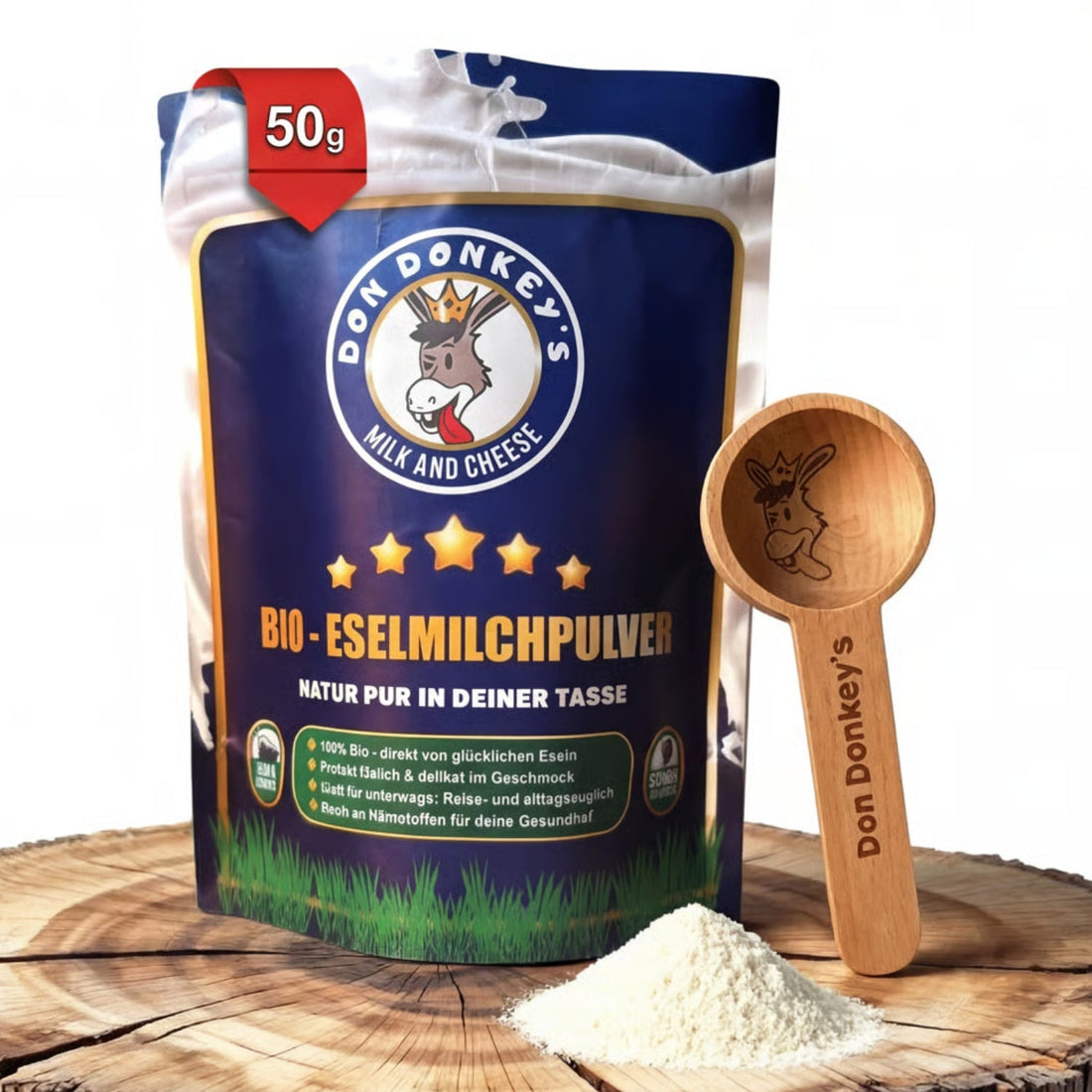
Donkey Milk Powder
Donkey milk in powder form
For anyone who prefers a longer shelf life: our donkey milk in powder form – easy to store and portion.
20g · Unit price: €1.245,00 / 1 kg · incl. VAT, plus shipping