
 Buyer protection

Research on donkey milk · Study 112
Raw, frozen, pasteurised, powder compared
Along the processing chain of a farm dairy, protein content was 13.5 g/kg in raw milk and 16.5 g/kg in reconstituted powder. In total, 1505 metabolites were recorded; 354 differed between the four forms of milk.
At a glance · tap the cards
The key figures
Study design
How it was studied
In a commercial farm dairy in Kuqa (Xinjiang, China) with around 200 lactating jennies, one production batch was followed from milking to powder. The samples were fresh raw milk from seven individual animals in mid-lactation (90 ± 10 days; RM, n = 7), pooled raw milk stored for 3–4 days at −15 ± 3 °C in stainless steel tanks (DM, n = 8), milk pasteurised from it (85 °C, 15 s; PM, n = 6) and powder subsequently freeze-dried from that, reconstituted with water at a ratio of 1:11 (weight/volume) (FM, n = 6). Basic constituents and pH, an untargeted metabolome by liquid chromatography–mass spectrometry, 15 trace elements by ICP-MS, and free short- and medium-chain and total medium- and long-chain fatty acids by gas chromatography–mass spectrometry were determined (trace elements and fatty acids n = 3–4 each). The analysis used one-way ANOVA with post-hoc tests, OPLS-DA and KEGG analysis.
Interactive chart · values from the study
Basic constituents of the four forms of milk
Means from Table 1; fat without significant difference (p = 0.480), lactose, protein and ash significantly different. Powder reconstituted 1:11 (weight/volume).
Second analysis
Fatty acid groups as a percentage of medium- and long-chain fatty acids
Means (n = 3–4) from Table 5 of the study.
Results
What the study measured
Protein and ash content were lower in the raw milk of the individual animals than in the three processed forms; protein rose from 13.5 g/kg (raw) to 15.1 g/kg each (stored, pasteurised) and 16.5 g/kg in the reconstituted powder. Lactose was 60.5 g/kg raw and 62.9 and 62.8 g/kg in stored and pasteurised milk respectively. Fat content (4.3–8.8 g/kg) and pH (6.80–7.02) did not differ significantly.
Of 1505 metabolites recorded, 354 were classed as candidates with differences. Compared with raw milk, 326, 556 and 425 metabolites differed in stored, pasteurised and freeze-dried milk respectively, mostly from protein, amino acid, nucleotide and carbohydrate metabolism. Between stored milk and the two processed forms, the differences mainly concerned pathways of fat metabolism.
Of 15 trace elements, cobalt (9.32 µg/L), manganese (24.8 µg/L), zinc (2661 µg/L), nickel and chromium were each higher in the reconstituted powder than in some other forms of milk, and iodine in pasteurised milk (52.2 µg/L). Copper, iron, selenium and molybdenum did not differ significantly. According to the authors, molybdenum (11.8–15.1 µg/L) and tin were described in donkey milk for the first time.
Total free short- and medium-chain fatty acids in the reconstituted powder were 49.1 µg/mL compared with 18.2–26.3 µg/mL in the other forms; butyric, caproic, caprylic and isovaleric acid in particular were elevated.
Among the medium- and long-chain fatty acids, palmitic, oleic and linoleic acid dominated. The total amount did not differ significantly (p = 0.056). As a percentage, the share of medium-chain fatty acids fell from 24.3 % (raw) to 13.7–17.8 %; in the powder, unsaturated (47.2 %), monounsaturated (26.5 %) and n-6 fatty acids (16.1 %) rose.
The authors interpreted the metabolite differences after milking as a result of the milk’s own enzyme activity before complete cooling and recommended shortening the time until freezing; enzyme activities were not measured.
Authors’ conclusion: In the view of Zhang et al. (2026), changes between milking and frozen storage mainly concerned non-fat constituents, while pasteurisation and freeze-drying mainly shifted the fatty acid profile – with a lower share of medium-chain and a higher share of unsaturated fatty acids in the powder. The authors recommended shortening the time until cooling and storage and paying attention to the oxidation of unsaturated fatty acids during processing; they considered larger studies on other farms necessary.
Critical assessment
Strengths and limitations
The raw milk came from seven individually sampled jennies, the other samples from pooled batch milk from many animals. Differences between “raw” and “processed” may therefore also be due to the selection of animals, not only to storage or processing.
Trace elements and fatty acids were determined on only three to four samples per form of milk, from one batch from one farm on one day. Large fluctuations, for example in iron (223 to 2478 µg/L without significant difference), show the limited informative value.
The conclusion states that the basic constituents were not changed by freezing and heating, but Table 1 shows significant differences in protein, lactose, ash and density. In addition, the values for the powder depend on the reconstitution ratio of 1:11.
According to the abstract, monounsaturated, n-6 and n-9 fatty acids were lower in stored milk than in pasteurised milk and powder; according to the letters in Table 4, this applies only in comparison with the powder. For lauric acid, the text gives p = 0.020, the table p = 0.040.
The study follows one batch under practical conditions through storage, pasteurisation and freeze-drying and combines basic constituents, metabolome, trace elements and two fatty acid analyses with complete table values.
Editorial assessment: The study describes analytically the composition of donkey milk from a Chinese farm dairy through storage, pasteurisation and freeze-drying. Unlike the older study by Polidori et al. on fresh and freeze-dried donkey milk, it looks at different animals, a complete processing chain and additional measures such as metabolome and trace elements. No statements about effects or individual commercial products can be derived from it. To the research archive.
Research question for DON DONKEY’S®
How do the fatty acid profile and trace elements of freeze-dried donkey milk develop during storage of the powder for several months in different packaging?
Original publication
Changes in milk composition of raw, frozen, pasteurized, and freeze-dried jenny milk from a farm-scale dairy
Original title of the publication.
Zhang L.-T., Zhang K., Degen A., Xu Q., Xiong J.-L., Zhou X.-L.
Food Chemistry: X · 2026 · 38, 104240
College of Animal Science and Technology and College of Food Science and Technology, Tarim University, Alar, Xinjiang, China; Blaustein Institutes for Desert Research, Ben-Gurion University of the Negev, Beer Sheva, Israel; School of Animal Science and Nutrition Engineering, Wuhan Polytechnic University, Wuhan, China
10.1016/j.fochx.2026.104240: 10.1016/j.fochx.2026.104240
Transparency: Bingtuan Science and Technology Program (2026YD015), Tianshan Talent Project (2024SNGGNT-BT04) and National Natural Science Foundation of China (32260844). Corresponding author Zhou Xiaoling reports financial support from the Xinjiang Production and Construction Corps; the other authors declare no competing interests. No product-related statement for DON DONKEY’S®.
Summarised and reviewed by the DON DONKEY’S editorial team on the basis of the original publication · as of October 2026
The study summarised above was carried out independently of DON DONKEY’S® and does not relate to our products. It serves solely to inform about the state of research.
DON DONKEY’S® donkey milk and donkey milk powder are foods. They are not intended to prevent, treat or cure any disease and do not replace medical advice.

From our shop
DON DONKEY’S® donkey milk
100 % donkey milk · raw milk, frozen
On this page we report the findings of a published study. Independently of that, you will find our donkey milk here: 100 % donkey milk, frozen as raw milk.
100 ml bottle / 100ml · Unit price: €249,00 / 1 l · incl. VAT, plus shipping
Also in our shop
Donkey Milk Powder
Donkey milk in powder form
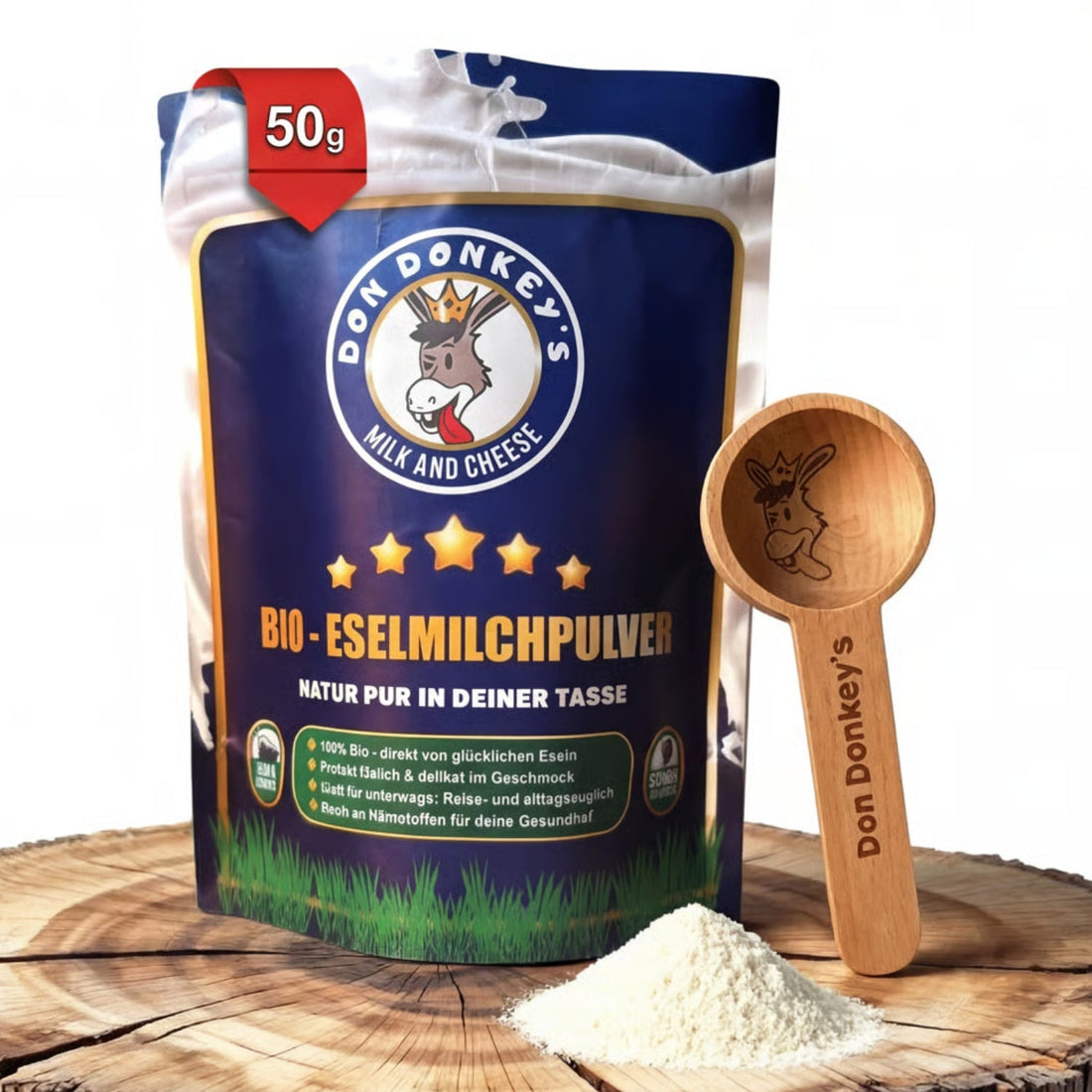
For anyone who prefers a longer shelf life: our donkey milk in powder form – easy to store and portion.
20g · Unit price: €1.245,00 / 1 kg · incl. VAT, plus shipping