
 Buyer protection

Research on donkey milk · Study 111
Rapid test: detecting cow’s milk in donkey milk
A chip sensor detected cow’s milk in donkey, sheep’s and goat’s milk from 0.05 % (v/v) in 12 minutes. Recovery was 92.0–105 %, and measurement variation 4.0 % (same day) and 6.5 % (different days).
At a glance · swipe or use the arrows
The key figures
Study design
How it was studied
Laboratory study on the development of an immunosensor on a silicon chip (22 × 2 mm) with two Mach–Zehnder interferometers: one measuring window was coated with bovine κ-casein, the other with bovine serum albumin as a reference. In a competitive test format, the chip was dipped first into 50-fold diluted milk with an antibody against bovine κ-casein and then into a solution with a secondary antibody for signal amplification; pumps or microfluidics were not needed. Surface coating, stirring, antibody dilution, κ-casein concentration and sample dilution were optimised. For calibration and testing, commercially available donkey, sheep’s and goat’s milk from Greece was spiked with cow’s milk (0–10 % v/v); detection limit, repeatability, recovery, regenerability and storage stability of the chips were determined.
Interactive chart · values from the study
Zero calibrator signal by type of milk
Values from section 3.3 and Figure S5 of the study; similar signals indicate a comparable matrix effect of the three types of milk.
Second analysis
Detection limits of different immunosensors
Literature comparison from Table 1 of the study; for SPR (laboratory), “< 0.1” is given. Samples and test duration (5–60 min) differ; the comparison methods were not tested on donkey milk.
Results
What the study measured
Coating the chip surface with 2 % aminosilane in ethanol for 20 minutes gave the highest signals; stirring the solutions increased the signal about fourfold. The authors chose a 1:200 dilution of the antiserum and 50 µg/mL κ-casein for the coating as the optimum.
At 10- and 20-fold dilution, milk constituents, especially fat, reduced the signal; from 50-fold dilution, this effect no longer occurred clearly. Centrifuging the milk was therefore not necessary.
The zero calibrator signals were similar for donkey milk (1.69 rad), sheep’s milk (1.66 rad) and goat’s milk (1.59 rad), and the calibration curves of the three types of milk overlapped. Adding 0.5 % cow’s milk reduced the signal to 54.8–58.5 % of the zero value.
The detection limit was 0.05 % (v/v) cow’s milk with a linear range of 0.1 to 10 %. The coefficients of variation were 4.0 % within one day and 6.5 % between different days.
In recovery experiments with 0.4, 0.8 and 2.5 % added cow’s milk, 92.0 to 105 % was recovered. A chip could be regenerated up to 80 times, and coated chips remained stable at room temperature for at least 28 days.
According to the authors, this was the first time that the admixture of cow’s milk to donkey milk had been examined with an immunosensor.
Authors’ conclusion: In the view of Kourti et al. (2024), the photonic dipstick sensor detected cow’s milk in donkey, sheep’s and goat’s milk from 0.05 % within 12 minutes, well below the EU limit of 1 % they cited. Because of the small devices and the absence of pumps and sample pretreatment, the authors considered the method suitable for checking adulteration on site; testing on real-world samples is still pending.
Critical assessment
Strengths and limitations
Only one commercial sample per type of milk
For each species, only one commercially available milk from one manufacturer was used and spiked with cow’s milk in the laboratory. Whether donkey milk from different breeds, lactation stages or processing forms (e.g. raw milk, powder) behaves in the same way was not tested; real suspect samples were not examined.
Test duration not reproducible
The steps described (2 min equilibration, 5 min first reaction, 2 min washing, 5 min secondary antibody) add up to 14 minutes, whereas 12 minutes is stated. Regeneration of the chip is not included.
Contradictions in the literature comparison
For the authors’ own predecessor sensor, the introduction gives 0.1 % in 10 minutes, the discussion 0.04 % in 25 minutes and Table 1 0.04 % in 10 minutes. The values for mozzarella and feta are swapped between the introduction and discussion. The statement that the sensor is more sensitive than all previous ones contradicts Table 1, which gives 0.01 % for a voltammetric method.
Minor errors in the details
The legend of Figure 3a mentions a 50-fold antiserum dilution, the text a 100-fold one; the sixth condition is not numbered, and the unit is missing for the aqueous aminosilane solution (“0.5 v/v”). Regeneration is given as 80 cycles, while Figure S6 shows 85.
The authors’ classifications
Statements on the nutritional value and tolerance of cow’s milk compared with donkey, sheep’s and goat’s milk are not substantiated and were not the subject of the study. The EU maximum of 1 % cited relates to the official reference method for cheese made from sheep’s, goat’s and buffalo milk, not explicitly to donkey milk.
Complete analytical validation
Detection limit, working range, precision over several days, recovery at three levels, regenerability and storage stability were tested and documented in parallel for all three types of milk. A reference sensor on the same chip compensates for non-specific matrix effects.
Editorial assessment: The study concerns the authenticity testing of donkey milk, i.e. the detection of cow’s milk admixture, and describes a laboratory prototype. It contains no statements about the constituents or effects of donkey milk. To the research archive.
Research question for DON DONKEY’S®
How reliably does the method detect cow’s milk admixture in real-world donkey milk, for example in raw milk from different farms, in milk powder or in processed products such as cosmetics and cheese?
Original publication
Photonic Dipstick Immunosensor to Detect Adulteration of Ewe, Goat, and Donkey Milk with Cow Milk through Bovine κ-Casein Detection
Original title of the publication.
Kourti D., Angelopoulou M., Makarona E., Economou A., Petrou P., Misiakos K., Kakabakos S.
Sensors · 2024 · 24(17), 5688
Institute of Nuclear & Radiological Sciences & Technology, Energy & Safety and Institute of Nanoscience & Nanotechnology, NCSR “Demokritos”, Aghia Paraskevi, Greece; Department of Chemistry, National and Kapodistrian University of Athens, Greece
10.3390/s24175688: 10.3390/s24175688
Transparency: co-financed by the European Regional Development Fund and Greek national funds under the Operational Programme “Competitiveness, Entrepreneurship and Innovation” (call RESEARCH–CREATE–INNOVATE, project T2EDK-01934/FOODSENS) and by the EU’s Horizon 2020 programme, Marie Skłodowska-Curie grant agreement No 101007299 (SAFEMILK). The authors declare no conflicts of interest. No product-related statement for DON DONKEY’S®.
Summarised and reviewed by the DON DONKEY’S editorial team on the basis of the original publication · as of October 2026
The study summarised above was carried out independently of DON DONKEY’S® and does not relate to our products. It serves solely to inform about the state of research.
DON DONKEY’S® donkey milk and donkey milk powder are foods. They are not intended to prevent, treat or cure any disease and do not replace medical advice.

From our shop
DON DONKEY’S® donkey milk
100 % donkey milk · raw milk, frozen
On this page we report the findings of a published study. Independently of that, you will find our donkey milk here: 100 % donkey milk, frozen as raw milk.
100 ml bottle / 100ml · Unit price: €249,00 / 1 l · incl. VAT, plus shipping
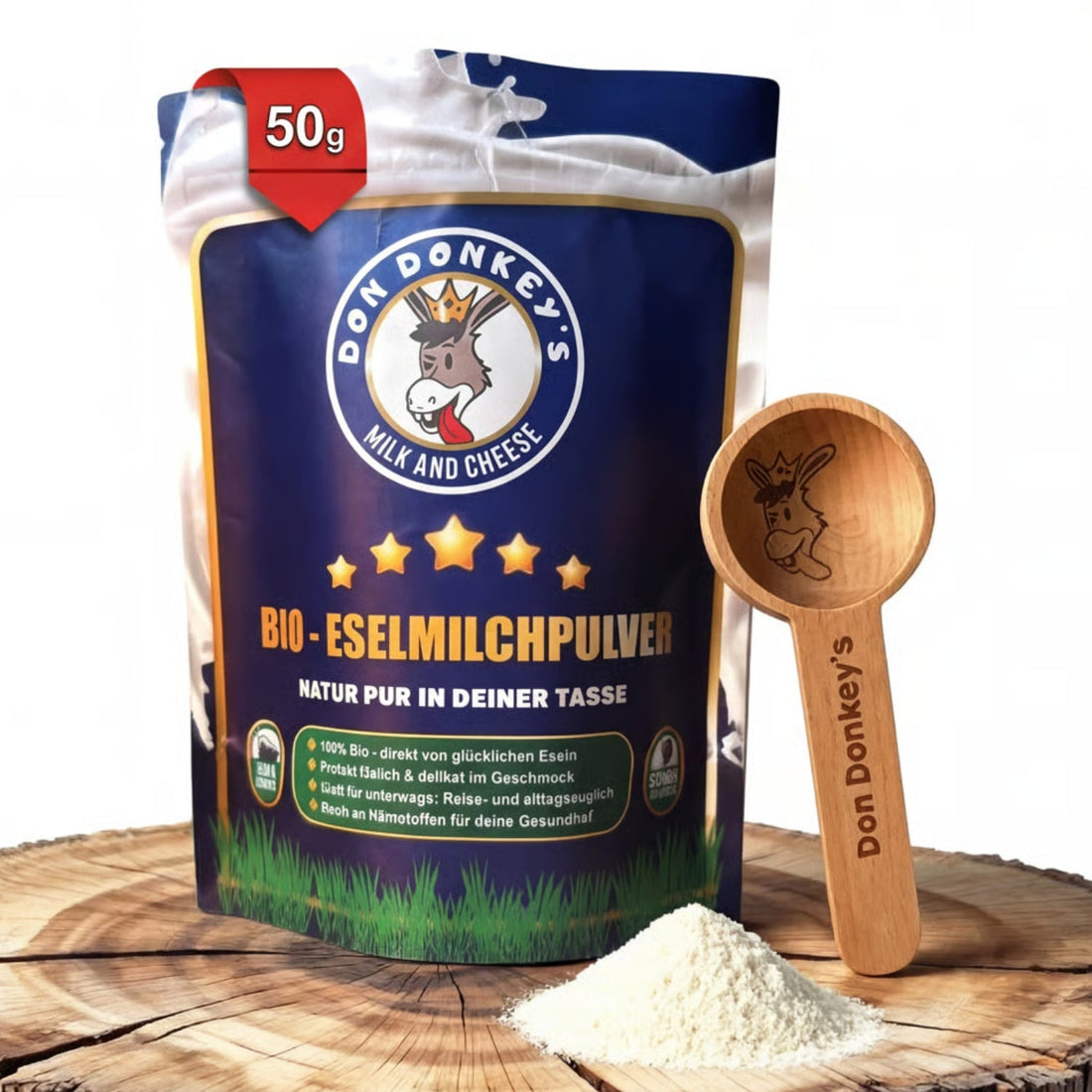
Also in our shop
Donkey Milk Powder
Donkey milk in powder form
For anyone who prefers a longer shelf life: our donkey milk in powder form – easy to store and portion.
20g · Unit price: €1.245,00 / 1 kg · incl. VAT, plus shipping