
 Buyer protection

Research on donkey milk · Study 110
Genetic markers for milk yield in donkeys
In 112 Xinjiang jennies, 236 gene variants were found that were statistically associated with milk yield or fat, protein or lactose content. In a validation group of 82 animals, daily milk yield differed by genotype for eight variants (e.g. 2.67 vs. 1.57 kg).
At a glance · tap the cards
The key figures
Study design
How it was studied
112 Xinjiang jennies (born in 2013 and 2014, 5th or 6th lactation) from two farms in Yopurga County (Kashgar region, China) were phenotyped; mean monthly milk yield (AY = daily yield × 30) and fat, protein and lactose content were derived from 4704 test-day milking records. The whole genome was sequenced from blood samples at around 10-fold coverage. After quality filtering, around 12 million single-nucleotide variants (SNPs) went into a genome-wide association analysis with mixed linear models, run with two analysis programs; the significance threshold was p < 1 × 10⁻⁶. Then 16 SNPs in 10 candidate genes were genotyped in 82 jennies by allele-specific PCR and linked to daily and total milk yield by one-way ANOVA.
Interactive chart · values from the study
Daily milk yield by genotype of selected variants
Means ± SE from Table 4 of the study (validation group, group sizes 9–41 animals per genotype). DRG2 C>A = position 4912631, DRG2 C>T = 4939345; PLK1 T>C = 23585377, PLK1 G>C = 23587802.
Second analysis
Significant SNPs per trait and analysis program
Data from section 2.4 and Figure 4 of the study; threshold p < 1 × 10⁻⁶. Program 1 = mixed-model program with 222, program 2 with 228 SNPs in total.
Results
What the study measured
The 112 jennies averaged 38.51 kg of milk per month with 1.02 % fat, 1.44 % protein and 6.46 % lactose; fat content (SD 0.93) and monthly yield (SD 14.87) varied widely between animals.
After quality control, 12,039,909 SNPs remained, mostly in regions between genes (43.20 %) and in introns (39.36 %). Principal component analysis showed no clear substructure between the two farms (PC1 7.48 %, PC2 6.21 %).
The two analysis programs found 222 and 228 significant SNPs; in total, 236 SNPs were associated with one of the four traits each, of which 11 for milk yield, 95 for fat, 5 for protein and 103 for lactose were found consistently. No gene was linked to three or four traits at once.
As possible key genes, the authors named GPIHBP1, FLII, TOP1MT and TNK1 for milk yield, NOTCH1, DRG2, MIEF2 and PLK1 for fat content, ACTC1 and GJD2 for protein content, and PADI1/3, CHP2, GFPT2 and DYRK2 for lactose content. A large proportion of the annotated genes (64.51–71.48 %) were functionally unknown.
All 16 SNPs tested were polymorphic in the validation group; two (DRG2 g.4912631, TNK1 g.14416183) deviated from Hardy–Weinberg equilibrium, which the authors explained by selective breeding.
For eight SNPs, daily and total milk yield differed by genotype, e.g. NOTCH1 TT 2.67 kg/day vs. CC 1.57 kg/day, GPIHBP1 CT 2.75 vs. CC 1.88 kg/day and FLII CT 2.67 vs. CC 1.66 kg/day.
Authors’ conclusion: In the view of Fang et al. (2025), this was the first genome-wide association study on milk traits in Xinjiang donkeys; the variants and candidate genes found, such as TOP1MT, GPIHBP1, FLII, DRG2 and PLK1, could serve as starting points for breeding for milk yield. The authors stressed that larger studies are needed to confirm the results and identify causal variants.
Critical assessment
Strengths and limitations
Small sample for a GWASClear limitation
112 animals from two farms and one breed are few for a genome-wide analysis; the authors themselves call for larger confirmatory studies. Statistical associations do not prove causal gene variants, and the functional interpretations of the candidate genes are based on literature on other species.
Contradictions in the markersNote
The abstract mentions five significant markers and assigns position g.9133371 to the TOP1MT gene; according to Table 2, it lies in NOTCH1, while TOP1MT is at position 38323301. The results section, by contrast, mentions eight significant SNPs.
Striking values in Table 4Note
For the two PLK1 variants, the values for TC (21 animals) and GC (21 animals) and for TT (40) and CC (40) are identical. The genotype counts add up to only 70–80 rather than 82 animals per SNP, without missing values being explained.
Milk yields hard to compareNote
The mean monthly yield of 38.51 kg corresponds arithmetically to about 1.28 kg per day, whereas the genotype groups of the validation group are at 1.57–2.75 kg per day. How daily and total milk yield were recorded in the validation group is not described. The discussion also gives 38.52 instead of 38.51 kg.
Methodological ambiguitiesNote
According to the methods section, no individual additive random effects were included, but the model given contains a polygenic random effect. The threshold of 1 × 10⁻⁶ is described both as Bonferroni-corrected and as “suggestive”; the number of genes per trait is given inconsistently (e.g. 18 and 50 for milk yield).
Two programs and a validation groupStrength
The results were cross-checked with two analysis programs and controlled for population structure, and selected variants were tested in a second group of animals by genotyping. Phenotypes and primer sequences are documented in tables.
Editorial assessment: The study concerns the genetics of milk yield in jennies in China and provides indications for animal breeding. No statements about the quality of the milk for humans or about commercial products can be derived from it. To the research archive.
Research question for DON DONKEY’S®
Can the gene variants found be confirmed in larger, independent donkey populations of other breeds, and which of them actually have a causal influence on milk production?
Original publication
Unveiling Genetic Markers for Milk Yield in Xinjiang Donkeys: A Genome-Wide Association Study and Kompetitive Allele-Specific PCR-Based Approach
Original title of the publication.
Fang C., Farnir F., Liu L., Xiao H.
International Journal of Molecular Sciences · 2025 · 26(7), 2961
College of Animal Science, Xinjiang Agricultural University, Urumqi, China; Faculté de Médecine Vétérinaire, Université de Liège, Belgium; Xinjiang Academy of Animal Sciences, Urumqi, China
10.3390/ijms26072961: 10.3390/ijms26072961
Transparency: Major Special Projects of Xinjiang Uygur Autonomous Region (2024A02005-1-2), Tianshan Talent Training Program (2022TSYCLJ0015) and Innovative projects for university students (dxscx2023191). The authors declare no conflicts of interest. No product-related statement for DON DONKEY’S®.
Summarised and reviewed by the DON DONKEY’S editorial team on the basis of the original publication · as of October 2026
The study summarised above was carried out independently of DON DONKEY’S® and does not relate to our products. It serves solely to inform about the state of research.
DON DONKEY’S® donkey milk and donkey milk powder are foods. They are not intended to prevent, treat or cure any disease and do not replace medical advice.

From our shop
DON DONKEY’S® donkey milk
100 % donkey milk · raw milk, frozen
On this page we report the findings of a published study. Independently of that, you will find our donkey milk here: 100 % donkey milk, frozen as raw milk.
100 ml bottle / 100ml · Unit price: €249,00 / 1 l · incl. VAT, plus shipping
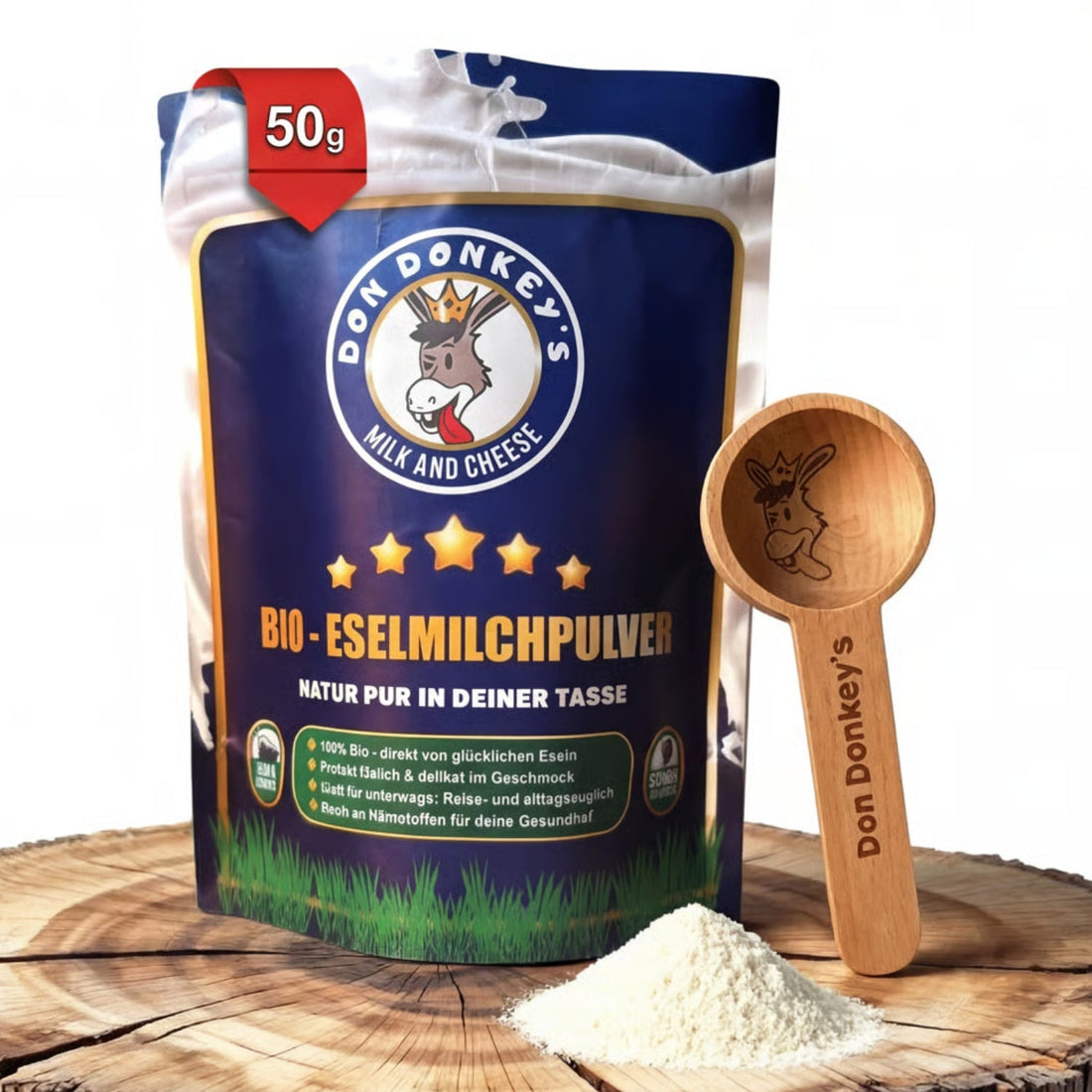
Also in our shop
Donkey Milk Powder
Donkey milk in powder form
For anyone who prefers a longer shelf life: our donkey milk in powder form – easy to store and portion.
20g · Unit price: €1.245,00 / 1 kg · incl. VAT, plus shipping