
 Buyer protection

Research on donkey milk · Study 108
Dietary oils change the lipid and aroma compound profile of donkey milk: a comprehensive analysis
27 jennies received soybean, linseed or palm oil in their feed for four weeks. 725 lipids and 391 volatile compounds were recorded in the milk; fat content in the linseed oil group was 0.07 % compared with 0.25–0.26 %.
At a glance · tap the cards
The key figures
Study design
How it was studied
27 lactating four-year-old jennies from a herd in Shandong Province, China, were selected for uniform body weight, parity and fertility and randomly allocated to three groups of nine animals each. The ration consisted of 80 % wheat straw plus maize, soya and a mineral and vitamin premix and contained 1 % soybean oil (SO), linseed oil (LO) or palm oil (PO). The animals were fed twice a day for four weeks in July and August (30 ± 5 °C). At the end of the trial, one milk sample (100 mL) was taken per animal. Fat, protein, lactose, dry matter, urea, freezing point depression, lactoferrin and saturated and polyunsaturated fatty acids were determined by FTIR milk analysis, the lipids by LC-MS and the volatile compounds by headspace solid-phase microextraction with GC-MS. The analysis used ANOVA and post-hoc tests, OPLS-DA (VIP > 1, p < 0.05) and KEGG pathway analyses.
Interactive chart · values from the study
Milk composition by dietary oil
Means (n = 9) from Table 2 of the study; all four parameters with a significant group effect (p < 0.05).
Second analysis
Lipids recorded by subclass
Shares of the number of lipid molecules identified according to the results text on Figure 1; “Other” calculated as the remainder to 100 %. Not equivalent to the amount of lipid.
Results
What the study measured
Milk composition differed by dietary oil: fat content in the linseed oil group was 0.07 %, below the soybean (0.25 %) and palm oil groups (0.26 %). Protein (1.81 %), dry matter (9.43 %) and lactoferrin were highest in the soybean group, lactose in the palm oil group (6.80 %).
In the palm oil group, saturated (0.28 %) and polyunsaturated fatty acids (0.24 %) were higher; in the linseed oil group, saturated fatty acids were lowest (0.08 %). Urea and freezing point depression were lower in the palm oil group.
In total, 725 lipids from 21 subclasses were recorded, including 411 triglycerides, 84 diglycerides, 46 phosphatidylcholines and 38 phosphatidylethanolamines. By relative amount, triglycerides made up around 91–92 % in all groups. Diglycerides were higher in the soybean group (5.14 % compared with 4.39–4.42 %), sphingolipids (Sph) and AcHex in the palm oil group.
110 lipids differed between the groups, mostly triglycerides (64) and diglycerides (24). The authors named TG (18:2_13:0_18:2) as a possible marker for distinguishing the groups; in the linseed oil group, several triglycerides with α-linolenic acid residues (18:3) were higher.
The differing lipids were assigned to 20 KEGG pathways; the authors named glycerophospholipid and glycerolipid metabolism as the most important, followed by fat digestion and absorption, GPI anchor biosynthesis, and arachidonic acid, α-linolenic acid, sphingolipid and linoleic acid metabolism.
Of 391 volatile compounds (including 72 esters, 55 heterocycles, 54 terpenoids), 70 differed between the groups, mainly heterocycles (13), ketones (10), esters and aromatics (9 each). Terpenoids, aldehydes, hydrocarbons, ketones, sulphur compounds, phenols, aromatics and acids were higher in the palm oil group than in the soybean group.
Authors’ conclusion: In the view of Ren et al. (2025), the type of dietary oil clearly influenced the composition of the lipid molecules in donkey milk; 110 of 725 lipids and 70 of 391 volatile compounds differed between the soybean, linseed and palm oil groups, with numerous volatile compounds higher in the palm oil group. The authors saw potential in this for steering the lipid and aroma profile of donkey milk via feeding; effects in humans were not examined.
Critical assessment
Strengths and limitations
Short trial under summer conditions
Nine animals from one herd were sampled once per group after four weeks; baseline values and a group without added oil are missing. The trial ran in July and August at 30 ± 5 °C, which may additionally have influenced milk production.
Implausible units
Lactoferrin is given in Table 2 as 9.34–9.78 % and equated with the literature as “9.0–10.0 %” in the discussion; this is orders of magnitude above usual values for donkey milk. Freezing point depression (443–458) is given in °C, apparently meaning millidegrees; the unit is missing for urea.
Text contradicts tables
The text says the fat content of the palm oil group was higher than in the soybean and linseed oil groups; according to Table 2, palm (0.26 %) and soybean (0.25 %) are level. The discussion describes Sph as higher in the soybean and linseed oil groups than in the palm oil group, while Table 3 shows the opposite (0.2096 compared with 0.0839 and 0.1148).
Counts not consistent
The broken-down classes of the 110 differing lipids add up to 108. The pairwise comparisons exceed the total (soybean vs. palm: 128 lipids and 79 volatile compounds compared with 110 and 70 in total). The abstract and discussion mention 90 % and 88.2 % unsaturated lipids, the abstract and highlights 20 and eight pathways respectively.
Interpretations and relation to other studies
Statements in the discussion on effects of diglycerides or unsaturated fatty acids come from the literature and were not examined; odour evaluations are missing entirely. The same ethics approval number is given as in a soybean/linseed oil study by the group published in parallel (28 three-year-old animals, four groups); number of animals, age and groups differ, and no data overlap is apparent.
Three types of oil compared directly
Three oils with clearly different fatty acid patterns were compared on an identical basal ration, and the lipid composition of feed and milk is set out side by side in tables. Lipidomics and GC-MS provide a broad profile, and the OPLS-DA models were checked with permutation tests.
Editorial assessment: The study documents that even 1 % oil in the ration is associated with measurable differences in the lipid and aroma compound profile of the milk. Because of implausible units, several contradictions between text and tables and the short trial period, the results should be read as indications; they cannot be transferred to taste, effects or individual commercial products. To the research archive.
Research question for DON DONKEY’S®
How do the lipid and aroma compound profiles of donkey milk develop when different dietary oils are fed at several doses over a whole lactation and outside the summer heat, and which of the measured differences are perceptible to the senses?
Original publication
Dietary Oils Alter Lipid and Volatile Compound Profiles of Donkey Milk: A Comprehensive Analysis
Original title of the publication.
Ren W., Sun L., Du X., Chen Y., Chen Y., Liang H., Kou X., Khan M.Z., Wang C., Li M.
Food Science & Nutrition · 2025 · 13(5), e70291
School of Agriculture and Biology, Liaocheng Research Institute of Donkey High-Efficiency Breeding and Ecological Feeding, Liaocheng University, Liaocheng, China
10.1002/fsn3.70291: 10.1002/fsn3.70291
Transparency: National Key R&D Program of China (2022YFD1600103, 2023YFD1302004), Shandong Provincial Natural Science Foundation (ZR2022QC130), Shandong Province Modern Agricultural Technology System Donkey Industrial Innovation Team (SDAIT-27), Support Program for Innovation and Technology in Universities of Shandong Province (2023KJ354), Livestock and Poultry Breeds Project of Ministry of Agriculture and Rural Affairs (19211162), Key Technology Research and Development Program of Shandong (2021TZXD012) and Innovation and Entrepreneurship Training Program for College Students (CXCY2024270). The authors declare no conflicts of interest. No product-related statement for DON DONKEY’S®.
Summarised and reviewed by the DON DONKEY’S editorial team on the basis of the original publication · as of October 2026
The study summarised above was carried out independently of DON DONKEY’S® and does not relate to our products. It serves solely to inform about the state of research.
DON DONKEY’S® donkey milk and donkey milk powder are foods. They are not intended to prevent, treat or cure any disease and do not replace medical advice.

From our shop
DON DONKEY’S® donkey milk
100 % donkey milk · raw milk, frozen
On this page we report the findings of a published study. Independently of that, you will find our donkey milk here: 100 % donkey milk, frozen as raw milk.
100 ml bottle / 100ml · Unit price: €249,00 / 1 l · incl. VAT, plus shipping
Also in our shop
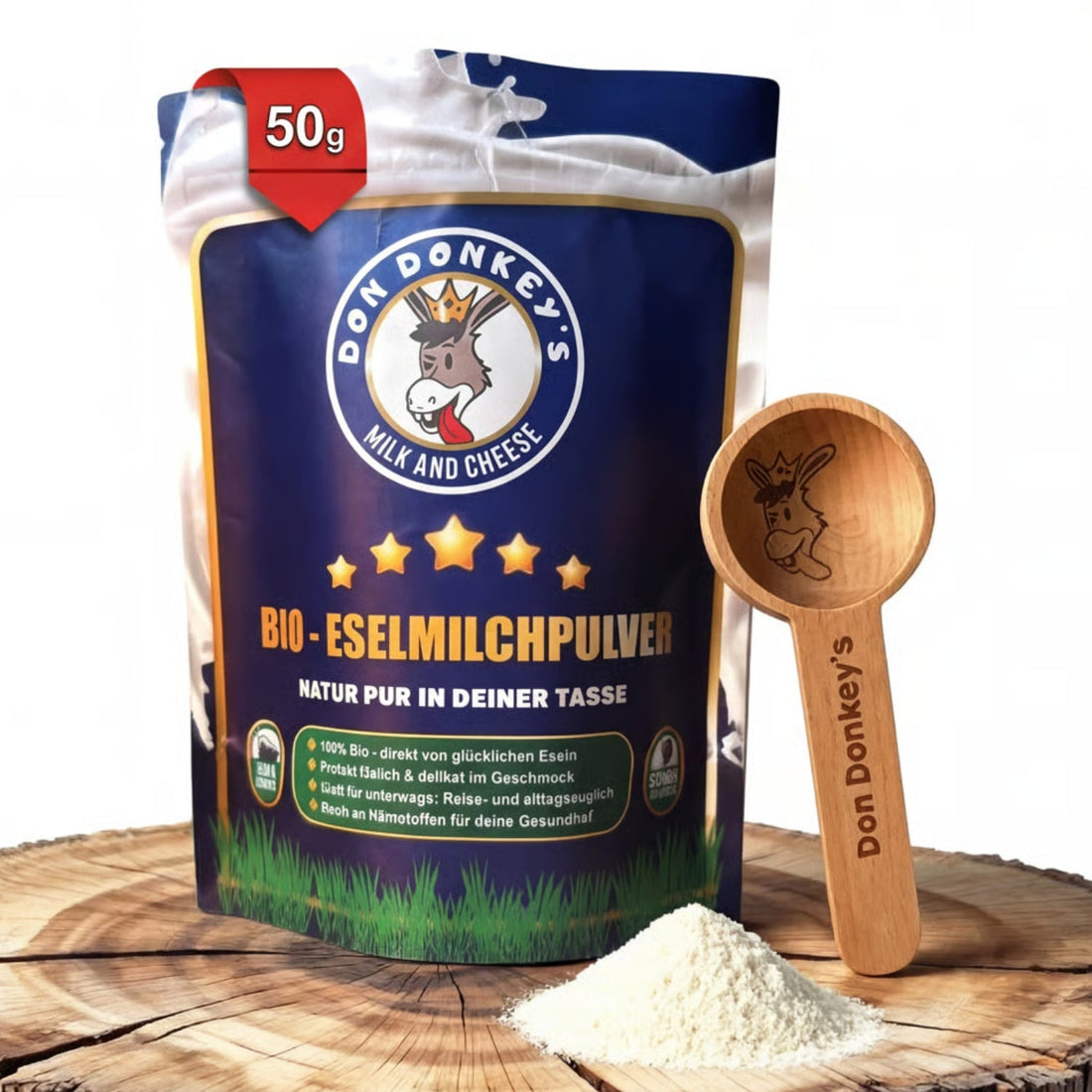
Donkey Milk Powder
Donkey milk in powder form
For anyone who prefers a longer shelf life: our donkey milk in powder form – easy to store and portion.
20g · Unit price: €1.245,00 / 1 kg · incl. VAT, plus shipping