
 Buyer protection

Research on donkey milk · Study 106
Effect of methionine on milk performance and milk constituents in lactating jennies
With 5 g of methionine per day, the milk yield obtained was 1.72 kg compared with 1.15 kg without supplement; 15 g/d showed no effect on yield (1.14 kg). 568 metabolites were recorded in the milk, 41 of which differed between the groups.
At a glance · tap the cards
The key figures
Study design
How it was studied
Feeding trial with 18 healthy multiparous Dezhou jennies (on average 71 days in lactation, 273 ± 30 kg) and their foals on a farm in Liaocheng (Shandong, China). Six jenny–foal pairs each received 0 g (control), 5 g (M1) or 15 g of methionine per day in addition to 6 kg of grass hay and 2.5 kg of concentrate per animal. The trial lasted 5 weeks including 1 week of pre-feeding. At the end of the trial, the jennies were milked by hand twice a day after 4 hours of foal separation; milk yield, composition (infrared analysis) and the milk and serum metabolome (untargeted LC-MS) were recorded, as well as the weight gain of the foals. The analysis used one-way ANOVA with Duncan’s test.
Interactive chart · values from the study
Milk yield obtained by methionine level
Means (n = 6) from Table 2; amount obtained after 4 hours of foal separation, time reference not given in the table (p = 0.0054).
Second analysis
Amounts of milk constituents
Means (n = 6) from Table 3 of the study; amounts relative to the milk obtained.
Results
What the study measured
With 5 g of methionine per day, the milk yield obtained, at 1.72 kg, was significantly above the control (1.15 kg) and the 15 g group (1.14 kg). The foals in the 15 g group gained more weight, at 19.6 kg, than those in the control (15.1 kg); the 5 g group was in between (19.4 kg).
The contents showed only small differences: dry matter (9.27 and 9.32 vs. 9.04 %), lactoferrin (0.097 vs. 0.094 g/L) and polyunsaturated fatty acids were higher in both methionine groups, protein content only at 15 g (1.71 vs. 1.51 %). Fat, lactose and urea contents did not differ significantly.
Because of the higher milk yield, the daily amounts of protein (25.18 vs. 16.62 g), lactose (110.26 vs. 73.10 g), fat, dry matter and solids-not-fat in the 5 g group were also above those of the control.
In the milk metabolome, 568 metabolites were recorded, mainly lipids, organic acids and heterocyclic compounds. 41 differed between the groups; at 15 g, myristic acid (factor 2.04) and L-aspartic acid (factor 1.68), among others, were higher and 3-hydroxybutyric acid lower.
Methionine itself was markedly lower in the milk of the supplemented groups than in the control (factor 0.06), as was D-proline; the authors do not discuss this further.
In serum, 753 metabolites were recorded; 17 differed between 5 g and control, 48 between 15 g and control, including various lysophospholipids. According to the authors, enriched pathways included inositol phosphate, lysine and ascorbate metabolism.
Authors’ conclusion: In the view of Huang et al. (2024), supplementing 5 g of methionine per day increased the milk yield obtained and the amounts of milk protein, lactoferrin and milk fat and changed the metabolite profile of the milk. The authors attributed this to changes in serum metabolites and saw their work as an initial basis for the nutrition of lactating jennies; health effects in humans were not examined.
Critical assessment
Strengths and limitations
Six animals per group were examined over only 5 weeks; milk and blood were sampled once at the end of the trial without baseline values. The authors themselves describe the work as a pilot study in the discussion.
According to the abstract, 5 g of methionine increased the protein and fat contents; according to Table 3, protein content at 5 g does not differ from the control (1.55 vs. 1.51 %), and fat content does not differ in any group (p = 0.08). The abstract and conclusion name L-ascorbate as increased, whereas Table 7 shows it as lower at 15 g (factor 0.43); D-glutamine and L-lysine do not appear in any table.
The lactoferrin amount (10.35 mg with 1.15 kg of milk and 0.094 g/L) is arithmetically about 10 times too low, and the amount of polyunsaturated fatty acids is given in mg instead of g. The fat amount of the control (1.88 g) does not match 1.15 kg × 0.40 % (around 4.6 g); the milk yield has no time reference.
Table 1 gives the methionine supplement as 0.002 % and 0.006 % of the concentrate, which with 2.5 kg would correspond to only 0.05 and 0.15 g instead of 5 and 15 g. The animal experiment approval has the same number as another study by the research group (Zhou et al. 2025).
Among the metabolites reported as different are several compounds that look synthetic and whose assignment is not plausible for milk or serum; the annotation of untargeted LC-MS data should be read with caution here. The authors’ interpretations regarding suitability for infant nutrition were not examined; effects in humans were not the subject of the study.
The trial compares two doses with a control group on the same basal ration and combines milk performance, foal weight gain and the milk and serum metabolome. Means are tabulated with standard deviations, and the quality control samples showed high repeatability (R² 0.992–0.996).
Editorial assessment: The study mainly shows an effect on the milk yield obtained with 5 g of methionine, while the percentage composition of the milk changed only slightly. Because of the small groups and several inconsistencies between text and tables, the results should be regarded as preliminary. To the research archive.
Research question for DON DONKEY’S®
Why did only the lower methionine dose increase milk yield, and can this effect be confirmed in larger, longer trials with several dose levels and repeated measurements?
Original publication
Effect of methionine on milk performance and milk constituents in lactating jennies
Original title of the publication.
Huang F., Du X., Ma Z., Liu G., Wang C., Zhou M.
Animals · 2024 · 14(20), 3027
College of Agriculture and Biology, Liaocheng Research Institute of Donkey High-Efficiency Breeding and Ecological Feeding, Liaocheng University, Liaocheng, China
10.3390/ani14203027: 10.3390/ani14203027
Transparency: Shandong Provincial Natural Science Foundation (ZR2023MC149), National Key R & D Program of China (2022YFD1600103), Key Technology Research and Development Program of Shandong (2021TZXD012) and Open Project of Liaocheng University Animal Husbandry Discipline (319312105-5). The authors declare no conflicts of interest. No product-related statement for DON DONKEY’S®.
Summarised and reviewed by the DON DONKEY’S editorial team on the basis of the original publication · as of October 2026
The study summarised above was carried out independently of DON DONKEY’S® and does not relate to our products. It serves solely to inform about the state of research.
DON DONKEY’S® donkey milk and donkey milk powder are foods. They are not intended to prevent, treat or cure any disease and do not replace medical advice.

From our shop
DON DONKEY’S® donkey milk
100 % donkey milk · raw milk, frozen
On this page we report the findings of a published study. Independently of that, you will find our donkey milk here: 100 % donkey milk, frozen as raw milk.
100 ml bottle / 100ml · Unit price: €249,00 / 1 l · incl. VAT, plus shipping
Also in our shop
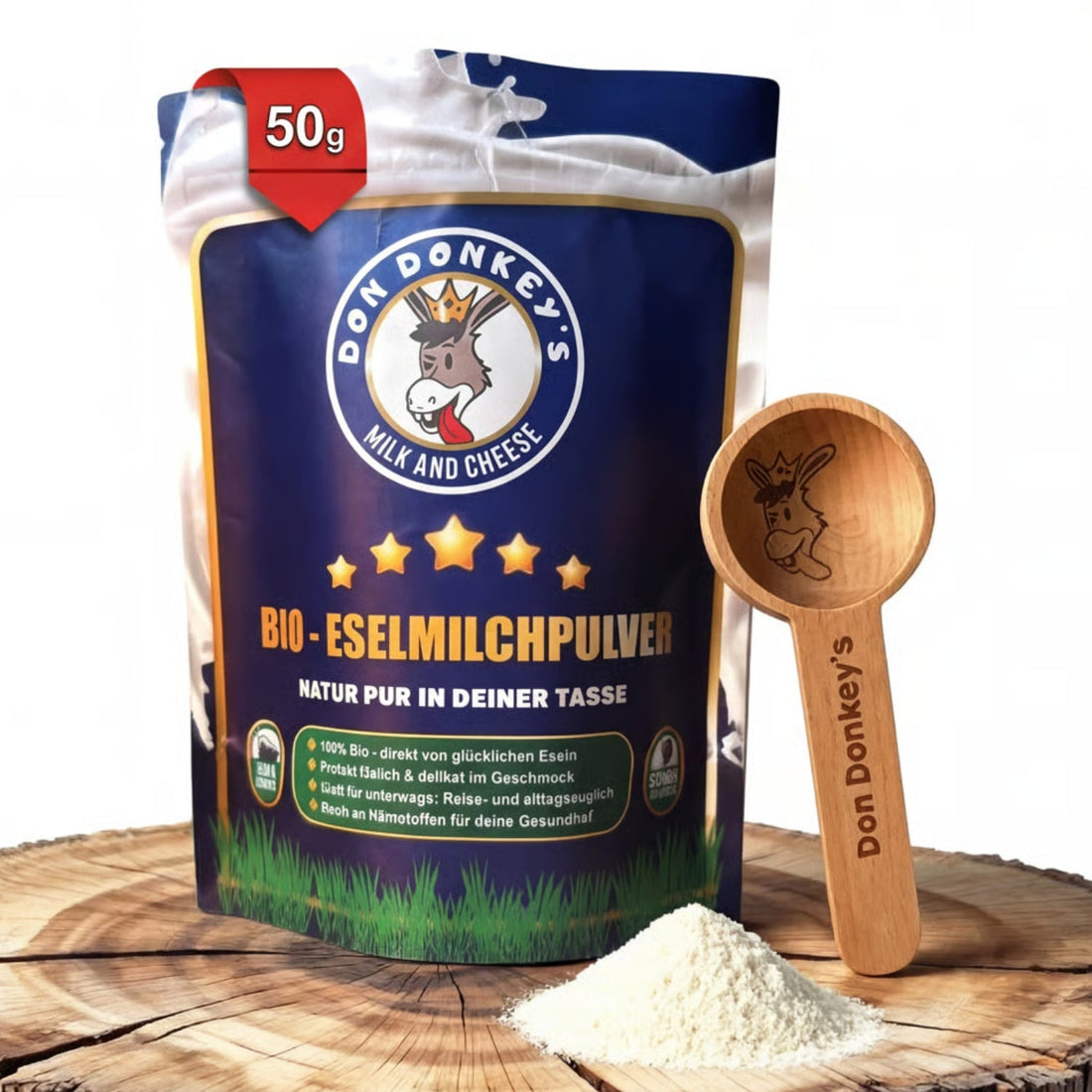
Donkey Milk Powder
Donkey milk in powder form
For anyone who prefers a longer shelf life: our donkey milk in powder form – easy to store and portion.
20g · Unit price: €1.245,00 / 1 kg · incl. VAT, plus shipping