
 Buyer protection

Research on donkey milk · Study 105
Selenium in feed: milk yield and milk fatty acids
With 0.3 mg selenium per kg of feed dry matter, the extrapolated milk yield rose from 3.26 to 3.84 kg/d; the fat, protein and lactose contents of the milk stayed the same. The share of saturated fatty acids fell from 56.74 % to 54.06 % (0.5 mg: 50.90 %).
At a glance · swipe or use the arrows
The key figures
Study design
How it was studied
Feeding trial with 24 lactating Dezhou jennies (on average 40 days in lactation, 247 ± 26 kg, 2.8 foalings) on a farm in Inner Mongolia, China. The animals were randomly allocated to four groups (n = 6 each): basal ration without supplement (0.04 mg Se/kg DM) and supplements of 0.15, 0.3 and 0.5 mg selenium per kg dry matter as selenium yeast (≥ 98 % of the selenium in organically bound form, mainly selenomethionine). After 2 weeks of acclimatisation, 8 weeks of data collection followed with individual housing. The foals were separated twice a day for 3 hours each; the daily milk yield (EMY) was extrapolated from the amount obtained. Milk constituents were determined by infrared analysis with a donkey-milk-specific calibration, and 37 fatty acids by gas chromatography. In addition, digestibility, selenium and fatty acids in plasma, short-chain fatty acids in the faeces and the faecal microbiome (16S rRNA) were analysed.
Interactive chart · values from the study
Fatty acid groups in milk fat by selenium level
Means (n = 6) from Table 5 of the study; gas chromatography of 37 fatty acids.
Second analysis
Extrapolated daily milk yield by selenium level
Means (n = 6) from Table 2; extrapolated to 24 hours from the amount obtained after two 3-hour foal separations. Only 0.3 mg differed significantly.
Results
What the study measured
Selenium concentration in plasma rose with the supplement from 107.37 µg/L (control) to 157.20, 169.20 and 186.10 µg/L. Feed intake (7.62–8.14 kg DM/d) did not differ.
With 0.3 mg Se/kg DM, extrapolated milk yield (3.84 vs. 3.26 kg/d), milk yield per kg of feed and the daily amounts of lactose, solids-not-fat and dry matter were higher than in the control. Milk fat yield was higher in all selenium groups (13.94–15.54 vs. 11.98 g/d). The percentage contents of fat, protein, lactose and dry matter remained unchanged.
In milk fat, the share of saturated fatty acids fell with all supplements (56.74 % to 54.84 %, 54.06 % and 50.90 %); unsaturated and monounsaturated fatty acids and oleic acid rose. Polyunsaturated fatty acids, linoleic acid and the P/S ratio were higher at 0.3 and 0.5 mg; α-linolenic acid and total n-3 fatty acids only at 0.5 mg (4.28 % and 4.41 %).
The calculated fatty acid indices AI and TI fell with increasing supplementation (AI 1.36 to 1.09; TI 1.01 to 0.76), and palmitic acid decreased from 22.21 % to 19.00 %. The n-6/n-3 ratio (4.98–5.42) remained unchanged.
Digestibility of the ADF fibre fraction rose at 0.3 and 0.5 mg (38.84 % and 39.57 % vs. 32.58 %); biological value of the protein and nitrogen utilisation were higher only at 0.3 mg. In the animals’ faeces, acetate and butyrate rose at 0.3 and 0.5 mg.
The diversity of the faecal microbiome (2921 OTUs) did not differ between the groups, but the community structure did. At 0.3 mg, Christensenellaceae R-7 group, Lachnospiraceae XPB1014 and an Erysipelotrichaceae genus, among others, were more frequent; these correlated positively with milk yield and digestion parameters.
Authors’ conclusion: In the view of Meng et al. (2025), the selenium supplement had a dose-dependent effect: 0.3 mg Se/kg dry matter was the most favourable level, as it increased milk yield and protein synthesis efficiency and shifted the fatty acid pattern of the milk towards unsaturated fatty acids; the authors named better nutrient utilisation and changes in the faecal microbiome as a possible cause. In their view, 0.5 mg Se/kg brought no advantage in milk yield but changed the fatty acid pattern the most.
Critical assessment
Strengths and limitations
Small groups, selenium in milk not measured
Six animals of one breed from one farm were examined per group, which the authors themselves name as a limitation. The selenium content of the milk was not determined, only that in plasma.
Conclusion goes beyond the table
The abstract and conclusion attribute an increase in α-linolenic acid and n-3 fatty acids to the 0.3 mg dose; according to Table 5, however, these do not differ from the control at 0.3 mg (3.62 vs. 3.38 % and 3.75 vs. 3.50 %), only at 0.5 mg. The discussion also speaks of a higher share of saturated fatty acids at 0.3 mg, whereas the table shows a decrease (56.74 to 54.06 %).
Implausible fatty acid amounts
In Table 6 (fatty acid amounts per day), saturated and unsaturated fatty acids together add up to around 318 g/d, while milk fat yield in Table 2 is 12 to 16 g/d. The units of this table are therefore not comprehensible; in addition, the ratio and index values are identical to those in Table 5.
Methodological inconsistencies
The methods section mentions Spearman correlations, the figure legends Pearson. Milk yield efficiency is defined as SCM/feed intake × 100, but values of 0.22 to 0.28 are given. The section on faecal fatty acids mentions an undefined “AOE” group.
Indices and interpretations
AI, TI and DFA are calculated figures derived from the fatty acid pattern, not measured effects. The authors’ statements about nutritional value for humans and the role of individual genera of the gut microbiome are based on correlations and were not tested.
Graded doses with control
Four dose levels including a control, repeated measurements over 8 weeks with the pre-period as a covariate, a donkey-milk-specific calibration of the milk analysis and complete tables for 37 fatty acids in plasma and milk make the data easy to follow; the sequence data are publicly deposited.
Editorial assessment: The study describes how a selenium supplement in feed changes the milk yield and fatty acid pattern of the milk of Dezhou jennies; the percentage main constituents stayed the same. No conclusions about health effects in humans or about commercial products can be drawn from it. To the research archive.
Research question for DON DONKEY’S®
How much of the supplemented selenium actually reaches the milk in jennies, and does the shift in the fatty acid pattern remain stable in other breeds, rations and over a whole lactation?
Original publication
Rectal Microbiome Reveals the Improved Effect of Dietary Selenium Levels on Lactation Performance and Milk Fatty Acid Profiles in Lactating Donkeys
Original title of the publication.
Meng F., Zhao Y., Guo Y., Guo X., Zhang Q., Wang Z., Li L., Hui F., Tong M., Yan S.
Animals · 2025 · 15(22), 3309
Inner Mongolia Key Laboratory of Animal Nutrition and Feed Science, College of Animal Science, Inner Mongolia Agricultural University, Hohhot, China
10.3390/ani15223309: 10.3390/ani15223309
Transparency: National Natural Science Foundation of China (32160794) and Basic Research Fund for Universities in Inner Mongolia Autonomous Region (BR251030). The authors declare no competing interests. A livestock company in Inner Mongolia provided the trial base. No product-related statement for DON DONKEY’S®.
Summarised and reviewed by the DON DONKEY’S editorial team on the basis of the original publication · as of October 2026
The study summarised above was carried out independently of DON DONKEY’S® and does not relate to our products. It serves solely to inform about the state of research.
DON DONKEY’S® donkey milk and donkey milk powder are foods. They are not intended to prevent, treat or cure any disease and do not replace medical advice.

From our shop
DON DONKEY’S® donkey milk
100 % donkey milk · raw milk, frozen
On this page we report the findings of a published study. Independently of that, you will find our donkey milk here: 100 % donkey milk, frozen as raw milk.
100 ml bottle / 100ml · Unit price: €249,00 / 1 l · incl. VAT, plus shipping
Also in our shop
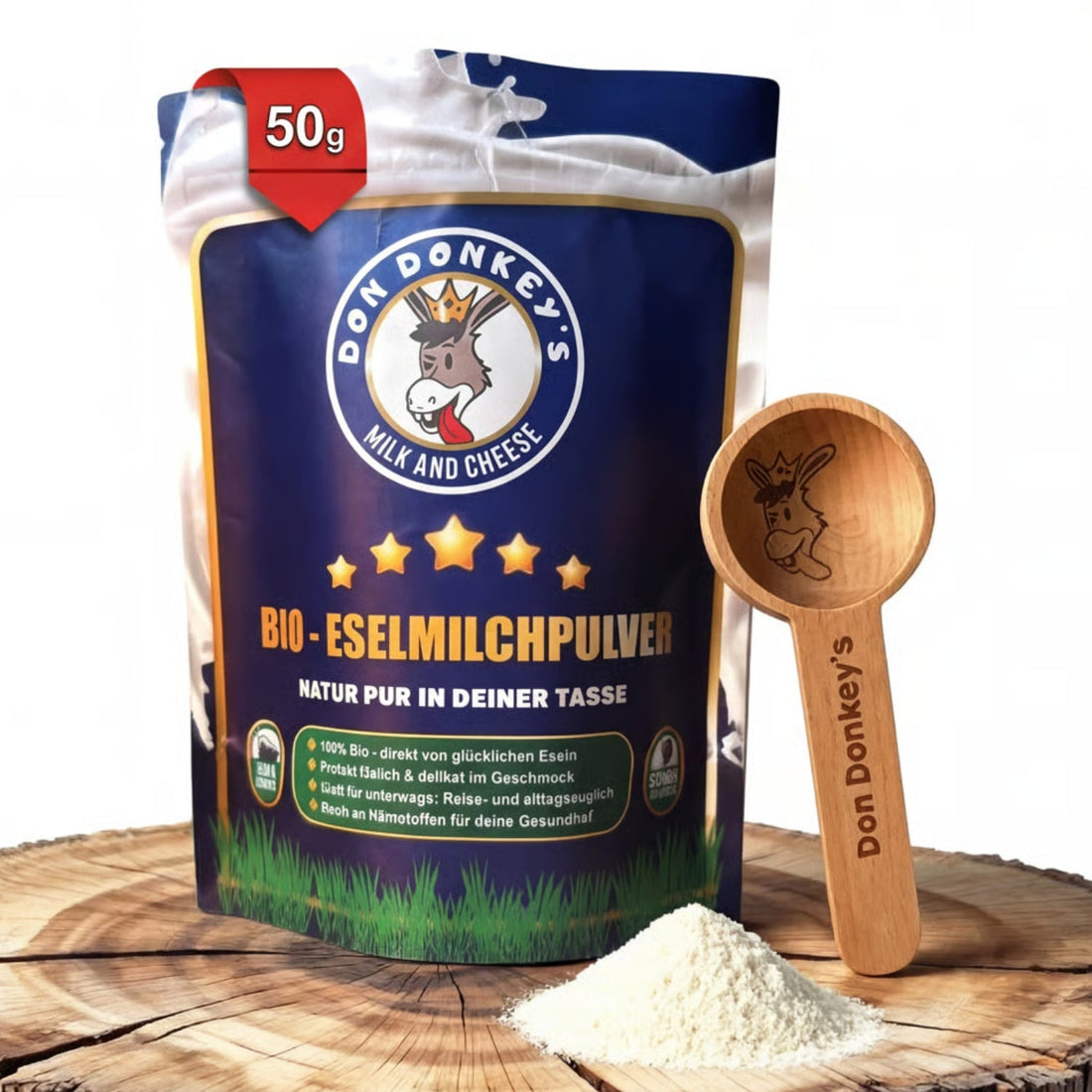
Donkey Milk Powder
Donkey milk in powder form
For anyone who prefers a longer shelf life: our donkey milk in powder form – easy to store and portion.
20g · Unit price: €1.245,00 / 1 kg · incl. VAT, plus shipping