
 Buyer protection

Research on donkey milk · Study 104
Dietary energy, milk yield and milk profile in jennies
In 24 Dezhou jennies, the medium energy level (12.4 MJ/kg) gave the highest milk yield obtained, at 0.93 kg/d (high: 0.86, low: 0.75 kg/d). Between the low and medium levels, 176 milk metabolites and 87 whey proteins differed.
At a glance · tap the cards
The key figures
Study design
How it was studied
Feeding trial with 24 lactating Dezhou jennies (on average 29 days in lactation, 4.2 foalings, 256 ± 34 kg) and their foals on a farm in Inner Mongolia, China. The animals were randomly allocated to three total mixed rations with 13.1 (high, HED), 12.4 (medium, MED) and 11.7 MJ/kg digestible energy (low, LED) (n = 8 each); crude protein was uniformly around 14 %. After 2 weeks of acclimatisation, 8 weeks of data collection followed. The foals were separated twice a day for 3 hours each, after which the jennies were machine-milked; a daily milk yield (EMY) was extrapolated from the amount obtained. Milk constituents were determined by infrared spectroscopy. In addition, digestibility, blood values, hormones and antioxidant enzymes in serum, the faecal microbiome (16S rRNA) and, for the low vs. medium comparison, the serum and milk metabolome (LC-MS) and the whey proteome were recorded. The analysis used mixed models and orthogonal contrasts (linear, quadratic).
Interactive chart · values from the study
Milk yield by energy level
Means (n = 8) from Table 2; amount obtained after two 3-hour foal separations, EMY extrapolated from this to 24 hours.
Second analysis
Daily amount of milk constituents
Means (n = 8) from Table 2 of the study; quadratic effect p < 0.05 in each case.
Results
What the study measured
Milk yield obtained, extrapolated daily yield, energy- and solids-corrected milk and milk yield per kg of feed intake were highest at the medium energy level (e.g. EMY 3.71 vs. 3.43 and 2.99 kg/d). There was no interaction between energy level and week of lactation.
Milk composition changed only slightly: protein 1.66–1.74 %, lactose 6.50–6.57 %, dry matter 9.11–9.18 %; fat (0.28–0.32 %) and solids-not-fat did not differ significantly. The daily amounts differed more clearly, for example 12.20 g of fat and 65.86 g of protein at medium energy.
With increasing energy, dry matter intake rose from 6.80 to 8.02 kg/d, as did the digestibility of dry matter, fat and fibre (NDF). β-hydroxybutyrate and free fatty acids in serum fell, which the authors interpreted as lower fat mobilisation.
Serum activities of glutathione peroxidase and superoxide dismutase and total antioxidant capacity were highest at the medium level; malondialdehyde rose with energy (1.58 to 1.93 nmol/mL). Prolactin and insulin were also highest at the medium level.
In the animals’ faecal microbiome, species richness and Shannon index were lower at high energy than in the other two groups; the share of Firmicutes was 68.02 % (medium 54.92 %, low 49.93 %).
For the low vs. medium comparison, 93 differing serum metabolites and 176 differing milk metabolites were found (144 of them lower at low energy, including L-tryptophan, L-histidine, biotin, pantothenic acid, glutathione), as well as 87 differing whey proteins. According to the authors, jointly enriched pathways included thyroid hormone synthesis and tyrosine and glutathione metabolism.
Authors’ conclusion: In the view of Zhao et al. (2026), milk performance, nutrient digestion and antioxidant parameters in the jennies’ blood responded quadratically to the energy content of the feed, with the highest values at 12.4 MJ/kg digestible energy; 13.1 MJ/kg could reduce milk performance. The authors saw changes in the faecal microbiome, metabolites and proteins – particularly in thyroid hormone synthesis and tyrosine and glutathione metabolism – as a possible explanation and recommended 12.4 MJ/kg as a guide value for feeding.
Critical assessment
Strengths and limitations
Omics for two groups onlyClear limitation
Metabolome and proteome were analysed only for low vs. medium energy; why the high level gave less milk remains open, as the authors themselves acknowledge. For the proteome, one figure legend gives n = 4; the group size of the metabolome analyses is not stated explicitly.
Text and table differNote
The results text describes feed intake as rising and then falling, but Table 2 shows a steady rise (6.80 – 7.20 – 8.02 kg/d). Contrary to the text, lactose was highest at the high level (6.57 %), and fat content did not differ significantly (p = 0.102 and 0.108), although the abstract and text report an increase in milk constituents.
Rations differ not only in energyNote
According to the methods section, the forage to concentrate ratio was 30:70; according to Table 1, however, the rations consist of around 70 % millet straw, alfalfa and maize silage. In addition, alfalfa (30.0 vs. 4.5 %), millet straw (26.9 vs. 54.8 %) and crude fat (4.46 vs. 2.82–2.96 %) vary strongly, so energy effects cannot be separated from effects of the feed components.
Striking units and figuresNote
Free fatty acids in serum are given as 191–403 mmol/L, which appears about 1000 times too high (probably µmol/L). The values for AST (4.2–5.0 U/L) and ALT (315–378 U/L) seem unusual. For OTU clustering, the methods section gives 97 % and the results section 82.35 % similarity, and the number of jointly enriched pathways is given once as 75 and once as 73.
Amount obtained and interpretationsClear limitation
What was recorded was the amount obtained after 6 hours of foal separation; the daily amount is extrapolated. The link between metabolic pathways and milk performance is based on correlations and enrichment analyses and was not tested experimentally. Effects in humans were not the subject of the study.
Randomised trial over 8 weeksStrength
Three graded energy levels, random allocation, weekly measurement with the pre-period as a covariate and orthogonal contrasts allow a systematic dose–response assessment. Tables contain means, SEM and p-values; the sequence data are publicly deposited.
Editorial assessment: The study provides data on feeding lactating jennies and shows that it was mainly the daily milk yield, rather than the percentage composition, that changed with dietary energy. It complements the study by Hui et al. (2024) from the same research group already in the archive, which examined dietary energy in late pregnancy and minerals in colostrum. No statements about effects in humans or about commercial products can be derived from it. To the research archive.
Research question for DON DONKEY’S®
What processes cause a very energy-rich ration to give less milk in jennies than a medium one – and does the optimum of 12.4 MJ/kg still hold when the rations vary only in energy content with the same feed composition?
Original publication
Integrating Metabolomic and Proteomic Profiles Reveals the Mechanism of Dietary Energy Levels Regulating Milk Performance and Antioxidative Capabilities of Lactating Donkeys
Original title of the publication.
Zhao Y., Yue Y., Zhao Z., Chen Y., Yan S., Shi B., Akonyani Z.P.
Antioxidants · 2026 · 15(5), 528
Key Laboratory of Animal Nutrition and Feed Science of Inner Mongolia Autonomous Region, College of Animal Science, Inner Mongolia Agricultural University, Hohhot, China
10.3390/antiox15050528: 10.3390/antiox15050528
Transparency: Natural Science Foundation of Inner Mongolia Autonomous Region (2024MS03014), Science and Technology Major Project of Inner Mongolia Autonomous Region (zdzx2018001) and Basic Research Fund for Universities in Inner Mongolia Autonomous Region (BR251030). The conflict of interest section states that a livestock company in Horinger County (Inner Mongolia, China) provided the trial base for the feeding trial; no other conflicts are mentioned. No product-related statement for DON DONKEY’S®.
Summarised and reviewed by the DON DONKEY’S editorial team on the basis of the original publication · as of October 2026
The study summarised above was carried out independently of DON DONKEY’S® and does not relate to our products. It serves solely to inform about the state of research.
DON DONKEY’S® donkey milk and donkey milk powder are foods. They are not intended to prevent, treat or cure any disease and do not replace medical advice.

From our shop
DON DONKEY’S® donkey milk
100 % donkey milk · raw milk, frozen
On this page we report the findings of a published study. Independently of that, you will find our donkey milk here: 100 % donkey milk, frozen as raw milk.
100 ml bottle / 100ml · Unit price: €249,00 / 1 l · incl. VAT, plus shipping
Also in our shop
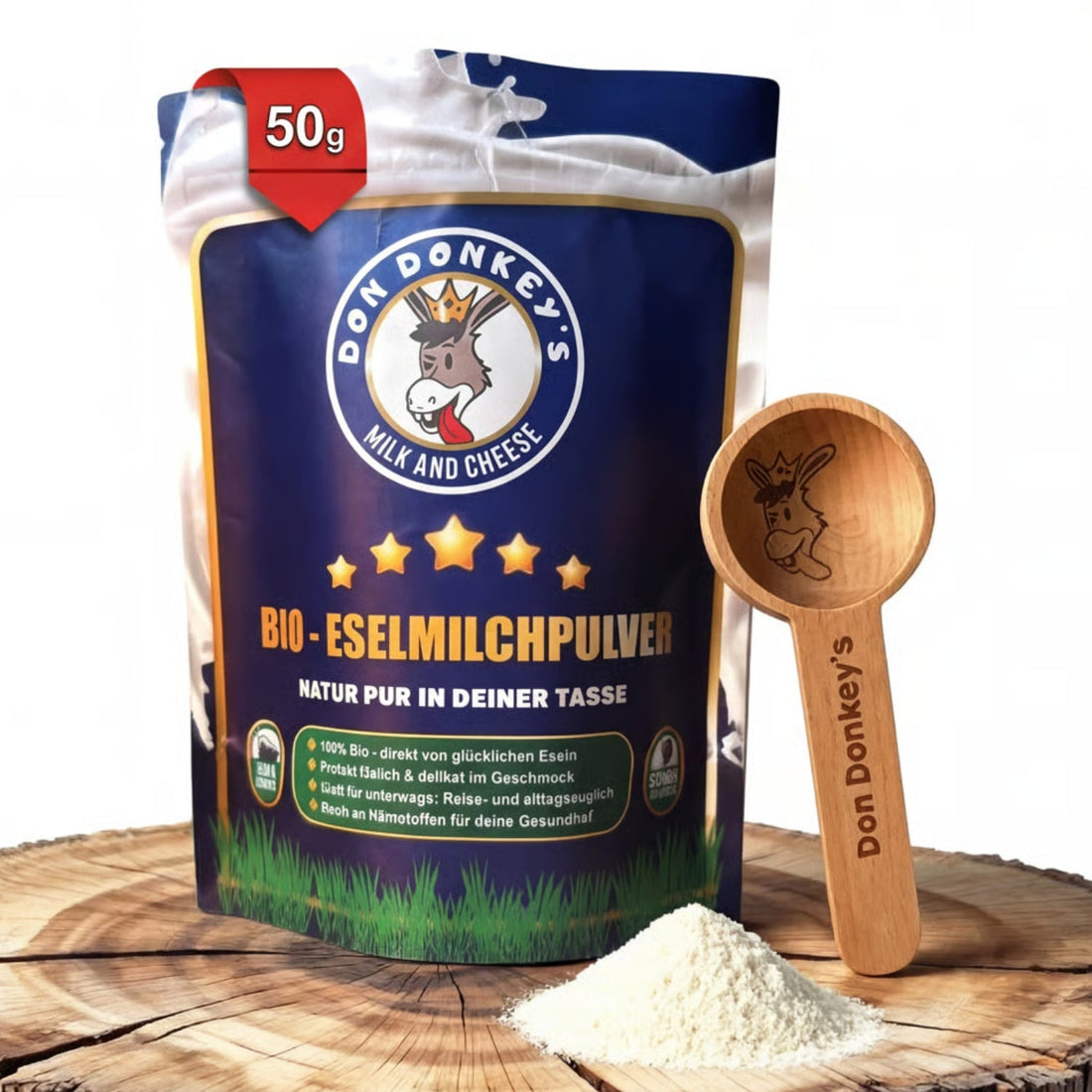
Donkey Milk Powder
Donkey milk in powder form
For anyone who prefers a longer shelf life: our donkey milk in powder form – easy to store and portion.
20g · Unit price: €1.245,00 / 1 kg · incl. VAT, plus shipping