
 Buyer protection

Research on donkey milk · Study 103
miRNA in milk vesicles: donkey, human and cow
In vesicles from the milk of three Dezhou jennies, 292 miRNAs were detected, 48 of them possibly novel. 73 mature miRNA sequences were also found in data sets on human and cow’s milk.
At a glance · swipe or use the arrows
The key figures
Study design
How it was studied
Milk from three Dezhou jennies (5 years, 2nd lactation, 28–45 days after birth) on a breeding farm in Qinghai, China, was processed separately for each animal. Extracellular vesicles (EVs) were enriched by centrifugation, enzymatic casein removal, precipitation and size-exclusion chromatography; electron microscopy, particle size measurement and marker proteins were determined only on the sample from animal D2. The small RNAs were sequenced and evaluated against the donkey genome and a miRNA database. Public data sets on vesicles from human milk (3 donors, around day 50 of lactation) and cow’s milk (7 cows) were reprocessed with the same analysis pipeline and compared descriptively via identical mature miRNA sequences; target gene predictions and enrichment analyses followed.
Interactive chart · values from the study
miRNAs detected per donkey milk sample
Values from Table 2 of the study; “Total” counts non-redundant miRNAs across all three samples.
Second analysis
Mature miRNA sequences shared by the data sets
Overlaps by 100 % identical sequence (text and Figure 2A). Pairwise in total: donkey–human 127, donkey–cow 114, human–cow 134.
Results
What the study measured
Sequencing of the three donkey samples yielded 84.76 million raw reads, 56.15 million of them after filtering; 67.84–72.02 % could be mapped to the donkey genome. In total, 292 miRNAs were found (244 known, 48 possibly novel), 203 to 257 per sample.
On sample D2, electron microscopy, particle measurement (main peak 127.5 nm, median 130.0 nm, 1.30 × 10¹² particles/mL) and marker proteins indicated material enriched in vesicles. These characterisations are not available for D1 and D3.
After uniform reanalysis, 261, 428 and 441 unique mature miRNA sequences remained for donkey, human and cow. 73 occurred in all three data sets, 127 were shared by donkey and human, 114 by donkey and cow.
Within the 73 shared sequences, the abundance ranking correlated most strongly between donkey and human (ρ = 0.773), followed by human–cow (0.603) and donkey–cow (0.495). In PCA and cluster analysis, however, the samples separated clearly by data set (PC1 65.42 %, PC2 15.33 %).
miR-143-3p and miR-122-5p were higher in the donkey data set than in both comparison data sets (miR-143-3p: 14,774.47 CPM compared with 193.67 and 13.52 CPM). Other miRNAs such as miR-30b-5p were markedly lower in the donkey; the differences therefore ran in both directions.
Target genes were predicted for 20 (donkey–human) and 25 (donkey–cow) selected miRNAs; after matching with experimentally supported entries, 9 and 10 genes remained. The few significant enrichments concerned, among other things, urea and nitrogen metabolism and cell adhesion; the authors explicitly regarded them only as hypotheses, not as evidence of an effect.
Authors’ conclusion: In the view of Yan et al. (2026), vesicles from donkey milk contained a diverse miRNA repertoire with a core of sequences also found in human and cow’s milk, but with their own abundance pattern; miR-143-3p and miR-122-5p stood out in the donkey data set. The authors regarded their results as descriptive, hypothesis-generating data and explicitly not as evidence of species-specific differences or biological effects.
Critical assessment
Strengths and limitations
Donkey, human and cow’s milk come from three independent studies with different sampling, vesicle isolation, library preparation and sequencing. The authors themselves stress that differences therefore cannot be attributed to species alone; the lactation stages also differed (donkey 28–45 days, human milk around day 50).
The donkey data are based on three jennies from one farm. Whether samples D1 and D3 were comparably enriched in vesicles is open, as microscopy, particle measurement and marker proteins are available only for D2; purity and yield were not determined.
Because of a fixed pipetting volume, about twice as much RNA went into the library for D1 as for D2 and D3 (2.67 vs. 1.35 ng). RNA integrity was not checked, and the authors no longer had records of library concentrations.
After reanalysis, 261 unique mature sequences are given for the donkey, although only 244 known miRNAs had been identified before. The methods section mentions only one shared batch for libraries and sequencing; only the limitations section mentions that the vesicles were isolated in two runs.
Target genes and pathways are based on computer predictions, not experiments. Whether miRNAs from milk vesicles survive processing and digestion or have any effect in the body was not examined; the authors explicitly do not infer any effect.
All raw data were reanalysed with a uniform pipeline, and only fully identical sequences were compared. The authors deliberately refrained from significance tests between the data sets, disclosed limitations in detail and deposited their sequence data publicly.
Editorial assessment: The study describes which small RNA molecules can be detected in vesicles from raw donkey milk and compares them cautiously with published data on other types of milk. Neither an effect in humans nor any statement about individual commercial products can be derived from the detection. To the research archive.
Research question for DON DONKEY’S®
How stable is the miRNA profile of donkey milk vesicles over the lactation, between breeds and after processing steps such as freeze-drying, when all types of milk are examined with the same method?
Original publication
Comparative small RNA profiling of donkey, human and bovine milk-derived extracellular vesicles reveals conserved and distinct miRNA abundance patterns
Original title of the publication.
Yan M., Gomchok D., Niangji C., Wuren T.
Food Chemistry: Molecular Sciences · 2026 · 13, 100457
College of Agriculture and Animal Husbandry and Research Center for High Altitude Medicine, School of Medicine, Qinghai University, Xining, Qinghai, China
10.1016/j.fochms.2026.100457: 10.1016/j.fochms.2026.100457
Transparency: Kunlun Talents Program of Qinghai Province. The authors declare no competing financial interests or personal relationships that could have influenced the work. No product-related statement for DON DONKEY’S®.
Summarised and reviewed by the DON DONKEY’S editorial team on the basis of the original publication · as of October 2026
The study summarised above was carried out independently of DON DONKEY’S® and does not relate to our products. It serves solely to inform about the state of research.
DON DONKEY’S® donkey milk and donkey milk powder are foods. They are not intended to prevent, treat or cure any disease and do not replace medical advice.

From our shop
DON DONKEY’S® donkey milk
100 % donkey milk · raw milk, frozen
On this page we report the findings of a published study. Independently of that, you will find our donkey milk here: 100 % donkey milk, frozen as raw milk.
100 ml bottle / 100ml · Unit price: €249,00 / 1 l · incl. VAT, plus shipping
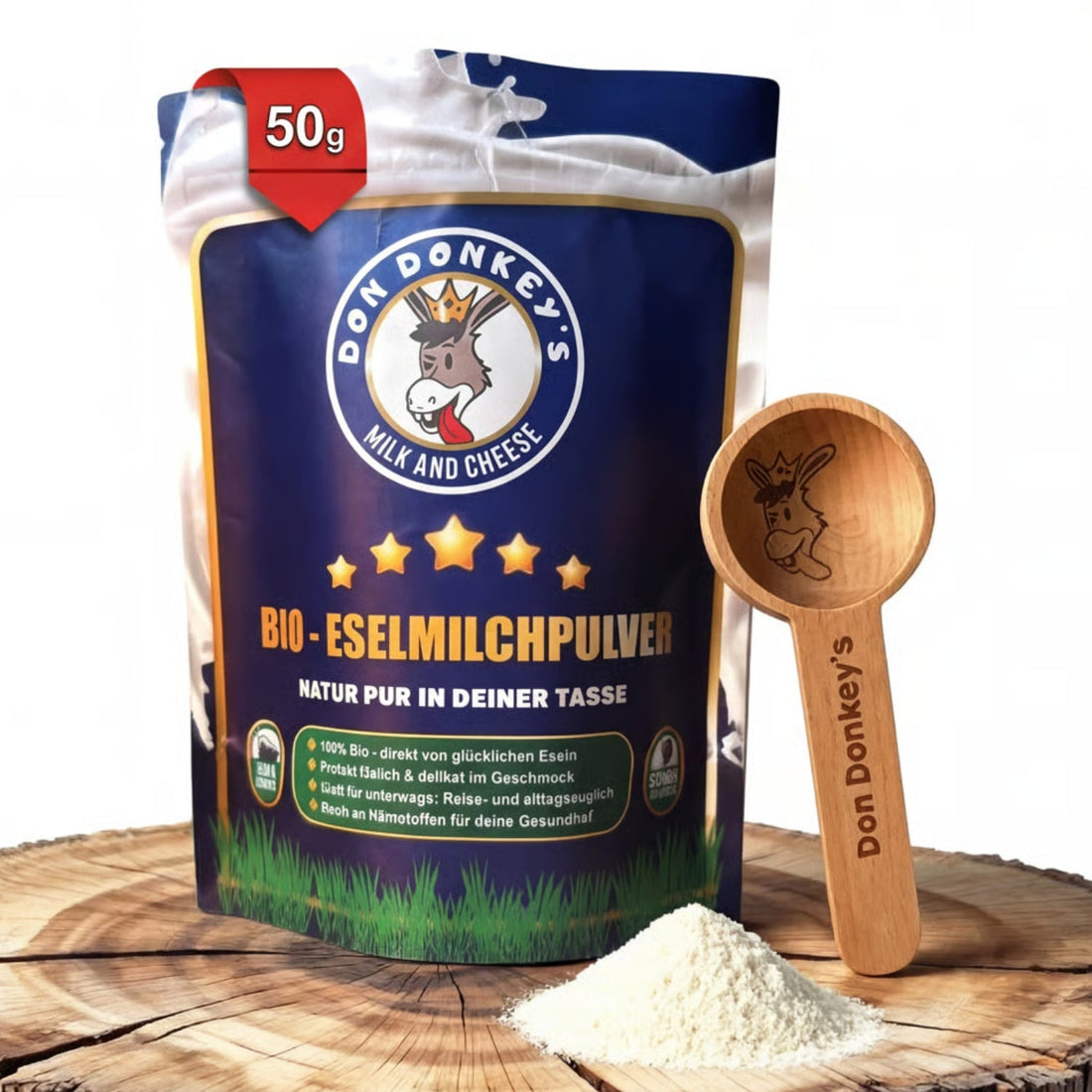
Also in our shop
Donkey Milk Powder
Donkey milk in powder form
For anyone who prefers a longer shelf life: our donkey milk in powder form – easy to store and portion.
20g · Unit price: €1.245,00 / 1 kg · incl. VAT, plus shipping