
 Buyer protection

Research on donkey milk · Study 10
Donkey milk and cow's milk allergy
In 2019 in Florence, Sarti et al. examined how children with cow's milk protein allergy tolerated donkey milk, how they grew with it over six months – and what the nutrient content and hygiene of the milk used were.
What it's about
Three questions in one study
Children with cow's milk protein allergy need an alternative to cow's milk. In Italy, donkey milk is also used for this. A team from paediatric allergology, nutritional counselling, veterinary medicine and food hygiene examined three questions at once:
Is donkey milk tolerated in a medically supervised challenge? How do children develop who receive it for six months as part of a supplemented diet? And what does the milk used contain microbiologically and in terms of nutrients?
The milk came from a herd of around 160 Amiata donkeys in central Italy. The children were cared for at the Anna Meyer Children's Hospital in Florence.
What exactly was studied?
Briefly explained
The terms used in this study
The most common form of cow's milk allergy. Antibodies usually trigger reactions quickly, for example on the skin or in the airways.
A delayed, non-IgE-mediated reaction of the gut to food protein, mainly in infants.
Under medical supervision, the child drinks gradually increasing amounts – the most reliable test of tolerability.
Colony-forming units per millilitre – a measure of the number of viable microorganisms in a sample.
81 children with cow's milk allergy underwent allergy testing.
78 children drank donkey milk in a medically supervised challenge.
22 children received donkey milk for six months, with fat and vitamin D supplementation and check-ups.
36 milk samples were tested for microorganisms, pathogens and nutrients.
Interactive · The data at a glance
Tolerability, growth, milk
How many children tolerated the challenge, how did they grow over six months – and what did the analysis of the milk show? Switch between the four views.
IgE-mediated allergy16 children
FPIES6 infants
Illustration of the values reported in the original publication. The arrangement of the dots is schematic.
Key findings
What the researchers report
77 of 78 children tolerated donkey milk
One child reacted. Three other children were not challenged because of positive allergy tests to donkey milk.
Growth not impaired
In the children with IgE allergy, the length z-score improved significantly, and weight developed as in the reference group.
Bacterial count around 94 % lower after pasteurisation
Salmonella, Listeria and Campylobacter were not detected in the raw milk samples. For vulnerable consumers, the authors recommend heat treatment.
The study had no control group, the children were selected and their diet was individually supplemented (3 g fat per 100 ml milk and vitamin D). No growth advantage from donkey milk can be derived from this. After pasteurisation, lysozyme was still active; the publication does not include a direct comparison with the raw milk.
Critical assessment
Well tolerated – under medical supervision
What the study shows
What it does not show
Research question for DON DONKEY’S®
What's in our milk – batch by batch?
The study shows how much a careful analysis of the milk used can reveal. For us this is a reason to document the nutrients and hygiene parameters of our own milk regularly and traceably.
Original publication
Donkey’s Milk in the Management of Children with Cow’s Milk Protein Allergy: Nutritional and Hygienic Aspects
Sarti L., Martini M., Brajon G., Barni S., Salari F., Altomonte I., Ragona G., Mori F., Pucci N., Muscas G., Belli F., Corrias F., Novembre E.
Italian Journal of Pediatrics · 2019 · 45:102
Anna Meyer Children's Hospital Florence, University of Pisa, IZS Lazio e Toscana
DOI: 10.1186/s13052-019-0700-4
Full text: PMC6698021
The publication describes the use of donkey milk from an Italian farm under medical supervision. It does not allow any product-related statement for DON DONKEY’S®.

From our shop
DON DONKEY’S® donkey milk
100 % donkey milk · raw milk, frozen
On this page we report the findings of a published study. Independently of that, you will find our donkey milk here: 100 % donkey milk, frozen as raw milk.
100 ml bottle / 100ml · Unit price: €249,00 / 1 l · incl. VAT, plus shipping
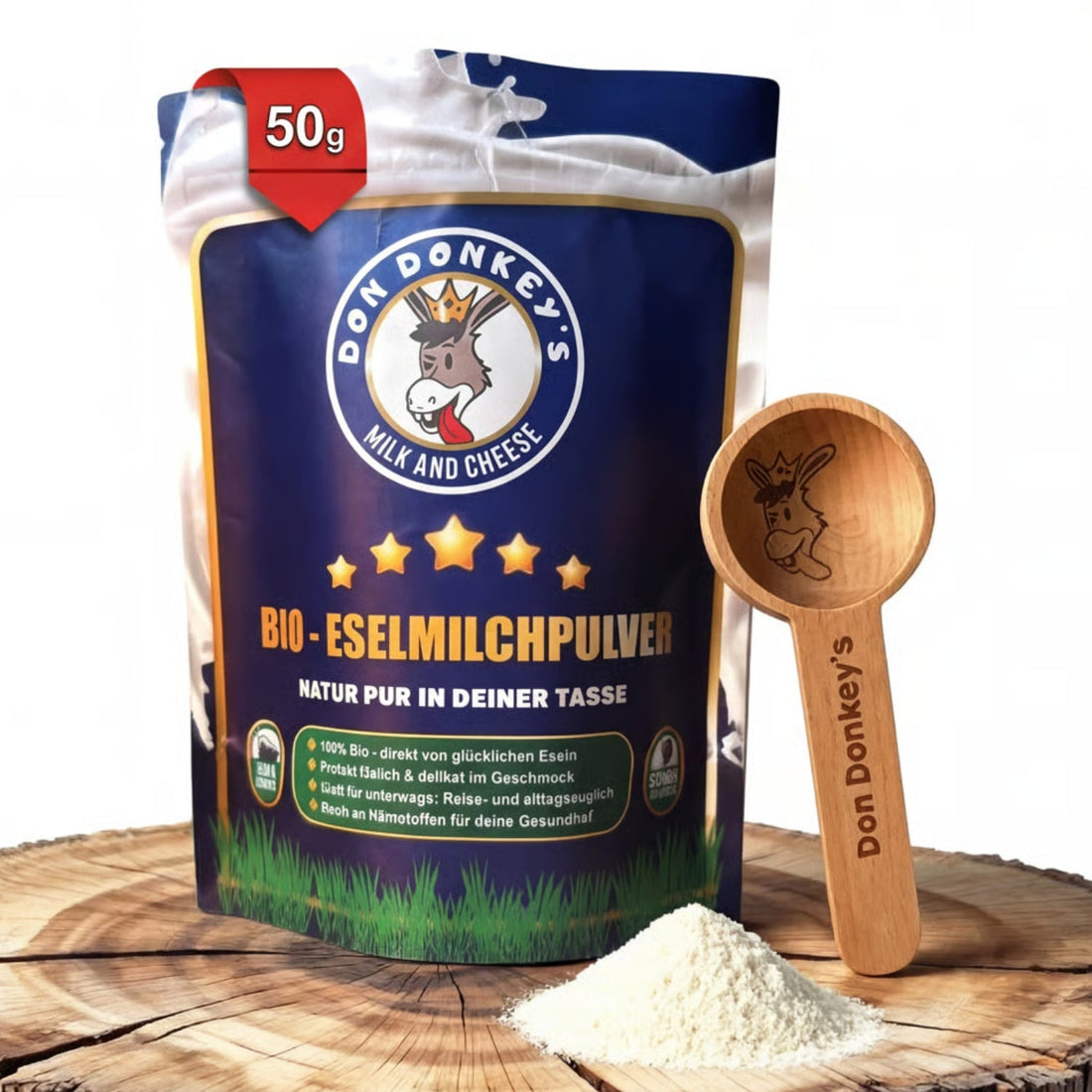
Also in our shop
Donkey Milk Powder
Donkey milk in powder form
For anyone who prefers a longer shelf life: our donkey milk in powder form – easy to store and portion.
20g · Unit price: €1.245,00 / 1 kg · incl. VAT, plus shipping