
 Buyer protection

Donkey milk knowledge archive · Historical source
Fact check: did Cleopatra really bathe in donkey milk?
No ancient text reports that Cleopatra bathed in donkey milk. The sources name Poppaea Sabina, Nero’s wife, around 95 years after Cleopatra’s death.
- Author
- Cross-check of ancient sources (Pliny the Elder, Cassius Dio) and research literature
- Work
- Fact check: did Cleopatra bathe in donkey milk?
- Passage
- Pliny, NH 9.119–121 (Cleopatra); NH 11.238 and 28.183 (Poppaea); Cassius Dio 62.28.1 (Poppaea)
- Time & place
- Cleopatra VII (69–30 BC) · Ptolemaic Egypt
- Type of source
- Fact check
In the original words
What the original says
duo fuere maximi uniones per omne aevum; utrumque possedit Cleopatra, Aegypti reginarum novissima
There were two pearls, the largest of all time; both were owned by Cleopatra, the last of the queens of Egypt.
Poppaea hoc Neronis principis instituit, balnearum quoque solia sic temperans, ob hoc asinarum gregibus eam comitantibus.
Poppaea, the wife of Emperor Nero, introduced this custom and also prepared her baths in this way; for this reason, whole herds of she-asses accompanied her.
English rendering: our own translation by the DON DONKEY’S editorial team, following the sense of the text.
Background
Who, when, what kind of text
Cleopatra VII (69–30 BC) was the last ruler of Ptolemaic Egypt. Ancient authors report extensively on her luxury, above all in connection with Mark Antony. The now widespread claim that she bathed in donkey milk is often repeated in advertising and guidebooks.
For this fact check, we examined the relevant ancient passages on donkey milk baths and on Cleopatra’s luxury and compared them with the research literature, in particular with the study by the medical historian Frank Ursin (2020).
Poppaea Sabina, the wife of Emperor Nero, died in AD 65 – about 95 years after Cleopatra. She is the person with whom the ancient sources associate the donkey milk bath.
Content
What the source reports about donkey milk
The ancient reports of baths in donkey milk name Poppaea without exception: Pliny the Elder (NH 11.238 and 28.183, c. AD 77), the satirist Juvenal (Satire 6, early 2nd c.) and Cassius Dio (62.28.1, early 3rd c.).
About Cleopatra’s luxury, Pliny tells a quite different story: she owned two exceptionally large pearls and, in a wager with Antony, dissolved one of them in vinegar and drank it in order to give the most expensive banquet (NH 9.119–121). There is no mention of donkey milk there.
Ursin (2020) concludes that no ancient source documents a donkey milk bath taken by Cleopatra. He traces the attribution back to the cinema of the 1930s: the same actress, Claudette Colbert, played both Poppaea and Cleopatra at that time; in her person both roles merged. On this basis, the 1963 Cleopatra film starring Elizabeth Taylor popularised the milk bath.
At a glance
Figures & facts from the source
Fact check
Recorded or just told?
Cleopatra bathed in donkey milk.
Not attested in antiquity. Ancient authors (Pliny, Juvenal, Cassius Dio) associate donkey milk baths with Poppaea Sabina, Nero’s wife. For Cleopatra, Pliny instead hands down the anecdote of the pearl dissolved in vinegar. According to Ursin (2020), the attribution to Cleopatra is a modern transfer from 20th-century cinema.
Critical assessment
How reliable is this source?
Result
The claim that Cleopatra bathed in donkey milk is not supported by ancient sources. The story is documented for Poppaea Sabina.
How the mix-up arose
According to Ursin (2020), it is a modern transfer that became popular through 20th-century film images. The paper appeared in the open-access classics journal “thersites” and is freely readable.
What the Poppaea sources provide
The reports about Poppaea are also anecdotes about luxury, not evidence of an effect. They show a Roman beauty practice, not its benefit.
Limits of the fact check
A missing record does not prove that Cleopatra never used donkey milk. It only shows that the widespread claim has no ancient basis.
Our assessment
We prefer to tell the story correctly: in the ancient sources, the famous donkey milk bath belongs to Poppaea, not Cleopatra. There, too, it is an anecdote about luxury – not evidence of an effect.
References
Sources to check
- Primary sourcePliny NH 9.119–121, Cleopatra’s pearls, Eng. trans. Bostock/Riley 1855 (Perseus)
https://www.perseus.tufts.edu/hopper/text?doc=Perseus%3Atext%3A1999.02.0137%3Abook%3D9%3Achapter%3D58 - Primary sourcePliny NH 28.183, Poppaea’s milk baths, Eng. trans. Bostock/Riley 1855, Book 28, ch. 50 (Perseus)
https://www.perseus.tufts.edu/hopper/text?doc=Perseus%3Atext%3A1999.02.0137%3Abook%3D28%3Achapter%3D50 - SupplementaryF. Ursin (2020): “The mother of chemical peeling” – Oder: Wie Kleopatra zum Bad in Eselsmilch kam, thersites 12, 38–70 (DOI 10.34679/thersites.vol12.95)
https://thersites-journal.de/index.php/thr/article/view/95
More sources and studies in the research archive. Summarised by the DON DONKEY’S editorial team, as of November 2026.
The source summarised above does not come from DON DONKEY’S® and does not refer to our products. It serves solely to inform about knowledge of donkey milk.
DON DONKEY’S® donkey milk and donkey milk powder are foods. They are not intended to prevent, treat or cure any disease and do not replace medical advice.

From our shop
DON DONKEY’S® donkey milk
100 % donkey milk · raw milk, frozen
On this page we reproduce a source on donkey milk. Independently of that, you will find our donkey milk here: 100 % donkey milk, frozen as raw milk.
100 ml bottle / 100ml · Unit price: €249,00 / 1 l · incl. VAT, plus shipping
Also in our shop
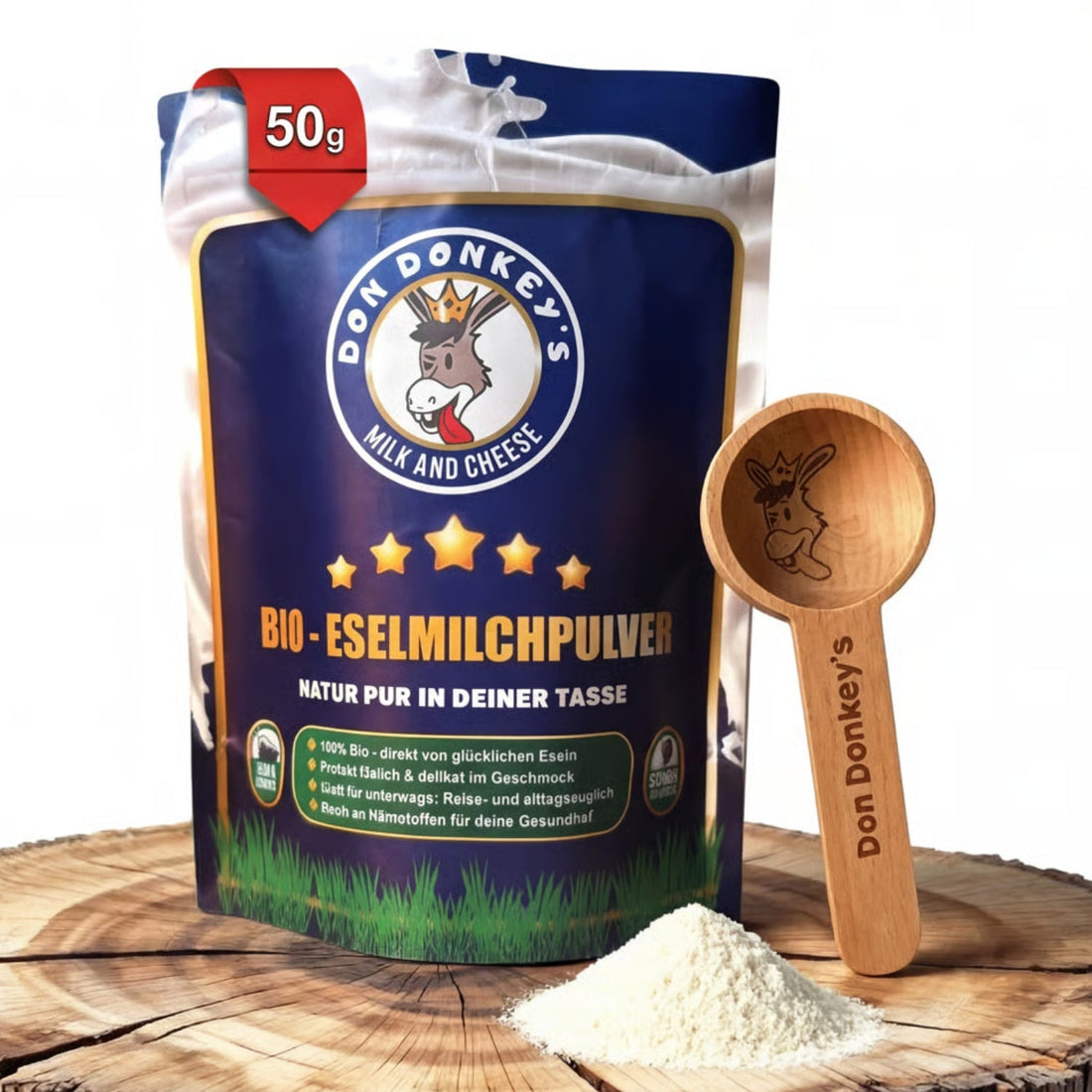
Donkey Milk Powder
Donkey milk in powder form
For anyone who prefers it longer-lasting: our donkey milk in powder form – easy to store and portion.
20g · Unit price: €1.245,00 / 1 kg · incl. VAT, plus shipping