
 Buyer protection

Donkey milk knowledge archive · Organisation & authority
China GB 19644-2024: donkey milk powder in a national standard for the first time
China’s 2024 milk powder standard names donkey milk powder for the first time: at least 2.5 g fat per 100 g and protein of at least 18 % of the non-fat solids. The animal species must be stated.
- Author
- National Health Commission (NHC) and State Administration for Market Regulation (SAMR) of the People’s Republic of China
- Work
- National food safety standard GB 19644-2024 “Milk powder and modified milk powder” (乳粉和调制乳粉), in force since 8.2.2025
- Passage
- Foreword; no. 2.1 (definition of milk powder); no. 3.3 Table 2 (protein, fat, acidity); no. 4.2 (statement of the animal species)
- Time & place
- 12 March 2024 · People’s Republic of China
- Type of source
- National standard (China)
In the original words
What the original says
The technical requirements for yak milk powder, camel milk powder, donkey milk powder, and horse milk powder are added.
Technical requirements for yak, camel, donkey and horse milk powder were added.
Milk powder from other animal sources shall be marked with animal varieties, such as “goat milk powder” or “powdered goat milk.”
Milk powder of other animal origin must be labelled with the animal species, for example “goat milk powder”.
English rendering: our own translation by the DON DONKEY’S editorial team, following the sense of the text.
Background
Who, when, what kind of text
In China, national food safety standards (GB standards) lay down binding requirements for product groups. On 12 March 2024, the National Health Commission and the market regulator published a total of 47 new or revised standards, including GB 19644-2024 for milk powder. It replaces GB 19644-2010 and has applied since 8 February 2025.
The draft had been notified to the World Trade Organization in 2020 and again in 2023. The Chinese explanatory notes on the draft state that milk from yak, donkey, horse and camel had developed into raw material sources of growing volume in China; until then, there was only a regional standard of the Xinjiang Autonomous Region for donkey milk powder (DBS 65/019-2017).
According to the explanatory notes, the limits for donkey milk powder are based on measurement data from the industry: for the protein share, 136 batches were evaluated up to August 2020.
Content
What the source reports about donkey milk
The standard defines milk powder as a powdered product made from the raw milk of a single animal species (no. 2.1). Modified milk powder must contain at least 70 per cent milk solids from the main raw material (no. 2.2).
For donkey milk powder, Table 2 specifies: protein at least 18 per cent of the non-fat milk solids, at least 11.0 g per 100 g for modified donkey milk powder; fat (whole milk powder only) at least 2.5 g per 100 g; acidity of the reconstituted milk at most 6 °T. For comparison: cow’s milk powder at least 34 per cent protein of the non-fat solids and 26.0 g fat per 100 g.
Under no. 4.2, only cow’s milk powder may simply be called “milk powder”; milk powder from other animal species must be labelled with the animal species. In principle, this corresponds to the EU rule for liquid milk.
In the explanatory notes to the draft, the measured protein share in 136 batches of donkey milk powder was 17.9 to 23.6 per cent of the non-fat solids (mean 20.8 per cent).
At a glance
Figures & facts from the source
Critical assessment
How reliable is this source?
Type of source
Binding national product standard. The official text is in Chinese; the English version used here is an unofficial translation by the US Department of Agriculture, and the figures match the Chinese draft.
What the values mean
These are minimum or maximum values for a commercial product, not typical averages. The low fat minimum reflects the low fat content of donkey milk.
Omitted parts
The standard also contains food safety requirements; they are not the subject of this entry.
Significance
With its inclusion in a national standard, donkey milk powder is recognised as a product category of its own in China.
Our assessment
The Chinese standard shows how a large producer market classifies donkey milk powder legally: with its own minimum values and a statement of the animal species. It does not apply to products in the EU.
References
Sources to check
- Primary sourceUSDA FAS report CH2024-0055 with unofficial English translation of the standard (PDF)
https://apps.fas.usda.gov/newgainapi/api/Report/DownloadReportByFileName?fileName=Updated%20National%20Food%20Safety%20Standard%20for%20Milk%20Powder%20and%20Modified%20Milk%20Powder_Beijing_China%20-%20People%27s%20Republic%20of_CH2024-0055 - Primary sourceChinese draft with explanatory notes, notified to the WTO (G/SPS/N/CHN/1160/Add.1, 2023)
https://members.wto.org/crnattachments/2023/SPS/CHN/23_09975_00_x.pdf
More sources and studies in the research archive. Summarised by the DON DONKEY’S editorial team, as of November 2026.
The source summarised above does not come from DON DONKEY’S® and does not refer to our products. It serves solely to inform about knowledge of donkey milk.
DON DONKEY’S® donkey milk and donkey milk powder are foods. They are not intended to prevent, treat or cure any disease and do not replace medical advice.

From our shop
DON DONKEY’S® donkey milk
100 % donkey milk · raw milk, frozen
On this page we reproduce a source on donkey milk. Independently of that, you will find our donkey milk here: 100 % donkey milk, frozen as raw milk.
100 ml bottle / 100ml · Unit price: €249,00 / 1 l · incl. VAT, plus shipping
Also in our shop
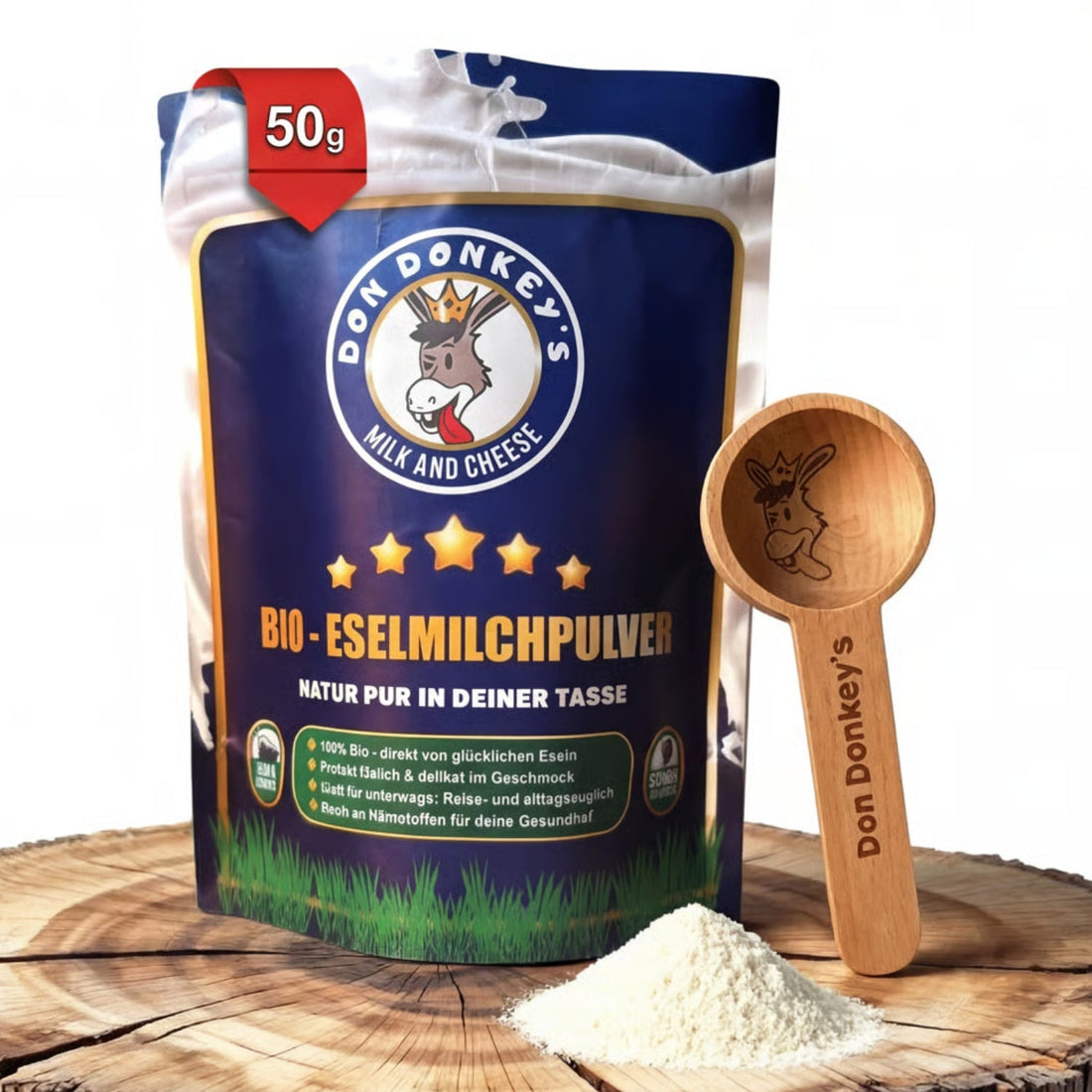
Donkey Milk Powder
Donkey milk in powder form
For anyone who prefers it longer-lasting: our donkey milk in powder form – easy to store and portion.
20g · Unit price: €1.245,00 / 1 kg · incl. VAT, plus shipping