
 Buyer protection

Donkey milk knowledge archive · Historical source
Mrs Beeton (1861): ass’s milk in the “Book of Household Management”
The most famous Victorian household manual, Isabella Beeton’s “Book of Household Management” of 1861, compares seven kinds of animal milk with human milk in its chapter on milk. Ass’s milk, says paragraph 1613, comes nearest to human milk of any other.
- Author
- Isabella Mary Beeton (1836–1865)
- Work
- The Book of Household Management, London: S. O. Beeton 1861
- Passage
- Chapter XXXII “General Observations on Milk, Butter, Cheese, and Eggs”, section “Milk”, § 1613, p. 807
- Time & place
- 1861 (previously in monthly parts from 1859) · London
- Type of source
- Household manual and cookery book
In the original words
What the original says
Milk of the human subject is much thinner than cow's milk; Ass's milk comes the nearest to human milk of any other; Goat's milk is something thicker and richer than cow's milk;
Human milk is much thinner than cow’s milk; of all other kinds, ass’s milk comes [according to Beeton] closest to human milk; goat’s milk is somewhat thicker and richer than cow’s milk;
English rendering: our own translation by the DON DONKEY’S editorial team, following the sense of the text.

A look at the original
What the passage looks like
Page 807 of the first edition (London 1861) with paragraph 1613: ass’s milk compared with human, cow’s, goat’s, ewe’s, mare’s, camel’s and buffalo’s milk.
The page comes from a freely accessible digitised copy. Click to open the passage at the library.
Wellcome Collection, Digitalisat via Internet Archive; gemeinfrei
Background
Who, when, what kind of text
Isabella Beeton was in her mid-twenties when the book appeared. Her husband, the publisher Samuel Orchart Beeton, issued it in monthly parts from 1859 and in 1861 as a single volume of 1,112 pages. It is addressed to the middle-class mistress of the house and covers cookery, provisions, servants, sick-nursing and the law. Its paragraphs are numbered consecutively.
The book became one of the most successful manuals of the nineteenth century and continued to appear in revised editions long after Beeton’s early death in 1865. Besides recipes, it contains many short factual texts on the origin and properties of foods. Such texts were often compiled from older works; the book names only some of its sources.
Content
What the source reports about donkey milk
Chapter XXXII opens with general remarks on milk. Beeton explains that she will confine herself to cow’s milk, as it is by far the most useful in England. A single paragraph, number 1613, then briefly compares the milk of various animals with human milk.
Human milk is much thinner than cow’s milk, and ass’s milk comes nearest to it of any other. Goat’s milk is thicker and richer than cow’s, ewe’s milk yields more cream, and mare’s milk contains more sugar. Camel’s milk is used only in Africa, buffalo’s milk in India. At this point the book gives no recipes or uses for ass’s milk.
Donkey milk is not a substitute for breast milk or infant formula; infant feeding belongs in medical hands. Beeton’s sentence is a comparison of kinds of milk according to the knowledge of 1861, not a recommendation.
At a glance
Figures & facts from the source
Timeline
Where this source stands in the history of donkey milk
Each dot is a source from our knowledge archive – from Greek antiquity to the present day.
Critical assessment
How reliable is this source?
Source value
First edition, verifiable page by page in the Wellcome Library scan. The book reached a very large readership and shows what a Victorian housewife could read about milk. The passage contains no original research; it reflects the prevailing opinion.
One sentence, not a chapter
Ass’s milk plays only a minor role in the household book. That it nevertheless appears in a short comparison shows that its similarity to human milk was considered common knowledge around 1860, even outside medical textbooks.
Today’s assessment
Modern analyses confirm that donkey milk is closer to human milk than cow’s milk in some respects, such as its high lactose and low fat content; in others it differs markedly. It is not equivalent.
Our assessment
Mrs Beeton’s book stood in countless Victorian kitchens. That ass’s milk appears there in passing as the milk most similar to human milk shows how widespread this idea was around 1860.
References
Sources to check
- Primary sourceIsabella Beeton, The Book of Household Management, London: S. O. Beeton 1861, chapter XXXII “General Observations on Milk, Butter, Cheese, and Eggs”, § 1613, p. 807 (Wellcome Library copy in the Internet Archive)
https://archive.org/details/b20392758/page/n876/mode/1up - SupplementaryFull text at Project Gutenberg (eBook 10136), paragraph 1613
https://www.gutenberg.org/cache/epub/10136/pg10136-images.html#id09227
More sources and studies in the research archive. Summarised by the DON DONKEY’S editorial team, as of November 2026.
The source summarised above does not come from DON DONKEY’S® and does not refer to our products. It serves solely to inform about knowledge of donkey milk.
DON DONKEY’S® donkey milk and donkey milk powder are foods. They are not intended to prevent, treat or cure any disease and do not replace medical advice.

From our shop
DON DONKEY’S® donkey milk
100 % donkey milk · raw milk, frozen
On this page we reproduce a source on donkey milk. Independently of that, you will find our donkey milk here: 100 % donkey milk, frozen as raw milk.
100 ml bottle / 100ml · Unit price: €249,00 / 1 l · incl. VAT, plus shipping
Also in our shop
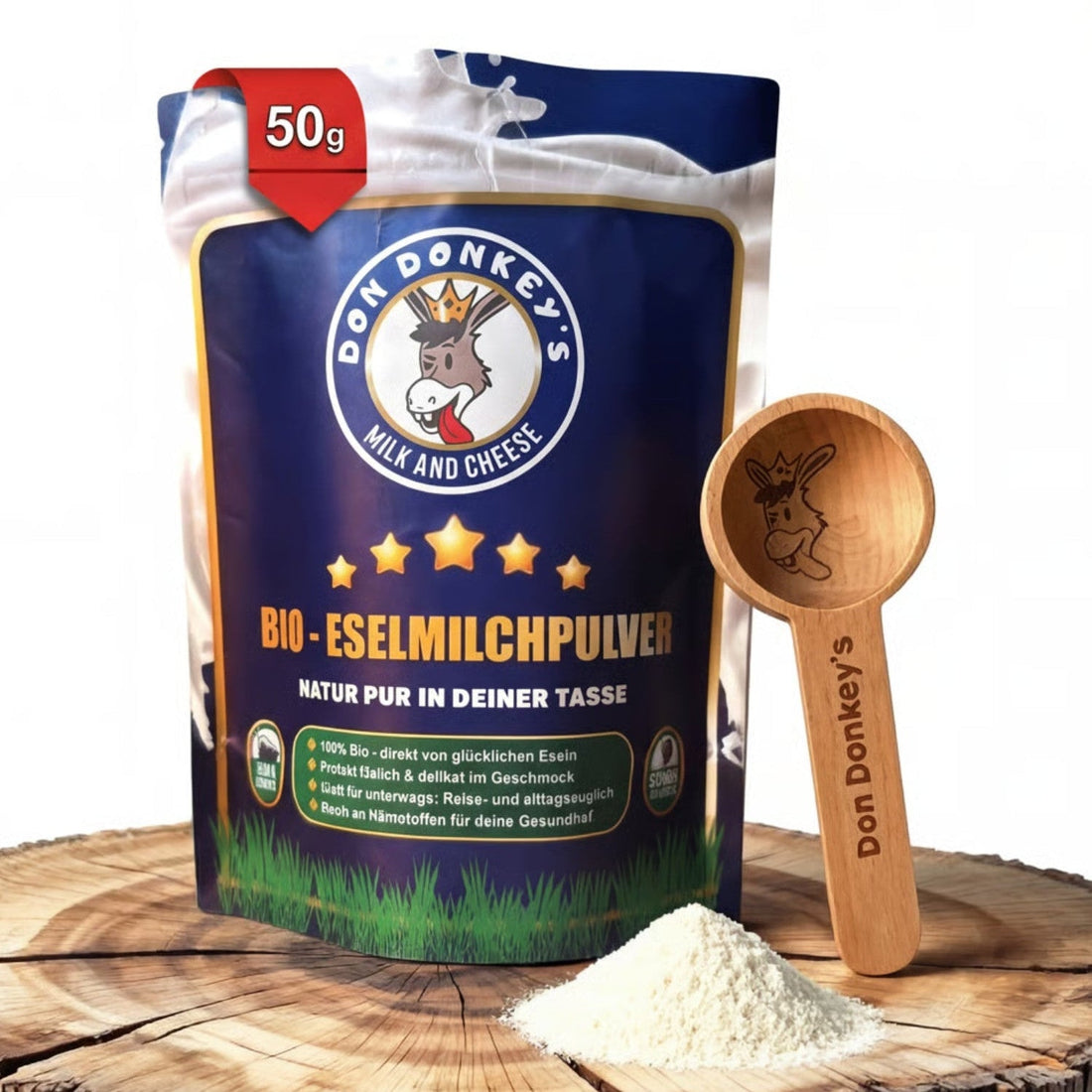
Donkey Milk Powder
Donkey milk in powder form
For anyone who prefers it longer-lasting: our donkey milk in powder form – easy to store and portion.
20g · Unit price: €1.245,00 / 1 kg · incl. VAT, plus shipping