
 Buyer protection


Contents
- Requirements do not start with a protein shake, but...
- Protein is not the same as a protein source.
- "Special" does not automatically mean "high in protein".
- Four things you should check on a nutritional table.
- Protein throughout the day: not complicated, but understandable.
- Why we at DON DONKEY'S® do not measure every...
- When general nutrition tips are not enough.
- Discover donkey milk – with open eyes for the...
- FAQ: Protein requirements without myths
- Knowledge instead of promises.
How much protein does the body really need?
Amidst protein shakes, gram counts, and nutrition myths, it is easy to lose sight of a simple question: How can daily protein requirements be effectively met with ordinary foods?
A well-founded nutrition guide – with an honest assessment of cow's milk and donkey milk.
Protein is not a fad nutrient. The body needs protein to build and renew its own structures. Nevertheless, daily requirements are often either overestimated or not consciously perceived at all. Especially those who are more intensively involved with their nutrition come across very different figures – and foods that are advertised as particularly "high in protein".
This article sorts out the basics: What do reference values say? How do you calculate requirements? Which foods actually contribute to this? And why is not every milk automatically a significant source of protein?
Requirements do not start with a protein shake, but with body weight.
The German Nutrition Society (DGE) states an estimated value or reference value for adults aged 19 to under 65 years of 0.8 grams of protein per kilogram of body weight per day. For people aged 65 and over, an estimated value of 1.0 grams per kilogram is given. These are orientation values for the respective age group, not a diagnosis and not a rigid goal for every life situation.
per day at 0.8 g/kg
per day at 0.8 g/kg
Calculation examples, not individual nutritional recommendations. Separate considerations apply for sports, pregnancy, breastfeeding, and special life situations.
The distribution is also important: A normal day with bread, legumes, dairy products, eggs, or other protein sources can already provide substantial amounts. Not every single food has to contain an exceptionally high amount of protein for this.
Protein is not the same as a protein source.
The figures on packaging usually refer to 100 grams or 100 milliliters. This makes comparisons convenient – but sometimes misleading. Because a standard serving can be significantly smaller or larger.
Illustrative estimates; nutritional values vary by product, variety, and analysis. The bars visualize exemplary protein amounts per stated serving, not the biological protein quality. The values are not a product-specific laboratory analysis by DON DONKEY'S®.
"Special" does not automatically mean "high in protein".
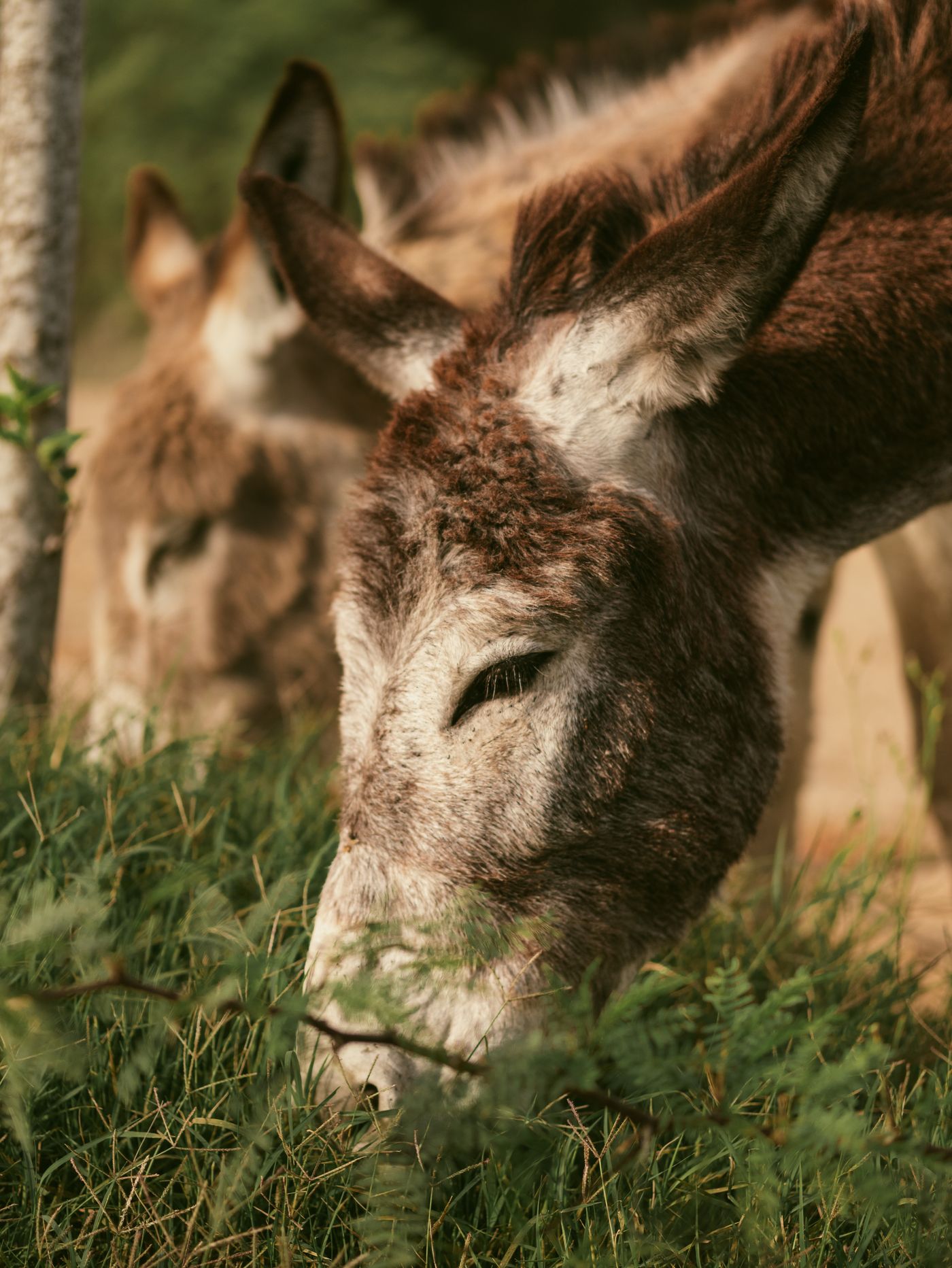
Donkey milk is a rare food with a characteristic composition. But this very peculiarity leads to misunderstandings: Someone who buys an exclusive natural product sometimes automatically expects high protein values. In fact, the protein content of donkey milk is often below that of cow's milk in published analyses. Values can also vary between individual samples. You can find a detailed comparison in the article Donkey milk or cow's milk: the differences.
This is neither a deficiency nor a judgment of quality. It simply describes the composition of a different type of milk. For the targeted coverage of a high protein requirement, legumes, quark, eggs, or other high-protein foods are often more suitable.
How many grams of protein does a portion actually consumed provide?
Which protein fractions and other ingredients are included? This is a different question from that of quantity.
Four things you should check on a nutritional table.
Recognize the reference quantity
Is the protein indication for 100 g, 100 ml, or a serving? A comparison only works with the same basis.
Calculate the actual serving
200 ml of a milk with 3.3 g of protein per 100 ml provides about 6.6 g of protein. Calculating is more sensible than a marketing promise.
Look at the entire food
Protein is only one factor. Energy, fat, carbohydrates, salt, tolerability, and food hygiene are also part of the decision.
Separate marketing from reference values
"Protein source" and "high protein content" are regulated nutrition claims in the EU. They should not be derived from a mere product story.
Protein throughout the day: not complicated, but understandable.
A varied diet can distribute several protein sources throughout the day. This does not have to be a meticulous gram planning or a special diet. Anyone looking for an overview can write down two or three typical days and compare the actual serving sizes with the nutritional information.
Breakfast
For example, yogurt or a plant-based alternative with a known protein content, combined with oatmeal and fruit.
Lunch
Legumes, grains, vegetables, and depending on the diet, other protein sources make up a varied meal.
Snack
A small portion of quark, nuts, or another suitable food can contribute to the daily balance.
Dinner
A normal meal with a protein source and sufficient energy rounds off the day.
Examples, not an individual nutrition plan. In the case of allergies, intolerances, or illnesses, select foods accordingly.
Why we at DON DONKEY'S® do not measure every food by a single nutritional value.
People deal with their nutrition for different reasons. For us, a clear principle applies: Donkey milk is a food and not a medicine.
"A food may be special without us attributing properties to it that are not proven."
We see our role in providing transparent information about origin, composition, processing, and use. Anyone who specifically needs more protein should choose based on actual protein amounts. Anyone interested in donkey milk should know what it is – and just as well, what it is not.
When general nutrition tips are not enough.
In the case of a persistent lack of appetite, unintentional weight loss, swallowing difficulties, or an illness, the nutrient requirements should be clarified by a doctor or a nutrition professional. Especially during periods of illness, energy and protein requirements, food safety, and tolerability may be assessed differently than in healthy adults.
Discover donkey milk – with open eyes for the nutritional values.
DON DONKEY'S® offers fresh donkey milk and donkey milk powder. Both products differ in water content, handling, and preparation. The powder is concentrated, but how much protein a prepared serving provides depends on the actual product value and the amount used. Please orient yourself on the concrete declaration instead of general statements.

Fresh Donkey Milk
Natural milk product, delivered frozen. Please note the instructions on the label.
Fresh Donkey Milk
Donkey Milk Powder
Dried form for different handling; observe the declaration and preparation.
Donkey Milk PowderFAQ: Protein requirements without myths
Does every adult need a protein shake daily?
No. Many people can meet their requirements with a varied diet. A supplement is not automatically necessary.
Is donkey milk a particularly high-protein milk?
Typically not. Published composition analyses often show lower protein amounts than cow's milk. The concrete product declaration is decisive.
How do I calculate my rough protein requirements?
For healthy adults under 65 years, 0.8 g per kilogram of body weight can serve as a DGE reference value. At 75 kg, this would be calculated as 60 g per day. Individual circumstances can vary.
Can too much protein be problematic?
A continuously high intake should be assessed by a doctor, especially in the case of certain pre-existing conditions. More is not automatically better.
Is protein the same as milk sugar?
No. Protein and lactose are different components of milk. Lactose intolerance is not the same as a milk protein allergy.
Is donkey milk intended for special nutritional situations?
No. Donkey milk is a food and not a medicine. In the case of illnesses, the diet should be coordinated with a doctor or a nutrition professional. Please also note the instructions on the label.





