
 Buyer protection


Contents
- Low fat is only part of the answer.
- Seven types of milk compared directly.
- What really distinguishes the types of milk?
- How much fat does a glass of milk contain?
- What exactly is in our donkey milk?
- Why donkey milk differs from cow's milk.
- Which milk suits your priorities?
- The most important answers.
- Discover a special milk for yourself.
- Understanding our nutritional information.
Which milk is low in fat?
You want to watch your fat intake and are wondering which milk is the right choice? There are significant differences between whole milk, skimmed milk, oat, almond and soy drinks, and donkey milk.
We compare seven types of milk using specific nutritional values. You will find out which milk is low in fat, how much protein it provides, and why calories, milk sugar, and fatty acids are also important.
Compare nutritional values →
Low fat is only part of the answer.
If you want to consume as little fat as possible, skimmed milk is an obvious choice. It contains at most 0.5% fat. But other types of milk can also be interesting – with sometimes completely different nutrient profiles.
An unsweetened almond drink, for example, can be very low in calories, but often provides little protein. Soy drinks often contain more protein, while oat drinks can have a higher carbohydrate content.
Donkey milk also differs significantly: Our DON DONKEY'S® donkey milk has on average only 0.6 g of fat per 100 ml in the published nutritional table. At the same time, it contains 6.5 g of natural milk sugar.
The lowest fat level commonly available in cow's milk.
Average fat content according to our product declaration.
Classic whole milk contains significantly more fat.
Seven types of milk compared directly.
For a meaningful comparison, we need more than just the fat content. That is why we also look at calories, protein, carbohydrates, and sugar. All figures refer to 100 ml.
| Type of milk | kcal | Fat | Saturated | Protein | Carbs | Sugar |
|---|---|---|---|---|---|---|
| Whole cow's milk, 3.5% | 64 | 3.5 g | 2.3 g | 3.3 g | 4.7 g | 4.7 g |
| Low-fat cow's milk, 1.5% | 47 | 1.5 g | 1.0 g | 3.3 g | 4.8 g | 4.8 g |
| Skimmed milk, reference value | 35 | 0.1 g | 0.1 g | 3.7 g | 5.0 g | 5.0 g |
| Oat drink without sugar* | 44 | 1.5 g | 0.2 g | 0.8 g | 6.4 g | 0.0 g |
| Almond drink without sugar* | 14 | 1.1 g | 0.0 g | 0.5 g | 0.0 g | 0.0 g |
| Soy drink without sugar* | 33 | 1.9 g | 0.3 g | 3.3 g | 0.0 g | 0.0 g |
| DON DONKEY'S® donkey milk | 39 | 0.6 g | 0.3 g | 1.8 g | 6.5 g | 6.5 g |
All figures per 100 ml, rounded. Cow's milk: typical reference values. * Plant-based drinks: typical unsweetened products, values vary by manufacturer. DON DONKEY'S®: published average nutritional information for fresh donkey milk. Figures from individual manufacturers and batches may vary.
What stands out about this table: Our donkey milk contains 0.6 g of fat per 100 ml, which is around 83% less fat than whole cow's milk with 3.5 g. At the same time, it provides less protein than cow's milk, but more natural milk sugar. This is a concrete difference in composition – not a blanket quality judgment.
What really distinguishes the types of milk?
Similar fat amounts do not automatically mean similar foods. Especially when comparing animal milk and plant-based drinks, it is worth looking at the individual nutrient groups.
Cow's milk: fat levels instead of different basic ingredients
For whole milk, low-fat cow's milk, and skimmed milk, the starting point is the same. By separating and partially returning milk fat, different fat levels are created.
This is why the products differ significantly in fat content, while protein, lactose, and calcium remain comparatively similar. Fat-soluble vitamins may decrease with the fat content.
Oat drink: carbohydrates despite zero grams of sugar
The unsweetened oat drink considered contains 6.4 g of carbohydrates, but according to the declaration, 0 g of sugar per 100 ml.
This is not a contradiction: Not all carbohydrates are sugar. The key is the distinction between total carbohydrates and "of which sugar". Added oils also influence the fat content.
Almond drink: low calories, but also low protein
The almond drink considered provides only 14 kcal and 1.1 g of fat per 100 ml. This makes it particularly low in energy among our reference products.
However, with 0.5 g of protein, it provides significantly less protein than cow's milk or the compared soy drink. Therefore, anyone who regularly replaces milk should also pay attention to the remaining nutrient supply.
Soy drink: A plant-based protein comparison
The unsweetened soy drink provides 3.3 g of protein and 1.9 g of fat per 100 ml.
Its protein content is thus approximately at the same level as low-fat cow's milk in our comparison. Calcium and certain vitamins are often added to plant-based drinks. The exact composition is on the packaging.
Donkey milk: Low fat, but more lactose
Our donkey milk contains on average 0.6 g of fat, 1.8 g of protein, and 6.5 g of carbohydrates per 100 ml. The carbohydrates consist predominantly of natural milk sugar.
Compared to whole cow's milk, the fat content is significantly lower. At the same time, donkey milk is not low in carbohydrates and is not lactose-free. The natural lactose contributes to its mild, slightly sweet taste.
Saturated fatty acids: Considering the type of fat
Total fat is not the only interesting figure. The distribution between saturated and unsaturated fatty acids also differs depending on the milk.
According to our nutritional declaration, our donkey milk contains 0.3 g of saturated fatty acids with 0.6 g of total fat. The compared soy drink contains 0.3 g of saturated fatty acids with 1.9 g of total fat. The absolute amounts and their proportions are therefore different ways of looking at it.
How much fat does a glass of milk contain?
A nutritional table usually refers to 100 ml. However, a normal glass often contains 200 to 250 ml. The quantity makes a noticeable difference in a comparison.
For a glass with 250 ml, we multiply the figures from the table by 2.5.
Fat in 250 ml.
Fat in 250 ml.
Fat in 250 ml.
A glass of our donkey milk therefore contains 7.25 g less fat than an equally large glass of whole cow's milk with 3.5% fat, based on the published average values.
Don't forget the calories: 250 ml of DON DONKEY'S® donkey milk provides approximately 97.5 kcal according to our nutritional table. The amount of fat alone does not explain the entire energy content: Milk sugar and protein also contribute to this.
What exactly is in our donkey milk?
At DON DONKEY'S®, we want to not only talk about special properties, but also explain them clearly with figures.
Our published nutritional table states 39 kcal, 0.6 g of fat, 6.5 g of carbohydrates, and 1.8 g of protein for 100 ml of fresh donkey milk on average.
This composition differs significantly from whole cow's milk. Donkey milk has its own ratio of the main nutrients. This is precisely what makes it interesting for a professional comparison.
We do not sell donkey milk because we want to badmouth other types of milk. Our goal is to transparently explain a rare natural product and make its special features understandable.
Discover our donkey milk →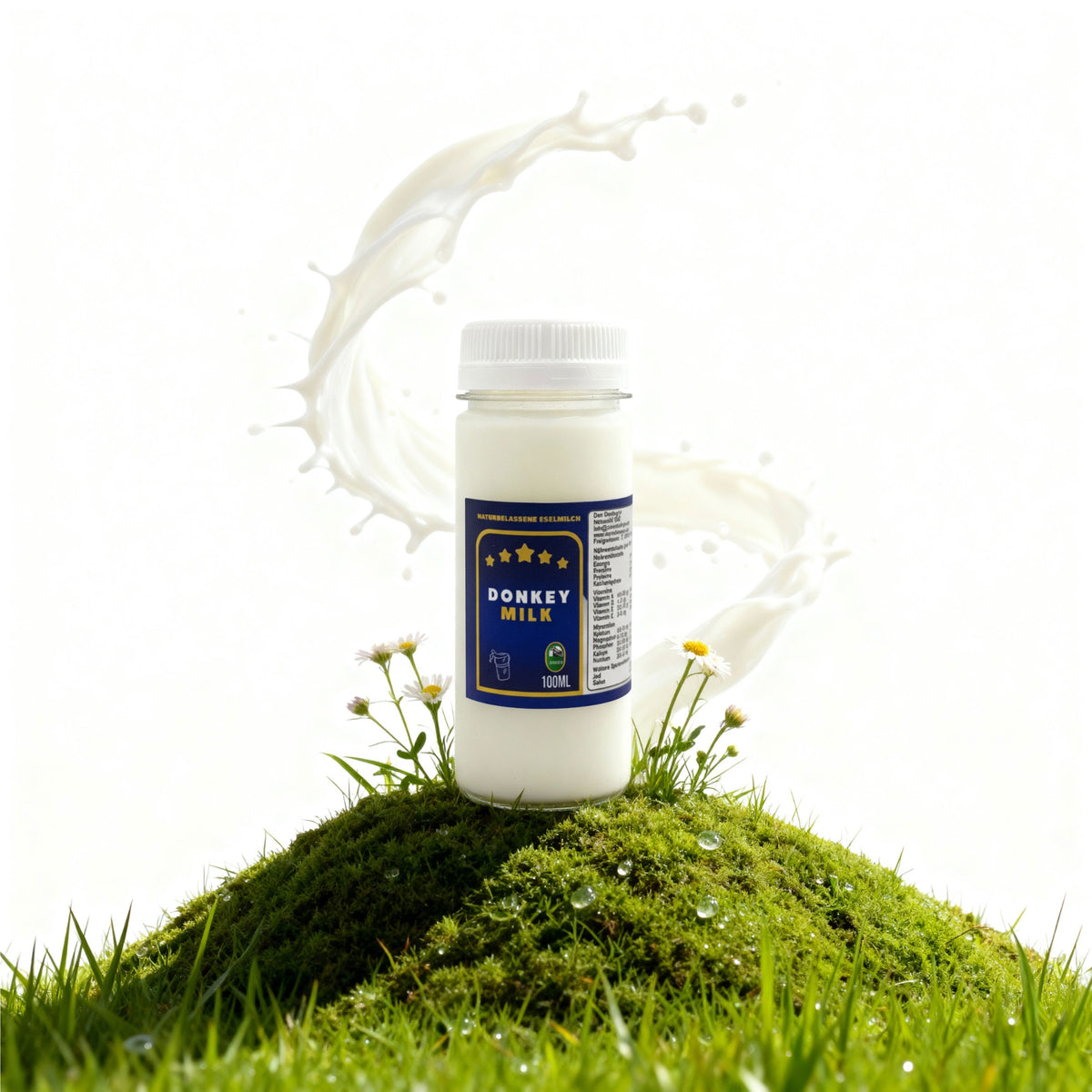
Per 100 ml.
Of which 0.3 g saturated fatty acids.
Natural sugar per 100 ml.
Average per 100 ml.
Why the values can fluctuate: Donkey milk is a natural product. Its composition depends on several factors, including the individual animal, the lactation phase, feeding, and housing conditions. Our nutritional information is therefore average values based on published analysis data – not a guarantee for every single batch.
Why donkey milk differs from cow's milk.
Milk is not a uniform food. Different animal species produce milk with different ratios of fat, protein, and lactose. This composition is shaped by several factors, including the biology of the respective animal species.
The fat content
Donkey milk typically contains less fat than whole cow's milk. Our published average values are 0.6 g per 100 ml.
For scientific classification, it is important that the literature also describes other values. Fat contents can vary with the lactation phase, feeding, and individual differences.
The milk sugar
Our donkey milk contains on average 6.5 g of natural milk sugar per 100 ml. This is above the typical lactose content of cow's milk.
The higher lactose content contributes to the slightly sweet taste. But it also means: donkey milk is not a lactose-free alternative.
The milk proteins
With an average of 1.8 g of protein per 100 ml, our donkey milk contains less total protein than typical cow's milk.
Furthermore, the distribution of individual protein fractions differs. Components such as lysozyme and lactoferrin are scientifically studied. However, this does not lead to a blanket health effect.
Production and storage
Our donkey milk is hand-milked on European partner farms, deep-frozen after milking, and laboratory-tested in Germany.
We offer it as unpasteurized raw milk. Please pay attention to the storage and consumption instructions on the label.
Our understanding of quality: Our fresh donkey milk is raw milk. Please pay attention to the storage and consumption instructions on the label. After thawing, it must be stored refrigerated and consumed within three days. Do not refreeze.
Which milk suits your priorities?
The comparison shows that there is not one right milk for everyone. What matters is what you pay particular attention to.
Choose a criterion. The recommendation will be displayed directly – without JavaScript.
What is important to you?
Skimmed milk contains at most 0.5% fat. Our DON DONKEY'S® donkey milk is on average 0.6% according to the nutritional table. Both are significantly lower in fat than classic whole cow's milk.
The compared almond drink provides only 14 kcal per 100 ml. This makes it the lowest in this comparison. However, it also contains little protein.
Low-fat cow's milk and the compared unsweetened soy drink each provide approximately 3.3 g of protein per 100 ml. This makes them interesting for a targeted protein comparison.
Soy drink contains more protein, almond drink fewer calories, and oat drink more carbohydrates. Pay attention to calcium and other nutrients with regular consumption.
Our donkey milk contains on average 0.6 g of fat, 1.8 g of protein, and 6.5 g of natural milk sugar per 100 ml. It is a rare animal milk specialty with its own composition.
If you use milk daily, do not only compare fat and calories. Protein, carbohydrates, calcium, and the rest of your diet are also important.
The most important answers.
Specific questions about the fat content, calories, and nutritional values of various types of milk.
Which milk contains the least fat?
Among common cow's milk varieties, skimmed milk contains the least fat, with a maximum of 0.5%. Our donkey milk contains an average of 0.6 g of fat per 100 ml.
How much fat does DON DONKEY'S® donkey milk contain?
Our published nutritional table states an average of 0.6 g of fat per 100 ml, of which 0.3 g are saturated fatty acids. The composition can naturally vary.
How many calories does donkey milk have?
DON DONKEY'S® states an average of 39 kcal or 165 kJ per 100 ml. A 250 ml glass contains approximately 97.5 kcal.
Is donkey milk lactose-free?
No. Our donkey milk contains an average of 6.5 g of natural lactose per 100 ml.
Does donkey milk have more protein than cow's milk?
No. Our donkey milk contains an average of 1.8 g of protein per 100 ml. Cow's milk typically provides approximately 3.3 g.
Why do the nutritional values of donkey milk vary?
Donkey milk is a natural product. The nutrient content can be influenced by the lactation stage, individual animals, feeding, and housing conditions. Therefore, average values are not equivalent to a batch-specific analysis.
Is low-fat milk generally healthier?
This cannot be answered universally. What matters is the overall diet, personal needs, and the complete composition of the respective food.
Discover a special milk for yourself.
Would you like to try donkey milk? We offer fresh, deep-frozen donkey milk and freeze-dried donkey milk powder. Small quantities are also available.
Our fresh donkey milk in small bottles – shipped deep-frozen.
View donkey milk →Another product form for storage and preparing individual portions.
Discover the powder →You can find current prices, availability, and delivery terms on the product pages.
Understanding our nutritional information.
For DON DONKEY'S®, we use the published average values from our product page. For plant-based drinks, we refer to typical values for unsweetened products; the values vary depending on the manufacturer. We also use scientific literature and general nutritional tables.
- DON DONKEY'S® – Donkey Milk – Average nutritional values and product information.
- German Nutrition Society – Technical information on nutrition.
- Nutritional Composition and Biological Activities of Donkey Milk – Scientific review of the composition of donkey milk.
All information is provided for general information purposes. The current nutritional declarations apply to the respective products.





