
 Buyer protection

Research on donkey milk · Study 20
Donkey milk exosomes & microRNA
An experimental study published in 2026 examined exosomes isolated from donkey milk and their microRNA cargo in a mouse model of chemically induced colitis. The focus was on inflammation, the intestinal barrier, molecular pathways and the gut microbiome.
A new line of research
Not just proteins: milk also contains tiny biological transport vesicles.
Exosomes are very small, membrane-enclosed extracellular vesicles. They can transport various molecular components – including proteins, lipids and RNA molecules.
Of particular interest are so-called microRNAs, or miRNAs for short. These small RNA molecules can be involved in regulating gene expression and thus in cellular signalling pathways.
Study logic
From donkey milk to the experimental colitis model
Donkey milk
The starting point was donkey milk as a natural source of extracellular vesicles.
Exosomes
The vesicles were isolated or enriched from the milk and characterised.
DSS colitis
The vesicles were then examined in an experimental colitis mouse model.
Analysis
Inflammation, the intestinal barrier, signalling pathways and changes in the gut microbiome were examined.
What does an exosome transport?
A tiny membrane – with molecular cargo.
In simple terms, an exosome can be understood as a very small transport vesicle. Its membrane encloses a complex molecular cargo.
In the study, numerous microRNAs in the donkey milk exosomes were characterised. let-7g and miR-148a were particularly highlighted.
The researchers then examined how these regulatory RNA molecules might be related to inflammation-relevant signalling pathways.
PATHWAY
Understanding exosomes
Vesicles, cargo and regulatory information
Membrane envelope
Exosomes are membrane-enclosed extracellular vesicles. The envelope fundamentally distinguishes them from a single free protein.
microRNAs
microRNAs are short RNA molecules that can be involved in regulatory processes of gene expression.
Target molecules
The study examined how selected microRNAs are related to inflammation-relevant molecular signalling pathways.
Mechanistic analysis
Two microRNAs were the particular focus.
The study links let-7g and miR-148a to two different inflammation-relevant signalling axes. These mechanistic investigations go beyond merely observing tissue changes.
let-7g
The study links let-7g to the regulation of the TLR4/NF-κB pathway, which is involved in inflammatory responses.
miR-148a
miR-148a was associated with the NLRP3/caspase-1/IL-18 system, another inflammation-relevant signalling axis.
Key observations
What the researchers examined in the mouse model
Inflammatory changes
In the experimental DSS colitis model, administration of the isolated donkey milk exosomes was associated with attenuated inflammatory changes.
Preserved intestinal structure
At the same time, findings were described that were consistent with a better preserved intestinal structure or barrier.
Regulatory RNA cargo
The vesicles contained numerous microRNAs. The mechanistic investigations focused, among others, on let-7g and miR-148a.
Molecular regulation
The study examined specific relationships to TLR4/NF-κB and to the NLRP3/caspase-1/IL-18 system.
Bacterial composition
DSS colitis changed the gut microbiome. After exosome treatment, a changed bacterial composition was also observed.
More than two molecules
Even mechanistic findings do not mean that let-7g and miR-148a alone explain all observed effects of the complex vesicles.
Gut microbiome
The bacterial composition also changed.
Changes in the gut microbiome were observed in the DSS colitis model. After treatment with donkey milk exosomes, a changed bacterial composition was also seen.
However, the direction of causality must be interpreted with caution. The vesicles could, for example, influence the microbiome indirectly by changing inflammation, the immune response or the intestinal barrier, thereby creating a different microbial environment.
This also distinguishes this research approach from lysozyme: an antimicrobial enzyme and a regulatory vesicle system are biologically different mechanisms.
schematic
illustration
Critical assessment
What Study 20 shows – and what it does not
What was examined
What was not proven
Research question for DON DONKEY’S®
Do natural vesicles survive freeze-drying?
For DON DONKEY’S®, this raises a clearly testable research question: are natural extracellular vesicles and their RNA cargo detectable in our own fresh milk – and are they preserved after freeze-drying and reconstitution?

DON DONKEY’S®
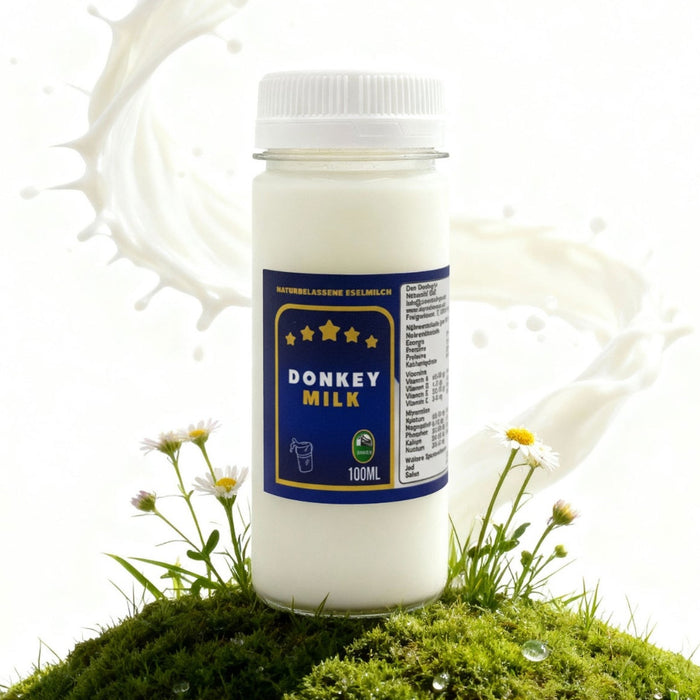
DON DONKEY’S® donkey milk
100 % pure donkey milk
Donkey milk contains a large number of biological structures and components that are the subject of scientific research. With extracellular vesicles and their RNA cargo, Study 20 opens up a particularly young field of research.
Original publication
Donkey milk exosomes protect against dextran sulfate sodium-induced colitis by delivering anti-inflammatory miRNAs and reshaping gut microbiota
Zhong Q., Huang G., Liu G., Ren Z., Wang Z.
Journal of Food Science · 2026
The publication describes experimental preclinical research with extracellular vesicles isolated or enriched from donkey milk in a mouse model. The results do not constitute clinical proof of efficacy for the consumption of donkey milk in humans.